



 Chat with AI
Exam 10: Consumer Choice and Behavioral Economics

Exam 1: Economics: Foundations and Models447 Questions
Exam 2: Trade-Offs, comparative Advantage, and the Market System492 Questions
Exam 3: Where Prices Come From: the Interaction of Demand and Supply476 Questions
Exam 4: Economic Efficiency, government Price Setting, and Taxes420 Questions
Exam 5: Externalities, environmental Policy, and Public Goods263 Questions
Exam 6: Elasticity: the Responsiveness of Demand and Supply294 Questions
Exam 7: The Economics of Health Care338 Questions
Exam 8: Firms,the Stock Market,and Corporate Governance522 Questions
Exam 9: Comparative Advantage and the Gains From International Trade377 Questions
Exam 10: Consumer Choice and Behavioral Economics300 Questions
Exam 11: Technology,production,and Costs327 Questions
Exam 12: Firms in Perfectly Competitive Markets296 Questions
Exam 13: Monopolistic Competition: the Competitive Model in a More Realistic Setting272 Questions
Exam 14: Oligopoly: Firms in Less Competitive Markets258 Questions
Exam 15: Monopoly and Antitrust Policy279 Questions
Exam 16: Pricing Strategy261 Questions
Exam 17: The Markets for Labor and Other Factors of Production281 Questions
Exam 18: Public Choice, taxes, and the Distribution of Income258 Questions
Exam 19: Gdp: Measuring Total Production and Income261 Questions
Exam 20: Unemployment and Inflation291 Questions
Exam 21: Economic Growth, the Financial System, and Business Cycles253 Questions
Exam 22: Long-Run Economic Growth: Sources and Policies262 Questions
Exam 23: Aggregate Expenditure and Output in the Short Run301 Questions
Exam 24: Aggregate Demand and Aggregate Supply Analysis286 Questions
Exam 25: Money,banks,and the Federal Reserve System281 Questions
Exam 26: Monetary Policy275 Questions
Exam 27: Fiscal Policy306 Questions
Exam 28: Inflation, unemployment, and Federal Reserve Policy257 Questions
Exam 29: Macroeconomics in an Open Economy278 Questions
Exam 30: The International Financial System258 Questions
Select questions type


Suppose the marginal utilities for the first three cans of soda are 100,80 and 60,respectively.The total utility received from consuming 2 cans is

Free
(Multiple Choice)
4.9/5  (85)
(85) Correct Answer: Verified
D
If Lisa spends her income on veggie burgers and pints of soy milk and the price of veggie burgers is three times the price of a pint of soy milk,then when Lisa maximizes her utility she will buy
Free
(Multiple Choice)
4.9/5 (72)
(72) Correct Answer:Verified
VerifiedA
Table 10-3
Ice Cream Cones Lime Fizz Soda Quantity 1 30 40 2 25 35 3 20 26 4 15 18 5 10 15 6 5 7
-Refer to Table 10-3.The table above shows Lee's marginal utility per dollar from consuming ice cream cones and cans of Lime Fizz Soda.The price of an ice cream cone is $2 and the price of Lime Fizz Soda is $1.Use this information to select the correct statement.
Free
(Multiple Choice)
4.9/5 (86)
(86) Correct Answer:Verified
VerifiedA
One reason that consumers and businesses might not act rationally is
(Multiple Choice)
4.9/5 (89)
(89) Which of the following is a common mistake consumers commit when they make decisions?
(Multiple Choice)
4.7/5 (79)
(79) The income effect of a price increase causes a decrease in the quantity of a normal good demanded.
(True/False)
4.8/5 (75)
(75) Economists usually assume that people act in a rational,self-interested way.In explaining how consumers make choices this means that economists believe
(Multiple Choice)
4.9/5 (92)
(92) The enjoyment or satisfaction people receive from consuming goods and services is called utility.
(True/False)
4.7/5 (80)
(80) Quantity of Pita Wraps Total Utility Quantity of Bubble Tea Total Utility 1 60 1 40 2 102 2 70 3 132 3 91 4 144 4 106 5 144 5 112 6 138 6 115 7 128 7 115 Keegan has $30 to spend on Pita Wraps and Bubble Tea.The price of a Pita Wrap is $6 and the price of a glass of Bubble Tea is $3.Table 10-1 shows his total utility from different quantities of the two items.
-Refer to Table 10-1.What is Keegan's optimal consumption bundle?
(Multiple Choice)
4.9/5 (79)
(79) Quantity of Soup (cups) Total Utility Quantity of Sandwiches Total Utility 1 40 1 45 2 60 2 75 3 72 3 102 4 82 4 120 5 88 5 135 6 90 6 145 Table 10-2 above shows Keira's utility from soup and sandwiches.The price of soup is $2 per cup and the price of a sandwich is $3.Keira has $18 to spend on these two goods.
-Refer to Table 10-2.If Keira maximizes her utility,how many units of each good should she buy?
(Multiple Choice)
4.8/5 (84)
(84) Behavioral economists examine choices that consumers make that are not economically rational.Economists generally assume that people are rational;that is,they weigh the benefits and costs of an action and choose an action only if the benefits outweigh the costs.Why do consumers not act rationally when the result is that they make themselves worse off?
(Essay)
4.8/5 (84)
(84) Economists Gary Becker and Kevin Murphy are associated with which of the following?
(Multiple Choice)
4.8/5 (81)
(81) Figure 10-3 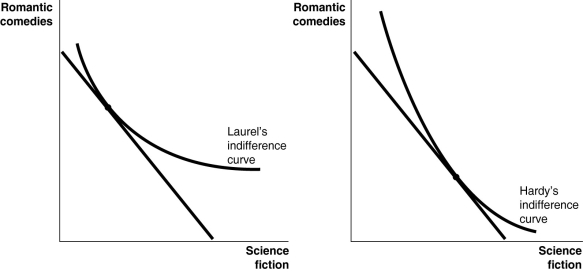 -Refer to Figure 10-3.Best friends Laurel and Hardy,both enjoy watching romantic comedies and science fiction movies.Based on the diagrams above what can you conclude about their movie preferences?
 (Multiple Choice)
4.7/5 (85)
(85) All of the following products are likely to have significant network externalities except
(Multiple Choice)
4.7/5 (70)
(70) Consider a downward-sloping demand curve.When the price of a normal good increases,the income and substitution effects
(Multiple Choice)
5.0/5 (76)
(76) The substitution effect of a change in the price of cauliflower is the portion of the change in the quantity of cauliflower demanded that can be attributed to the change in the price of a substitute vegetable such as asparagus.
(True/False)
4.8/5 (86)
(86) 
Filters
- Essay(0)
- Multiple Choice(0)
- Short Answer(0)
- True False(0)
- Matching(0)