



 Chat with AI
Exam 10: Consumer Choice and Behavioral Economics

Exam 1: Economics: Foundations and Models447 Questions
Exam 2: Trade-Offs, comparative Advantage, and the Market System492 Questions
Exam 3: Where Prices Come From: the Interaction of Demand and Supply476 Questions
Exam 4: Economic Efficiency, government Price Setting, and Taxes420 Questions
Exam 5: Externalities, environmental Policy, and Public Goods263 Questions
Exam 6: Elasticity: the Responsiveness of Demand and Supply294 Questions
Exam 7: The Economics of Health Care338 Questions
Exam 8: Firms,the Stock Market,and Corporate Governance522 Questions
Exam 9: Comparative Advantage and the Gains From International Trade377 Questions
Exam 10: Consumer Choice and Behavioral Economics300 Questions
Exam 11: Technology,production,and Costs327 Questions
Exam 12: Firms in Perfectly Competitive Markets296 Questions
Exam 13: Monopolistic Competition: the Competitive Model in a More Realistic Setting272 Questions
Exam 14: Oligopoly: Firms in Less Competitive Markets258 Questions
Exam 15: Monopoly and Antitrust Policy279 Questions
Exam 16: Pricing Strategy261 Questions
Exam 17: The Markets for Labor and Other Factors of Production281 Questions
Exam 18: Public Choice, taxes, and the Distribution of Income258 Questions
Exam 19: Gdp: Measuring Total Production and Income261 Questions
Exam 20: Unemployment and Inflation291 Questions
Exam 21: Economic Growth, the Financial System, and Business Cycles253 Questions
Exam 22: Long-Run Economic Growth: Sources and Policies262 Questions
Exam 23: Aggregate Expenditure and Output in the Short Run301 Questions
Exam 24: Aggregate Demand and Aggregate Supply Analysis286 Questions
Exam 25: Money,banks,and the Federal Reserve System281 Questions
Exam 26: Monetary Policy275 Questions
Exam 27: Fiscal Policy306 Questions
Exam 28: Inflation, unemployment, and Federal Reserve Policy257 Questions
Exam 29: Macroeconomics in an Open Economy278 Questions
Exam 30: The International Financial System258 Questions
Select questions type


The income effect results in consumers increasing the quantity of normal goods demanded when the price falls.
(True/False)
4.8/5  (76)
(76) The absolute value of the slope of the budget constraint is equal to
(Multiple Choice)
4.7/5 (71)
(71) Which of the following does not explain why consumers buy products that many other consumers are already buying?
(Multiple Choice)
4.8/5 (81)
(81) If a consumer receives 20 units of utility from consuming two candy bars,and 25 units of utility from consuming three candy bars,the marginal utility of the third candy bar is
(Multiple Choice)
4.8/5 (75)
(75) Jamal,Lawson,and Kyle have been standing in line for almost an hour waiting to be served at Kirala,a popular new Japanese restaurant.It is possible that some of the people in line won't be served at all before the restaurant closes.Which of the following could explain why the restaurant does not simply raise prices high enough to eliminate the lines?
A.In situations where consumption takes place publicly,demand for the product is also influenced by how many other people are buying the product.Consequently,a popular restaurant that increased its prices enough to eliminate lines might find that it had also eliminated its popularity.
B.Firms may sometimes not raise their prices for fear that it violates people's sense of fairness and might alienate customers.
C.The demand for restaurant meals is relatively elastic and if the firm raises prices it will lower its profits.
(Multiple Choice)
5.0/5 (81)
(81) Assume that you had a ticket for a basketball playoff game that you bought for $50,the maximum price you were willing to pay.If a friend of yours offers to buy the ticket for $100 but you decide not to sell it,how can your decision be explained?
(Multiple Choice)
4.9/5 (67)
(67) Consumers maximize total utility within their budget constraint by
(Multiple Choice)
4.8/5 (77)
(77) Which of the following correctly describes the result of a price increase for an inferior good?
(Multiple Choice)
4.9/5 (78)
(78) Eliza consumes 12 cappuccinos and 8 apple turnovers per week.The price of a cappuccino is $4 each and apple turnovers are $1 each.
a.What is the amount of income allocated to cappuccino and apple turnover consumption?
b.What is the price ratio (the price of cappuccinos relative to the price of apple turnovers)?
c.Explain the meaning of the price ratio you computed.
d.If Eliza maximize utility,what is the ratio of the marginal utility of cappuccinos to the marginal utility of apple turnovers?
e.If the price of apple turnovers falls,will Eliza consume more apple turnovers,fewer apple turnovers,or the same amount of apple turnovers? Explain your answer using the rule of equal marginal utility per dollar.
(Essay)
4.9/5 (72)
(72) If Callum is consuming his utility maximizing bundle and the price of one good rises,what happens to the marginal utility per dollar spent on this good (MU/P),and what should Callum do?
(Multiple Choice)
4.9/5 (69)
(69) Quantity of Soup (cups) Total Utility Quantity of Sandwiches Total Utility 1 40 1 45 2 60 2 75 3 72 3 102 4 82 4 120 5 88 5 135 6 90 6 145 Table 10-2 above shows Keira's utility from soup and sandwiches.The price of soup is $2 per cup and the price of a sandwich is $3.Keira has $18 to spend on these two goods.
-Refer to Table 10-2.Holding prices constant,when Keira's income changed from $18 to $23,what happens to her total utility and to the marginal utilities of the last cup of soup and the last sandwich purchased?
(Multiple Choice)
4.9/5 (75)
(75) Grant has $200 to spend each month on restaurant meals and jazz performances at his
neighborhood jazz club.The price of a typical restaurant meal is $20 and the price of a jazz performance ticket is $10.Grant is maximizing his utility by consuming 6 restaurant meals and attending 8 jazz performances.Suppose Grant still has $200 to spend,but the price of restaurant meal rises to $25,while the price of jazz performance ticket drops to $8.Can it be determined if Grant is better off or worse off than he was before the price change? Use a budget constraint/indifference curve graph to illustrate your answer.
(Essay)
4.9/5 (70)
(70) Economists have used ________ and ________ in experiments designed to determine whether consumers care about fairness when they make decisions.
(Multiple Choice)
4.8/5 (72)
(72) Carolyn spends her income on popular magazines and music CDs.If the price of a CD is four times the price of a magazine and if Carolyn is maximizing her utility,she buys
(Multiple Choice)
4.8/5 (78)
(78) Figure 10-4 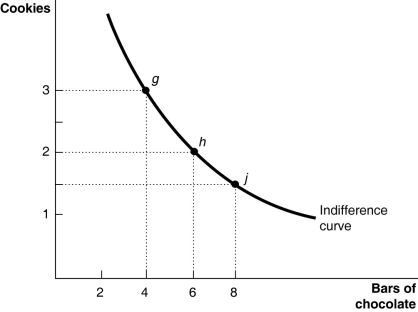 -Refer to Figure 10-4.What is the marginal rate of substitution for one bar of chocolate between g and h?
 (Multiple Choice)
4.8/5 (85)
(85) If Paul decides to buy a $60 ticket to a Cirque du Soleil show rather than a $45 ticket for a Blue Man Group performance,we can conclude that
(Multiple Choice)
4.7/5 (80)
(80) Which of the following is used to explain why a consumer's willingness to buy Microsoft Office increases as the number of other people who use Microsoft Office increases?
(Multiple Choice)
4.9/5 (72)
(72) 
Filters
- Essay(0)
- Multiple Choice(0)
- Short Answer(0)
- True False(0)
- Matching(0)