



 Chat with AI
Exam 12: Firms in Perfectly Competitive Markets

Exam 1: Economics: Foundations and Models447 Questions
Exam 2: Trade-Offs, comparative Advantage, and the Market System492 Questions
Exam 3: Where Prices Come From: the Interaction of Demand and Supply476 Questions
Exam 4: Economic Efficiency, government Price Setting, and Taxes420 Questions
Exam 5: Externalities, environmental Policy, and Public Goods263 Questions
Exam 6: Elasticity: the Responsiveness of Demand and Supply294 Questions
Exam 7: The Economics of Health Care338 Questions
Exam 8: Firms,the Stock Market,and Corporate Governance522 Questions
Exam 9: Comparative Advantage and the Gains From International Trade377 Questions
Exam 10: Consumer Choice and Behavioral Economics300 Questions
Exam 11: Technology,production,and Costs327 Questions
Exam 12: Firms in Perfectly Competitive Markets296 Questions
Exam 13: Monopolistic Competition: the Competitive Model in a More Realistic Setting272 Questions
Exam 14: Oligopoly: Firms in Less Competitive Markets258 Questions
Exam 15: Monopoly and Antitrust Policy279 Questions
Exam 16: Pricing Strategy261 Questions
Exam 17: The Markets for Labor and Other Factors of Production281 Questions
Exam 18: Public Choice, taxes, and the Distribution of Income258 Questions
Exam 19: Gdp: Measuring Total Production and Income261 Questions
Exam 20: Unemployment and Inflation291 Questions
Exam 21: Economic Growth, the Financial System, and Business Cycles253 Questions
Exam 22: Long-Run Economic Growth: Sources and Policies262 Questions
Exam 23: Aggregate Expenditure and Output in the Short Run301 Questions
Exam 24: Aggregate Demand and Aggregate Supply Analysis286 Questions
Exam 25: Money,banks,and the Federal Reserve System281 Questions
Exam 26: Monetary Policy275 Questions
Exam 27: Fiscal Policy306 Questions
Exam 28: Inflation, unemployment, and Federal Reserve Policy257 Questions
Exam 29: Macroeconomics in an Open Economy278 Questions
Exam 30: The International Financial System258 Questions
Select questions type


Assume that a perfectly competitive market is in long-run equilibrium.Suppose as a result of a health hazard associated with the industry's product,demand decreases drastically.What is the immediate result of this event?

Free
(Multiple Choice)
4.8/5  (80)
(80) Correct Answer: Verified
A
A perfectly competitive industry achieves allocative efficiency in the long run.What does allocative efficiency mean?
Free
(Multiple Choice)
4.8/5 (89)
(89) Correct Answer:Verified
VerifiedA
Assume the market for cage-free eggs is perfectly competitive.All else equal,as more farmers choose to produce and sell cage-free eggs,what is likely to happen to the equilibrium price of the eggs and profits of these farmers in the long run?
Free
(Multiple Choice)
4.8/5 (89)
(89) Correct Answer:Verified
VerifiedC
When firms exit a perfectly competitive industry,the market supply curve shifts to the left.
(True/False)
4.8/5 (79)
(79) A perfectly competitive firm produces 3,000 units of a good at a total cost of $36,000.The price of each good is $10.Calculate the firm's short-run profit or loss.
(Multiple Choice)
4.8/5 (86)
(86) What is the difference between "shutting down temporarily" and "exiting the industry"?
(Essay)
4.8/5 (72)
(72) If firms do not earn economic profits in a competitive equilibrium,why would the firms choose to stay in business?
(Essay)
4.8/5 (83)
(83) Figure 12-15 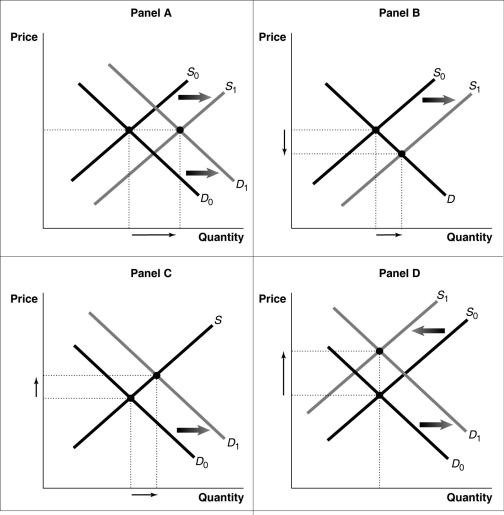 -Refer to Figure 12-15.Assume that the medical screening industry is perfectly competitive and that some firms are making short-run losses.Suppose the medical screening industry runs an effective advertising campaign which convinces a large number of people that yearly CT scans are critical for good health.Which of the diagrams in the figure best describes what happens in the industry?
 (Multiple Choice)
4.9/5 (74)
(74) In a decreasing-cost industry,the entry of new firms lowers average cost at each level of output.
(True/False)
4.9/5 (77)
(77)  Figure 12-6 shows the demand,marginal cost (MC)and average total cost (ATC)curves for Jason's House of Apples.
-Refer to Figure 12-6.Jason is currently producing 20 thousand pounds of apples.To maximize his profit Jason should
Figure 12-6 shows the demand,marginal cost (MC)and average total cost (ATC)curves for Jason's House of Apples.
-Refer to Figure 12-6.Jason is currently producing 20 thousand pounds of apples.To maximize his profit Jason should (Multiple Choice)
4.9/5 (83)
(83) After an increase in demand in a constant-cost industry,firms will find themselves with higher average cost curves.
(True/False)
4.9/5 (93)
(93) Which of the following is not a characteristic of a perfectly competitive market structure?
(Multiple Choice)
4.8/5 (86)
(86) Hogrocket,which developed the Tiny Invaders game for the iPhone,found that to maintain sales in a profitable competitive market,the price of a product
(Multiple Choice)
4.7/5 (73)
(73) Both buyers and sellers are price takers in a perfectly competitive market because
(Multiple Choice)
4.9/5 (88)
(88) The long-run supply curve for a perfectly competitive,constant-cost industry
(Multiple Choice)
4.7/5 (87)
(87) Quantity Total Cost Average Total Cost Marginal Cost 0 \ 10.00 ---- ---- 1 15.00 \ 15.00 \ 5.00 2 17.50 8.75 2.50 3 22.50 7.50 5.00 4 30.00 7.50 7.50 5 40.00 8.00 10.00 6 52.50 8.75 12.50 7 67.50 9.64 15.00 8 85.00 10.63 17.50 9 105.00 11.67 20.00 Arnie sells basketballs in a perfectly competitive market.Table 12-3 summarizes Arnie's output per day (Q),total cost (TC),average total cost (ATC)and marginal cost (MC).
-Refer to Table 12-3.What price (P)will Arnie charge and how much profit will he earn if the market price of basketballs is $12.50?
(Multiple Choice)
4.8/5 (72)
(72) Which of the following describes a situation in which every good or service is produced up to the point where the last unit provides a marginal benefit to consumers equal to the marginal cost of producing it?
(Multiple Choice)
4.9/5 (76)
(76) Firms in perfect competition produce the allocatively efficient output in the short run and in the long run.
(True/False)
4.9/5 (66)
(66)  Figure 12-5 shows cost and demand curves facing a typical firm in a constant-cost,perfectly competitive industry.
-Refer to Figure 12-5.What is the minimum price the firm requires to produce output?
Figure 12-5 shows cost and demand curves facing a typical firm in a constant-cost,perfectly competitive industry.
-Refer to Figure 12-5.What is the minimum price the firm requires to produce output? (Multiple Choice)
4.9/5 (82)
(82) 
Filters
- Essay(0)
- Multiple Choice(0)
- Short Answer(0)
- True False(0)
- Matching(0)