



 Chat with AI
Exam 2: Trade-Offs, comparative Advantage, and the Market System

Exam 1: Economics: Foundations and Models447 Questions
Exam 2: Trade-Offs, comparative Advantage, and the Market System492 Questions
Exam 3: Where Prices Come From: the Interaction of Demand and Supply476 Questions
Exam 4: Economic Efficiency, government Price Setting, and Taxes420 Questions
Exam 5: Externalities, environmental Policy, and Public Goods263 Questions
Exam 6: Elasticity: the Responsiveness of Demand and Supply294 Questions
Exam 7: The Economics of Health Care338 Questions
Exam 8: Firms,the Stock Market,and Corporate Governance522 Questions
Exam 9: Comparative Advantage and the Gains From International Trade377 Questions
Exam 10: Consumer Choice and Behavioral Economics300 Questions
Exam 11: Technology,production,and Costs327 Questions
Exam 12: Firms in Perfectly Competitive Markets296 Questions
Exam 13: Monopolistic Competition: the Competitive Model in a More Realistic Setting272 Questions
Exam 14: Oligopoly: Firms in Less Competitive Markets258 Questions
Exam 15: Monopoly and Antitrust Policy279 Questions
Exam 16: Pricing Strategy261 Questions
Exam 17: The Markets for Labor and Other Factors of Production281 Questions
Exam 18: Public Choice, taxes, and the Distribution of Income258 Questions
Exam 19: Gdp: Measuring Total Production and Income261 Questions
Exam 20: Unemployment and Inflation291 Questions
Exam 21: Economic Growth, the Financial System, and Business Cycles253 Questions
Exam 22: Long-Run Economic Growth: Sources and Policies262 Questions
Exam 23: Aggregate Expenditure and Output in the Short Run301 Questions
Exam 24: Aggregate Demand and Aggregate Supply Analysis286 Questions
Exam 25: Money,banks,and the Federal Reserve System281 Questions
Exam 26: Monetary Policy275 Questions
Exam 27: Fiscal Policy306 Questions
Exam 28: Inflation, unemployment, and Federal Reserve Policy257 Questions
Exam 29: Macroeconomics in an Open Economy278 Questions
Exam 30: The International Financial System258 Questions
Select questions type


Figure 2-5  -Refer to Figure 2-5.If the economy is currently producing at point Y,what is the opportunity cost of moving to point W?
Free
(Multiple Choice)
4.7/5  (86)
(86) Correct Answer: Verified
B
Rayburn Reed is a highly talented photographer.He has chosen to specialize in photography because of all of the following except
Free
(Multiple Choice)
4.8/5 (74)
(74) Correct Answer:Verified
VerifiedB
Table 2-8
Possible Output Combinations Cashews (thousands of pounds) Almonds (thousands of pounds) A 35 0 B 30 20 C 25 35 D 20 47 E 15 57 F 10 64 G 5 68 H 0 70
-Refer to Table 2-8.The Nut House produces only cashews and almonds.The table above shows the maximum possible output combinations of the two nuts using all resources and currently available technology.
a.Graph The Nut House's production possibilities frontier.Put almonds on the horizontal axis and cashews on the vertical axis.Be sure to identify the output combination points on your diagram.
b.Suppose The Nut House is currently producing at point C.What is the opportunity cost of producing an additional 12,000 pounds of almonds?
c.Suppose The Nut House is currently producing at point C.What happens to the opportunity cost of producing more and more almonds? Does it increase,decrease or remain constant? Explain your answer.
d.Suppose The Nut House is currently producing at point F.What happens to the opportunity cost of producing more and more cashews? Does it increase,decrease or remain constant? Explain your answer.
e.Suppose The Nut House is plagued by a variety of white root-rot disease,which destroys cashew trees but not almond trees.Show in a graph what happens to its PPF.
Free
(Essay)
5.0/5 (76)
(76) Correct Answer:Verified
Verifieda. 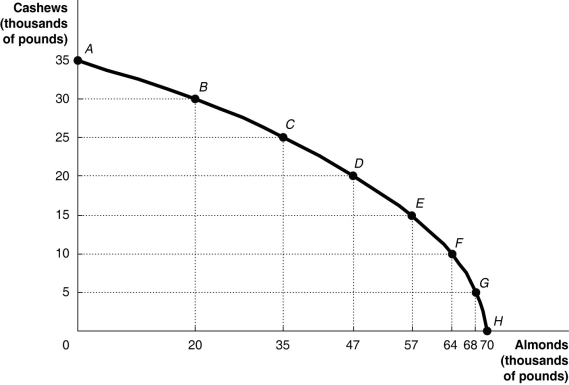 b.5,000 pounds of cashews
c.It increases.For example to move to D,The Nut House has to give up 5,000 pounds of cashews to produce an additional 10,000 pounds of almonds.For each additional 5,000 pounds of cashews foregone,the payoff in terms of almonds gets progressively smaller.
d.It increases.Each time it wants to produce an additional 5,000 pounds of cashews,more and more almonds must be given up.
e. 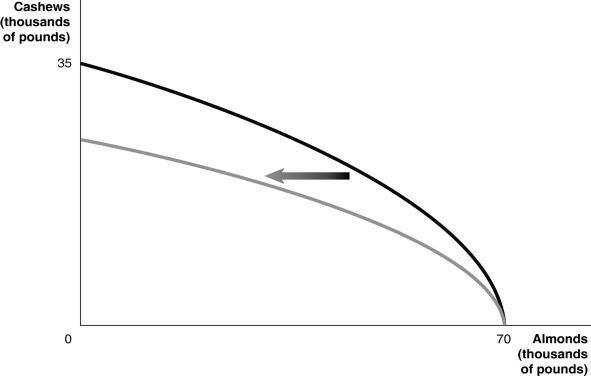
James Lucy Wagons 16 18 Tricycles 32 24 Table 2-17 shows the output per week of two people,James and Lucy.They can either devote their time to making wagons or making tricycles.
-Refer to Table 2-17.What is Lucy's opportunity cost of making a tricycle?
(Multiple Choice)
4.7/5 (85)
(85)  Figure 2-12 shows the production possibilities frontiers for Tahiti and Bora Bora.Each country produces two goods,milk and honey.
-Refer to Figure 2-12.What is the opportunity cost of producing one gallon of honey in Tahiti?
Figure 2-12 shows the production possibilities frontiers for Tahiti and Bora Bora.Each country produces two goods,milk and honey.
-Refer to Figure 2-12.What is the opportunity cost of producing one gallon of honey in Tahiti? (Multiple Choice)
4.8/5 (86)
(86) Consider a country that produces only two goods: kayaks and coconuts.Suppose it is possible for this country to increase its production of kayaks without producing fewer coconuts.In this case,its current output combination is efficient.
(True/False)
5.0/5 (74)
(74) Wristwutch Rice (bushels) Japan 200 hours 10 hours Thailand 180 hours 6 hours
-Refer to Table 2-30.This table shows the number of labor hours required to produce a wristwatch and a bushel of rice in Japan and Thailand.
a.Which country has an absolute advantage in the production of wristwatches?
b.Which country has an absolute advantage in the production of rice?
c.What is Japan's opportunity cost of producing one wristwatch?
d.What is Thailand's opportunity cost of producing one wristwatch?
e.What is Japan's opportunity cost of producing one bushel of rice?
f.What is Thailand's opportunity cost of producing one bushel of rice?
g.If each country specializes in the production of the product in which it has a comparative advantage,who should produce wristwatches?
h.If each country specializes in the production of the product in which it has a comparative advantage,who should produce rice?
(Essay)
4.8/5 (80)
(80) Minnie Mickey Hats 40 50 Urrbrellas 10 5 Table 2-18 shows the output per week of two people,Minnie and Mickey.They can either devote their time to making hats or making umbrellas.
-Refer to Table 2-18.Which of the following statements is true?
(Multiple Choice)
4.8/5 (81)
(81) Increasing opportunity cost along a bowed-out production possibilities frontier occurs because
(Multiple Choice)
4.8/5 (85)
(85) The slope of a production possibilities frontier measures the ________ of producing one more unit of a good.
(Multiple Choice)
4.9/5 (79)
(79) Without an increase in the supplies of factors of production,how can a nation achieve economic growth?
(Multiple Choice)
4.9/5 (84)
(84)
One Digital Camera Wheat (per pound) China 100 hours 4 hours South Korea 60 hours 3 hours Table 2-11 shows the number of labor hours required to produce a digital camera and a pound of wheat in China and South Korea.
-Refer to Table 2-11.China has a comparative advantage in the production of
(Multiple Choice)
4.9/5 (88)
(88) A decrease in the unemployment rate may be represented as a movement from a point inside the production possibilities frontier to a point on the frontier.
(True/False)
4.7/5 (90)
(90) All of the following countries come close to the free market benchmark except
(Multiple Choice)
4.9/5 (65)
(65) Table 2-1
Production choices for Tomaso's Trattoria
Choice Quantity of Pizzas Produced Quantity of Calzones Produced A 48 0 B 36 15 C 24 30 D 12 45 E 0 60
-Refer to Table 2-1.Assume Tomaso's Trattoria only produces pizzas and calzones.A combination of 24 pizzas and 30 calzones would appear
(Multiple Choice)
4.9/5 (80)
(80) Table 2-3
Production Choices for Dina's Diner
Choice Quantity of Sliders Produced Quantity of Hot Wings Produced A 160 0 B 120 50 C 80 100 D 40 150 E 0 200
-Refer to Table 2-3.Assume Dina's Diner only produces sliders and hot wings.A combination of 80 sliders and 50 hot wings would appear
(Multiple Choice)
4.9/5 (98)
(98) The production possibilities frontier shows the ________ combinations of two products that can be produced in a particular time period with available resources.
(Multiple Choice)
4.8/5 (86)
(86)  -Refer to Figure 2-1.Point B is

Filters
- Essay(0)
- Multiple Choice(0)
- Short Answer(0)
- True False(0)
- Matching(0)