



 Chat with AI
Exam 30: The International Financial System

Exam 1: Economics: Foundations and Models447 Questions
Exam 2: Trade-Offs, comparative Advantage, and the Market System492 Questions
Exam 3: Where Prices Come From: the Interaction of Demand and Supply476 Questions
Exam 4: Economic Efficiency, government Price Setting, and Taxes420 Questions
Exam 5: Externalities, environmental Policy, and Public Goods263 Questions
Exam 6: Elasticity: the Responsiveness of Demand and Supply294 Questions
Exam 7: The Economics of Health Care338 Questions
Exam 8: Firms,the Stock Market,and Corporate Governance522 Questions
Exam 9: Comparative Advantage and the Gains From International Trade377 Questions
Exam 10: Consumer Choice and Behavioral Economics300 Questions
Exam 11: Technology,production,and Costs327 Questions
Exam 12: Firms in Perfectly Competitive Markets296 Questions
Exam 13: Monopolistic Competition: the Competitive Model in a More Realistic Setting272 Questions
Exam 14: Oligopoly: Firms in Less Competitive Markets258 Questions
Exam 15: Monopoly and Antitrust Policy279 Questions
Exam 16: Pricing Strategy261 Questions
Exam 17: The Markets for Labor and Other Factors of Production281 Questions
Exam 18: Public Choice, taxes, and the Distribution of Income258 Questions
Exam 19: Gdp: Measuring Total Production and Income261 Questions
Exam 20: Unemployment and Inflation291 Questions
Exam 21: Economic Growth, the Financial System, and Business Cycles253 Questions
Exam 22: Long-Run Economic Growth: Sources and Policies262 Questions
Exam 23: Aggregate Expenditure and Output in the Short Run301 Questions
Exam 24: Aggregate Demand and Aggregate Supply Analysis286 Questions
Exam 25: Money,banks,and the Federal Reserve System281 Questions
Exam 26: Monetary Policy275 Questions
Exam 27: Fiscal Policy306 Questions
Exam 28: Inflation, unemployment, and Federal Reserve Policy257 Questions
Exam 29: Macroeconomics in an Open Economy278 Questions
Exam 30: The International Financial System258 Questions
Select questions type


In order to support an undervalued euro,the European Central Bank must ________ dollars.Over time,this action will cause the rate of inflation in the EU to ________.

Free
(Multiple Choice)
4.8/5  (76)
(76) Correct Answer: Verified
B
If the equilibrium exchange rate exceeds the par exchange rate in the market for pounds,the pound is overvalued.
Free
(True/False)
4.8/5 (77)
(77) Correct Answer:Verified
VerifiedFalse
Increasing a fixed exchange rate is called a revaluation.
Free
(True/False)
4.7/5 (86)
(86) Correct Answer:Verified
VerifiedTrue
Countries that abandoned the gold standard early in the Great Depression suffered an average decline in production of 3 percent between 1929 and 1934.Countries that stayed on the gold standard until 1933 or later suffered an average decline in production of
(Multiple Choice)
4.9/5 (72)
(72) Fluctuating exchange rates can alter a multinational firm's profits and losses.German company Bayer produces products in Germany and sells them in the United States.If the dollar depreciates against the euro,then Bayer's sales in the United States should ________ because it will take ________ U.S.dollars to purchase the German-made products.
(Multiple Choice)
4.8/5 (71)
(71) European governments removed many restrictions on flows of capital into and out of Europe in the ________.This policy increased both U.S.investment in European stocks and bonds and European investment in U.S.stocks and bonds.
(Multiple Choice)
4.8/5 (86)
(86) The exchange rate system agreed to in 1944,in which the U.S.government agreed to buy or sell gold at a fixed price of $35 per ounce,is referred to as
(Multiple Choice)
4.8/5 (74)
(74) Figure 30-7  -Refer to Figure 30-7.Which of the following is true?
 (Multiple Choice)
4.9/5 (73)
(73) Members of the European Union decided to adopt a single currency by what year?
(Multiple Choice)
4.8/5 (87)
(87) Fluctuating exchange rates can alter a multinational firm's profits and losses.The U.S.automobile manufacturer Tesla produces vehicles in the United States and sells them in Norway.(Norway is Tesla's largest overseas market. )If the dollar appreciates against the Norwegian krone,then Tesla's revenues from these operations should ________ and its profits from these operations should ________.
(Multiple Choice)
4.7/5 (81)
(81) Both countries involved in a pegging of currency must agree to the terms of the pegging.
(True/False)
4.9/5 (89)
(89) How will the exchange rate (foreign currency per dollar)respond to an increase in the relative rate of productivity growth in the United States in the long run?
(Multiple Choice)
4.9/5 (83)
(83) Figure 30-11 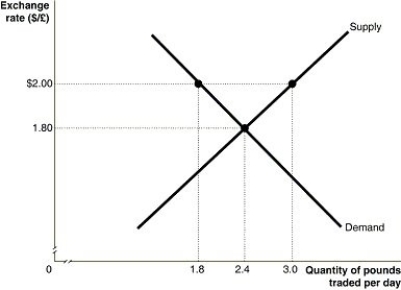 -Refer to Figure 30-11.The graph above depicts supply and demand for British pounds during a trading day,where the quantity is millions of pounds.In order to support a fixed exchange rate of $2.00 per pound,the British central bank must
 (Multiple Choice)
4.9/5 (87)
(87) What does it mean when one currency is "pegged" against another currency?
(Essay)
4.9/5 (81)
(81) A Big Mac costs $4.00 in the United States and 9.00 reals in Brazil.If the exchange rate is 2 reals per dollar,what is the dollar cost of a Big Mac in Brazil?
(Multiple Choice)
4.8/5 (87)
(87) The "Big Mac Theory of Exchange Rates" tests the accuracy of purchasing power parity theory.In July 2015,The Economist reported that the average price of a Big Mac in the United States was $4.79.In India,the average price of a Big Mac at that time was 116.25 rupees.What is the "implied exchange rate" between the yen and the dollar?
(Multiple Choice)
5.0/5 (81)
(81) China began pegging its currency,the yuan,to the dollar in 1994.Because the yuan was ________ at the pegged exchange rate,the level of Chinese exports remained ________ than they would have been if the exchange rate were allowed to float freely.
(Multiple Choice)
4.9/5 (70)
(70) A persistent surplus of pounds at a given fixed exchange rate (in dollars per pound)is evidence that the pound is ________ versus the dollar.This surplus can be reduced or eliminated through a ________ of the pound.
(Multiple Choice)
4.7/5 (75)
(75) 
Filters
- Essay(0)
- Multiple Choice(0)
- Short Answer(0)
- True False(0)
- Matching(0)