



 Chat with AI
Exam 30: The International Financial System

Exam 1: Economics: Foundations and Models447 Questions
Exam 2: Trade-Offs, comparative Advantage, and the Market System492 Questions
Exam 3: Where Prices Come From: the Interaction of Demand and Supply476 Questions
Exam 4: Economic Efficiency, government Price Setting, and Taxes420 Questions
Exam 5: Externalities, environmental Policy, and Public Goods263 Questions
Exam 6: Elasticity: the Responsiveness of Demand and Supply294 Questions
Exam 7: The Economics of Health Care338 Questions
Exam 8: Firms,the Stock Market,and Corporate Governance522 Questions
Exam 9: Comparative Advantage and the Gains From International Trade377 Questions
Exam 10: Consumer Choice and Behavioral Economics300 Questions
Exam 11: Technology,production,and Costs327 Questions
Exam 12: Firms in Perfectly Competitive Markets296 Questions
Exam 13: Monopolistic Competition: the Competitive Model in a More Realistic Setting272 Questions
Exam 14: Oligopoly: Firms in Less Competitive Markets258 Questions
Exam 15: Monopoly and Antitrust Policy279 Questions
Exam 16: Pricing Strategy261 Questions
Exam 17: The Markets for Labor and Other Factors of Production281 Questions
Exam 18: Public Choice, taxes, and the Distribution of Income258 Questions
Exam 19: Gdp: Measuring Total Production and Income261 Questions
Exam 20: Unemployment and Inflation291 Questions
Exam 21: Economic Growth, the Financial System, and Business Cycles253 Questions
Exam 22: Long-Run Economic Growth: Sources and Policies262 Questions
Exam 23: Aggregate Expenditure and Output in the Short Run301 Questions
Exam 24: Aggregate Demand and Aggregate Supply Analysis286 Questions
Exam 25: Money,banks,and the Federal Reserve System281 Questions
Exam 26: Monetary Policy275 Questions
Exam 27: Fiscal Policy306 Questions
Exam 28: Inflation, unemployment, and Federal Reserve Policy257 Questions
Exam 29: Macroeconomics in an Open Economy278 Questions
Exam 30: The International Financial System258 Questions
Select questions type


From the beginning of 1973 until August 2015,the value of the dollar has ________ relative to the Canadian dollar and ________ relative to the Japanese yen.
(Multiple Choice)
5.0/5  (94)
(94) What do reports that the dollar is "undervalued" mean? How will foreign exchange markets respond to this information? Support your answer graphically.
(Essay)
4.8/5 (79)
(79) China's exchange rate system from 1994 through 2005 is an example of
(Multiple Choice)
4.9/5 (61)
(61) What explains the appreciation of the Japanese yen relative to the U.S.dollar from 1970 to the early 1990s?
(Multiple Choice)
4.7/5 (80)
(80) During the Chinese experience with pegging the yuan to the dollar,the yuan was undervalued.As a result
(Multiple Choice)
4.8/5 (70)
(70) A decrease in a fixed exchange rate from $1.75 per pound to $1.60 per pound is called a(n)________ of the pound.
(Multiple Choice)
4.8/5 (76)
(76) A Big Mac costs $4.79 in the United States and 9.6 zlotys in Poland.If the exchange rate is 3 zlotys per dollar,purchasing power parity predicts that
(Multiple Choice)
4.9/5 (70)
(70) Figure 30-5  -Refer to Figure 30-5.The Chinese government pegs the yuan to the dollar,at one of the specified exchange rates on the graph,such that it overvalues its currency.Using the figure above,this would generate
 (Multiple Choice)
4.9/5 (91)
(91) If the average productivity of Indian firms is rising more quickly than the average productivity of American firms,which of the following would you expect to see? (India's currency is the rupee. )
(Multiple Choice)
4.9/5 (72)
(72) Which of the following is not an advantage to a country of choosing to fix its exchange rate against a major currency,rather than choosing a floating exchange rate?
(Multiple Choice)
4.9/5 (77)
(77) During the Chinese experience with pegging the yuan to the dollar,the yuan was ________.As a result,there was a ________ of dollars on the market,and the Chinese government had to purchase dollars to maintain the peg.
(Multiple Choice)
4.8/5 (84)
(84) A persistent shortage of yen at a given fixed exchange rate (in dollars per yen)is evidence that the yen is ________ versus the dollar.This shortage can be reduced or eliminated through a ________ of the yen.
(Multiple Choice)
4.9/5 (76)
(76) Figure 30-4  -Refer to Figure 30-4.The equilibrium exchange rate is at A,$3/pound.Suppose the British government pegs its currency at $4/pound.Speculators expect that the value of the pound will drop and this shifts the demand curve for pounds to D2.After the shift
 (Multiple Choice)
4.8/5 (67)
(67) Firms in Thailand that had ________ while the baht was pegged to the dollar faced interest payments that were higher than they had planned once the Thai government abandoned the peg because the baht had been pegged ________ the equilibrium exchange rate for the baht.
(Multiple Choice)
4.8/5 (86)
(86) Figure 30-8 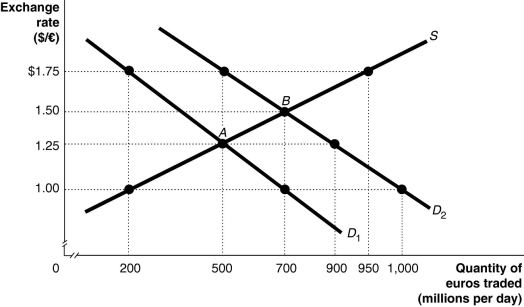 -Refer to Figure 30-8.The equilibrium exchange rate is at A,$1.25/euro.Suppose the European Central Bank pegs its currency at $1.00/euro.Speculators expect that the value of the euro will rise and this shifts the demand curve for euro to D2.After the shift
 (Multiple Choice)
4.8/5 (73)
(73) If speculators believe a currency is soon going to be revalued,they will increase their demand for that currency.
(True/False)
4.9/5 (73)
(73) Shares of stock and long-term debt,including corporate and government bonds and bank loans,are bought and sold on
(Multiple Choice)
4.8/5 (86)
(86) Figure 30-5
-Refer to Figure 30-5.The Chinese government pegs the yuan to the dollar,at one of the specified exchange rates on the graph,such that it undervalues its currency.Using the figure above,this would generate
-Refer to Figure 30-5.The Chinese government pegs the yuan to the dollar,at one of the specified exchange rates on the graph,such that it undervalues its currency.Using the figure above,this would generate (Multiple Choice)
4.8/5 (75)
(75) 
Filters
- Essay(0)
- Multiple Choice(0)
- Short Answer(0)
- True False(0)
- Matching(0)