



 Chat with AI
Exam 30: The International Financial System

Exam 1: Economics: Foundations and Models447 Questions
Exam 2: Trade-Offs, comparative Advantage, and the Market System492 Questions
Exam 3: Where Prices Come From: the Interaction of Demand and Supply476 Questions
Exam 4: Economic Efficiency, government Price Setting, and Taxes420 Questions
Exam 5: Externalities, environmental Policy, and Public Goods263 Questions
Exam 6: Elasticity: the Responsiveness of Demand and Supply294 Questions
Exam 7: The Economics of Health Care338 Questions
Exam 8: Firms,the Stock Market,and Corporate Governance522 Questions
Exam 9: Comparative Advantage and the Gains From International Trade377 Questions
Exam 10: Consumer Choice and Behavioral Economics300 Questions
Exam 11: Technology,production,and Costs327 Questions
Exam 12: Firms in Perfectly Competitive Markets296 Questions
Exam 13: Monopolistic Competition: the Competitive Model in a More Realistic Setting272 Questions
Exam 14: Oligopoly: Firms in Less Competitive Markets258 Questions
Exam 15: Monopoly and Antitrust Policy279 Questions
Exam 16: Pricing Strategy261 Questions
Exam 17: The Markets for Labor and Other Factors of Production281 Questions
Exam 18: Public Choice, taxes, and the Distribution of Income258 Questions
Exam 19: Gdp: Measuring Total Production and Income261 Questions
Exam 20: Unemployment and Inflation291 Questions
Exam 21: Economic Growth, the Financial System, and Business Cycles253 Questions
Exam 22: Long-Run Economic Growth: Sources and Policies262 Questions
Exam 23: Aggregate Expenditure and Output in the Short Run301 Questions
Exam 24: Aggregate Demand and Aggregate Supply Analysis286 Questions
Exam 25: Money,banks,and the Federal Reserve System281 Questions
Exam 26: Monetary Policy275 Questions
Exam 27: Fiscal Policy306 Questions
Exam 28: Inflation, unemployment, and Federal Reserve Policy257 Questions
Exam 29: Macroeconomics in an Open Economy278 Questions
Exam 30: The International Financial System258 Questions
Select questions type


Figure 30-12 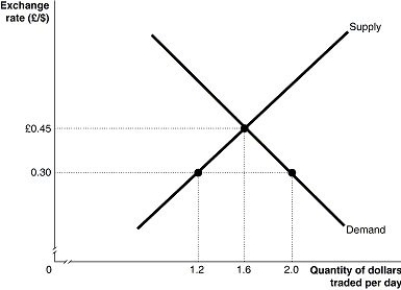 -Refer to Figure 30-12.The graph above depicts supply and demand for U.S.dollars during a trading day,where the quantity is millions of dollars.In order to support a fixed exchange rate of 0.30 pounds per dollar,the U.S.central bank must
 (Multiple Choice)
4.8/5  (81)
(81) Figure 30-2 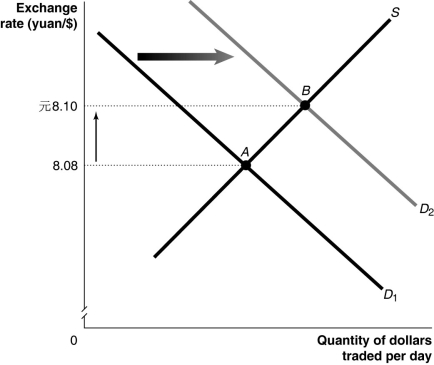 -Refer to Figure 30-2.Which of the following would cause the change depicted in the figure above?
 (Multiple Choice)
4.9/5 (74)
(74) Why might a country raise interest rates in the face of an exchange rate crisis?
(Essay)
4.8/5 (74)
(74) U.S.dollars can currently be exchanged for gold by foreign central banks,but not by U.S.citizens.
(True/False)
4.9/5 (72)
(72) If a firm in Thailand borrows dollars from a U.S.bank,its interest payments on the loan in bahts will decrease if the baht appreciates against the dollar.
(True/False)
4.9/5 (75)
(75) Under the gold standard,to increase the money supply in the country,the government must
(Multiple Choice)
5.0/5 (79)
(79) One reason purchasing power parity does not exactly hold is that many goods are not traded internationally.
(True/False)
4.9/5 (85)
(85) Why are foreign investors more likely to invest in U.S.government bonds than in U.S.corporate stocks and bonds?
(Essay)
4.8/5 (65)
(65) What three real-world complications keep purchasing power parity from being a complete explanation of exchange rate fluctuations in the long run? Explain.
(Essay)
4.9/5 (82)
(82) If the purchasing power of the dollar is less than the purchasing power of the British pound,purchasing power parity predicts that the exchange rate will
(Multiple Choice)
4.8/5 (86)
(86) Managed float exchange systems were abandoned with the implementation of the gold standard.
(True/False)
4.7/5 (73)
(73) Suppose Mexico and the United States are on the gold standard.If there is a half an ounce of gold in the dollar,and one quarter an ounce of gold in the peso,then the exchange rate is
(Multiple Choice)
4.7/5 (86)
(86) The International Monetary Fund was created to facilitate the borrowing and lending of dollar reserves to central banks of the countries participating in the Bretton Wood System.
(True/False)
4.8/5 (84)
(84) Explain why international capital markets have expanded since the 1980s.
(Essay)
4.8/5 (75)
(75) If a country's currency is determined only by the demand and supply for that country's currency,the country is said to have a
(Multiple Choice)
4.9/5 (77)
(77) If the rate of inflation in the United States exceeds the rate of inflation in Great Britain we would expect the U.S.dollar to depreciate in value against the British pound.
(True/False)
4.8/5 (82)
(82) Figure 30-7  -Refer to Figure 30-7.If the Indian government pegs its currency to the dollar at a value below $.02/rupee,we would say the currency is
 (Multiple Choice)
4.9/5 (86)
(86) When foreign investors in Thailand began to realize that Thailand could not maintain its peg to the dollar indefinitely,they began to ________ in Thailand and exchange ________.This change in investment by foreigners is termed capital flight.
(Multiple Choice)
4.8/5 (72)
(72) Under the Bretton Woods system,central bankers could obtain foreign currency loans from the
(Multiple Choice)
4.8/5 (84)
(84) 
Filters
- Essay(0)
- Multiple Choice(0)
- Short Answer(0)
- True False(0)
- Matching(0)