



 Chat with AI
Exam 27: Fiscal Policy


The tax wedge is the difference between the

 (75)
 Verified
C
Assuming a fixed amount of taxes and a closed economy,calculate the value of the government purchases multiplier,the tax multiplier,and the balanced budget multiplier if the marginal propensity to consume equals 0.75.
(73) VerifiedGovernment purchases multiplier = 1 / (1 - 0.75)= 4
Tax multiplier = -0.75 / (1 - 0.75)= −3
Balanced budget multiplier = 1
Explain why the tax multiplier is different from the government purchases multiplier,in both sign and relative magnitude.
(80) VerifiedA dollar change in government purchases has the opposite impact of a dollar change in taxes.For example,an increase in government purchases increases income,spending,and GDP in the economy.In contrast,an increase in taxes lowers income,spending,and GDP in the economy.As a result,the government purchases multiplier is positive,and the tax multiplier is negative.
A dollar change in government purchases will have a larger affect on GDP as compared to a dollar change in the tax multiplier.A change in government purchases affects overall spending directly.The first round GDP change in the multiplier process will be equal to this change in spending.In contrast,a change in taxes affects income first and then spending.For example,a tax cut will increase income,but not all of that income will be spent;some of it is saved.The fraction of income that is spent is the MPC times the income change.The first round GDP change in the multiplier process will be equal to this smaller change in spending.Hence,a decrease in taxes will have a smaller impact on equilibrium than would an increase in government purchases.
What is expansionary fiscal policy? What is contractionary fiscal policy?
(73) In Year 1 suppose the economy is at potential GDP and that the federal budget deficit equals $100 billion.In Year 2 the federal budget deficit rises to $150 billion,but the cyclically adjusted budget deficit falls to $75 billion.How can the actual budget deficit rise and the cyclically adjusted budget deficit fall?
(76) Fiscal policy actions that are intended to have long-run effects on real GDP attempt to increase ________ through changing ________.
(77) Show the impact of tax reduction and simplification using the dynamic aggregate demand and aggregate supply model.Clearly show and identify the impact of the tax change.Assume that aggregate demand and short-run aggregate supply shift as they typically do in the dynamic model.Show what happens to the price level and real GDP because of the tax change.
(73) Which of the following is considered contractionary fiscal policy?
(75) The three categories of federal government expenditures,in addition to government purchases,are
(88) When President Obama took office in January 2009,he pledged to pursue an expansionary fiscal policy to try to pull the economy out of the recession.The next month,Congress passed the American Recovery and Reinvestment Act of 2009,an $840 billion package of spending increases and tax cuts that was
(69) From an initial long-run equilibrium,if aggregate demand grows faster than long-run and short-run aggregate supply,then Congress and the president would most likely
(82) Which of the following would be most likely to induce Congress and the president to conduct contractionary fiscal policy? A significant
(86) An increase in government spending may expedite recovery from a recession in the short run,but in the long run this policy may
(73) If real GDP is $300 billion below potential GDP and the tax multiplier equals -1.5,then how much would the government need to change taxes to bring the economy to equilibrium at potential?
(73) Figure 27-3 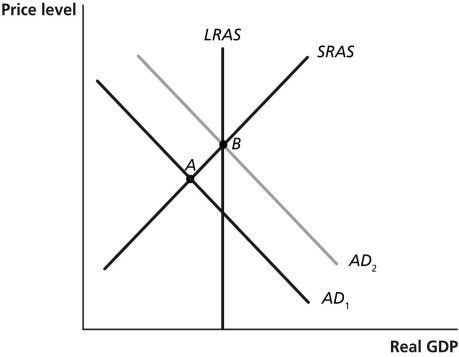 -Decreasing government spending ________ the price level and ________ equilibrium real GDP.
 (71) Of the $840 billion American Recovery and Reinvestment Act stimulus package which was enacted in 2009,approximately ________ took the form of tax cuts and ________ took the form of increases in government expenditures.
(58) Figure 27-10 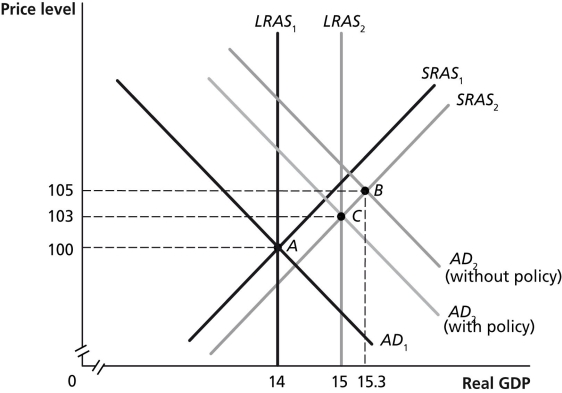 -Refer to Figure 27-10.In the graph above,suppose the economy in Year 1 is at point A and is expected in Year 2 to be at point B.Which of the following policies could Congress and the president use to move the economy to point C?
 (79) Figure 27-1  -Refer to Figure 27-1.Suppose the economy is in short-run equilibrium above potential GDP and no policy is pursued.Using the static AD-AS model in the figure above,this would be depicted as a movement from
 (80) Increasing the federal budget deficit will contribute to increasing the federal government debt.
(79) 
Filters
- Essay(0)
- Multiple Choice(0)
- Short Answer(0)
- True False(0)
- Matching(0)