



 Chat with AI
Exam 27: Fiscal Policy

Exam 1: Economics: Foundations and Models447 Questions
Exam 2: Trade-Offs, comparative Advantage, and the Market System492 Questions
Exam 3: Where Prices Come From: the Interaction of Demand and Supply476 Questions
Exam 4: Economic Efficiency, government Price Setting, and Taxes420 Questions
Exam 5: Externalities, environmental Policy, and Public Goods263 Questions
Exam 6: Elasticity: the Responsiveness of Demand and Supply294 Questions
Exam 7: The Economics of Health Care338 Questions
Exam 8: Firms,the Stock Market,and Corporate Governance522 Questions
Exam 9: Comparative Advantage and the Gains From International Trade377 Questions
Exam 10: Consumer Choice and Behavioral Economics300 Questions
Exam 11: Technology,production,and Costs327 Questions
Exam 12: Firms in Perfectly Competitive Markets296 Questions
Exam 13: Monopolistic Competition: the Competitive Model in a More Realistic Setting272 Questions
Exam 14: Oligopoly: Firms in Less Competitive Markets258 Questions
Exam 15: Monopoly and Antitrust Policy279 Questions
Exam 16: Pricing Strategy261 Questions
Exam 17: The Markets for Labor and Other Factors of Production281 Questions
Exam 18: Public Choice, taxes, and the Distribution of Income258 Questions
Exam 19: Gdp: Measuring Total Production and Income261 Questions
Exam 20: Unemployment and Inflation291 Questions
Exam 21: Economic Growth, the Financial System, and Business Cycles253 Questions
Exam 22: Long-Run Economic Growth: Sources and Policies262 Questions
Exam 23: Aggregate Expenditure and Output in the Short Run301 Questions
Exam 24: Aggregate Demand and Aggregate Supply Analysis286 Questions
Exam 25: Money,banks,and the Federal Reserve System281 Questions
Exam 26: Monetary Policy275 Questions
Exam 27: Fiscal Policy306 Questions
Exam 28: Inflation, unemployment, and Federal Reserve Policy257 Questions
Exam 29: Macroeconomics in an Open Economy278 Questions
Exam 30: The International Financial System258 Questions
Select questions type


The tax multiplier is calculated as "one minus the government purchases multiplier."
(True/False)
4.7/5  (96)
(96) Table 27-3
Year Potential Real GDP Real GDP Price Level 2016 \ 18.0 trillion \ 18.0 trillion 150 2017 18.5 trillion 18.2 trillion 152
-Refer to Table 27-3.Consider the hypothetical information in the table above for potential real GDP,real GDP,and the price level in 2016 and in 2017 if Congress and the president do not use fiscal policy.If Congress and the president use fiscal policy successfully to keep real GDP at its potential level in 2017,which of the following will be higher than if Congress and the president had taken no action?
(Multiple Choice)
4.9/5 (69)
(69) Long lags associated with the legislative process in implementing fiscal policy make it more difficult to use than monetary policy.
(True/False)
4.9/5 (80)
(80) Economists refer to the series of induced increases in consumption spending that result from an initial increase in autonomous expenditures as the ________ effect.
(Multiple Choice)
4.9/5 (77)
(77) Increases in government spending result in ________ in the short run,and permanent increases in government spending result in ________ in the long run.
(Multiple Choice)
4.8/5 (76)
(76) In preparing their estimates of the stimulus package's effect on GDP,Obama administration economists estimated a government purchases multiplier of 1.57.This indicates that a $1 billion increase in government purchases would increase equilibrium real GDP by
(Multiple Choice)
4.8/5 (85)
(85) The nation of Hyperbole is in a recession,and the government decides to increase taxes and reduce government spending to reduce the growing deficit.This will ________ aggregate demand and will likely ________ real GDP and employment.
(Multiple Choice)
4.8/5 (90)
(90) Which of the following statements about the Social Security,Medicare,and Medicaid programs is true?
(Multiple Choice)
4.7/5 (68)
(68) Part of the spending on the Doyle Drive project in northern California came from the American Reinvestment and Recovery Act,which is an example of discretionary fiscal policy aimed at increasing
(Multiple Choice)
4.8/5 (84)
(84) The largest source of federal government revenue in 2014 was
(Multiple Choice)
4.9/5 (83)
(83) Figure 27-11 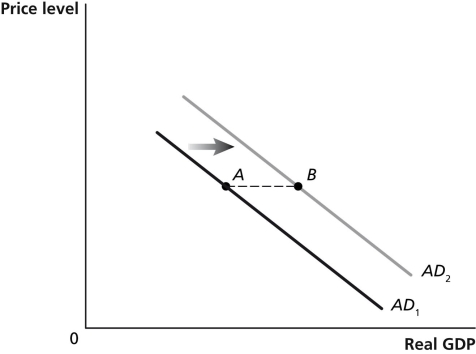 -Refer to Figure 27-11.In the graph above,the shift from AD1 to AD2 represents the total change in aggregate demand.If government purchases increased by $50 billion,then the distance from point A to point B ________ $50 billion.
 (Multiple Choice)
4.7/5 (84)
(84) Forecasts by the Congressional Budget Office show spending on Social Security,Medicare,and Medicaid rising from 10.1 percent of GDP in 2015 to ________ percent of GDP in 2090,and by 2090 the federal government will be spending,as a fraction of GDP,________ on these three programs as it currently spends on all programs combined.
(Multiple Choice)
4.7/5 (92)
(92) The double taxation problem occurs because households pay taxes on dividends and capital gains from stock and corporations pay taxes on corporate profits.
(True/False)
4.9/5 (85)
(85) Table 27-2
Year Potential Real GDP Real GDP Price Level 2016 \ 18.0 trillion \ 18.0 trillion 150 2017 18.5 trillion 18.8 trillion 154
-Refer to Table 27-2.Consider the hypothetical information in the table above for potential real GDP,real GDP,and the price level in 2016 and in 2017 if Congress and the president do not use fiscal policy.If Congress and the president want to keep real GDP at its potential level in 2017,they should
(Multiple Choice)
4.9/5 (77)
(77) Which of the following provides health-care coverage to people age 65 and over?
(Multiple Choice)
4.9/5 (69)
(69) Suppose the federal budget deficit for the year was $100 billion and the economy was in a recession.If the economy had been at potential GDP,it is estimated that tax revenues would have been $60 billion higher and government spending on transfer payments $50 billion lower.Using these estimates,the cyclically adjusted budget
(Multiple Choice)
4.9/5 (80)
(80) 
Filters
- Essay(0)
- Multiple Choice(0)
- Short Answer(0)
- True False(0)
- Matching(0)