



 Chat with AI
Exam 27: Fiscal Policy

Exam 1: Economics: Foundations and Models447 Questions
Exam 2: Trade-Offs, comparative Advantage, and the Market System492 Questions
Exam 3: Where Prices Come From: the Interaction of Demand and Supply476 Questions
Exam 4: Economic Efficiency, government Price Setting, and Taxes420 Questions
Exam 5: Externalities, environmental Policy, and Public Goods263 Questions
Exam 6: Elasticity: the Responsiveness of Demand and Supply294 Questions
Exam 7: The Economics of Health Care338 Questions
Exam 8: Firms,the Stock Market,and Corporate Governance522 Questions
Exam 9: Comparative Advantage and the Gains From International Trade377 Questions
Exam 10: Consumer Choice and Behavioral Economics300 Questions
Exam 11: Technology,production,and Costs327 Questions
Exam 12: Firms in Perfectly Competitive Markets296 Questions
Exam 13: Monopolistic Competition: the Competitive Model in a More Realistic Setting272 Questions
Exam 14: Oligopoly: Firms in Less Competitive Markets258 Questions
Exam 15: Monopoly and Antitrust Policy279 Questions
Exam 16: Pricing Strategy261 Questions
Exam 17: The Markets for Labor and Other Factors of Production281 Questions
Exam 18: Public Choice, taxes, and the Distribution of Income258 Questions
Exam 19: Gdp: Measuring Total Production and Income261 Questions
Exam 20: Unemployment and Inflation291 Questions
Exam 21: Economic Growth, the Financial System, and Business Cycles253 Questions
Exam 22: Long-Run Economic Growth: Sources and Policies262 Questions
Exam 23: Aggregate Expenditure and Output in the Short Run301 Questions
Exam 24: Aggregate Demand and Aggregate Supply Analysis286 Questions
Exam 25: Money,banks,and the Federal Reserve System281 Questions
Exam 26: Monetary Policy275 Questions
Exam 27: Fiscal Policy306 Questions
Exam 28: Inflation, unemployment, and Federal Reserve Policy257 Questions
Exam 29: Macroeconomics in an Open Economy278 Questions
Exam 30: The International Financial System258 Questions
Select questions type


In a closed economy with fixed or autonomous (non-income dependent)taxes,the balanced budget government purchases multiplier is negative.
(True/False)
4.8/5  (75)
(75) An appropriate fiscal policy response when aggregate demand is growing at a faster rate than aggregate supply is to decrease the money supply.
(True/False)
4.7/5 (81)
(81) If Congress and the president pursue an expansionary fiscal policy at the same time as the Federal Reserve pursues an expansionary monetary policy,how might the expansionary monetary policy affect the extent of crowding out in the short run?
(Essay)
4.8/5 (94)
(94) If we include consideration of potential effects of a proposed tax reduction and simplification on the labor supply,we would expect crowding out of investment and net exports brought about by the tax cut to be
(Multiple Choice)
4.8/5 (75)
(75) Figure 27-4 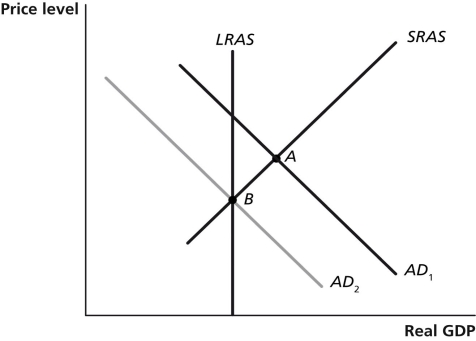 -Refer to Figure 27-4.In the graph above,suppose the economy is initially at point A.The movement of the economy to point B as shown in the graph illustrates the effect of which of the following policy actions by Congress and the president?
 (Multiple Choice)
4.9/5 (73)
(73) Suppose Congress increased spending by $100 billion and raised taxes by $100 billion to keep the budget balanced.What will happen to real equilibrium GDP?
(Multiple Choice)
4.8/5 (78)
(78) Crowding out,following an increase in government spending,results from (the exchange rate is the foreign exchange price of the domestic currency)
(Multiple Choice)
4.9/5 (86)
(86) The income tax system serves as an automatic stabilizer over the course of the business cycle.
(True/False)
4.9/5 (69)
(69) A decrease in the tax rate will ________ the disposable income of households and ________ the size of the multiplier effect.
(Multiple Choice)
4.9/5 (91)
(91) A tax rebate,like the one issued in 2008,is likely to ________ consumption spending ________ than would a permanent tax cut.
(Multiple Choice)
4.9/5 (87)
(87) Figure 27-2 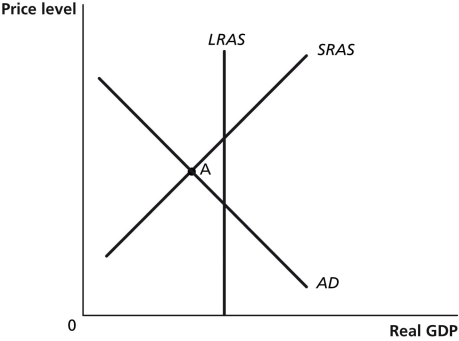 -Refer to Figure 27-2.In the graph above,if the economy is at point A,an appropriate fiscal policy by Congress and the president would be to
 (Multiple Choice)
4.8/5 (80)
(80) Figure 27-1  -Refer to Figure 27-1.An increase in taxes would be depicted as a movement from ________,using the static AD-AS model in the figure above.
 (Multiple Choice)
5.0/5 (84)
(84) Suppose real GDP is $13 trillion,potential real GDP is $13.5 trillion,and Congress and the president plan to use fiscal policy to restore the economy to potential real GDP.Assuming a constant price level,Congress and the president would need to decrease taxes by
(Multiple Choice)
4.9/5 (74)
(74) Which of the following is considered expansionary fiscal policy?
(Multiple Choice)
4.9/5 (73)
(73) A change in consumption spending caused by income changes is ________ change in spending,and a change in government spending that occurs to improve roads and bridges is ________ change in spending.
(Multiple Choice)
4.9/5 (84)
(84) If the economy is growing beyond potential real GDP,which of the following would be an appropriate fiscal policy to bring the economy back to long-run aggregate supply? An increase in
(Multiple Choice)
4.9/5 (95)
(95) 
Filters
- Essay(0)
- Multiple Choice(0)
- Short Answer(0)
- True False(0)
- Matching(0)