



 Chat with AI
Exam 27: Fiscal Policy

Exam 1: Economics: Foundations and Models447 Questions
Exam 2: Trade-Offs, comparative Advantage, and the Market System492 Questions
Exam 3: Where Prices Come From: the Interaction of Demand and Supply476 Questions
Exam 4: Economic Efficiency, government Price Setting, and Taxes420 Questions
Exam 5: Externalities, environmental Policy, and Public Goods263 Questions
Exam 6: Elasticity: the Responsiveness of Demand and Supply294 Questions
Exam 7: The Economics of Health Care338 Questions
Exam 8: Firms,the Stock Market,and Corporate Governance522 Questions
Exam 9: Comparative Advantage and the Gains From International Trade377 Questions
Exam 10: Consumer Choice and Behavioral Economics300 Questions
Exam 11: Technology,production,and Costs327 Questions
Exam 12: Firms in Perfectly Competitive Markets296 Questions
Exam 13: Monopolistic Competition: the Competitive Model in a More Realistic Setting272 Questions
Exam 14: Oligopoly: Firms in Less Competitive Markets258 Questions
Exam 15: Monopoly and Antitrust Policy279 Questions
Exam 16: Pricing Strategy261 Questions
Exam 17: The Markets for Labor and Other Factors of Production281 Questions
Exam 18: Public Choice, taxes, and the Distribution of Income258 Questions
Exam 19: Gdp: Measuring Total Production and Income261 Questions
Exam 20: Unemployment and Inflation291 Questions
Exam 21: Economic Growth, the Financial System, and Business Cycles253 Questions
Exam 22: Long-Run Economic Growth: Sources and Policies262 Questions
Exam 23: Aggregate Expenditure and Output in the Short Run301 Questions
Exam 24: Aggregate Demand and Aggregate Supply Analysis286 Questions
Exam 25: Money,banks,and the Federal Reserve System281 Questions
Exam 26: Monetary Policy275 Questions
Exam 27: Fiscal Policy306 Questions
Exam 28: Inflation, unemployment, and Federal Reserve Policy257 Questions
Exam 29: Macroeconomics in an Open Economy278 Questions
Exam 30: The International Financial System258 Questions
Select questions type


In preparing their estimates of the stimulus package's effect on GDP,Obama administration economists estimated a government purchases multiplier of 1.57.Economist Robert Barro argues that during wartime,the government purchases multiplier would be ________ the administration's estimate,and economists Lawrence Christiano,Martin Eichenbaum,and Sergio Rebelo argued that when short-term interest rates are near zero,the multiplier would be ________ the administration's estimate.
(Multiple Choice)
4.7/5  (94)
(94) Assume a country is required by law to balance the budget every year.Suppose aggregate demand falls,causing a recession and a budget deficit.To balance the budget,what would the government need to do with the level of government spending and taxes? How would these changes in government spending and taxes affect aggregate demand and the economy?
(Essay)
4.8/5 (78)
(78) The federal budget deficit acts as an automatic stabilizer because
(Multiple Choice)
4.7/5 (82)
(82) Suppose the government spending multiplier is 2.The federal government cuts spending by $40 billion.What is the change in GDP if the price level is not held constant?
(Multiple Choice)
4.9/5 (70)
(70) Contractionary fiscal policy to prevent real GDP from rising above potential real GDP would cause the inflation rate to be ________ and real GDP to be ________.
(Multiple Choice)
4.8/5 (64)
(64) An increase in the tax wedge associated with a given economic activity will decrease the level of that activity.
(True/False)
5.0/5 (65)
(65) Figure 27-8 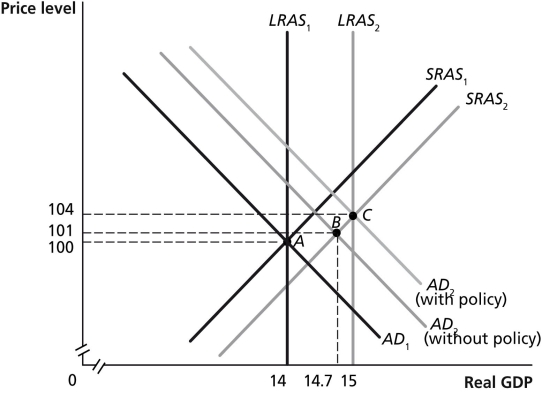 -Refer to Figure 27-8.In the graph above,suppose the economy in Year 1 is at point A and is expected in Year 2 to be at point B.Which of the following policies could Congress and the president use to move the economy to point C?
 (Multiple Choice)
4.8/5 (77)
(77) The tax increases necessary to fund future Social Security and Medicare benefit payments would be
(Multiple Choice)
4.8/5 (84)
(84) Contractionary fiscal policy is used to decrease aggregate demand in an attempt to fight rising inflation.
(True/False)
4.9/5 (85)
(85) Part of the spending on the Doyle Drive project in northern California came from the American Reinvestment and Recovery Act,which is an example of ________ aimed at increasing real GDP and employment.
(Multiple Choice)
4.9/5 (79)
(79) It is ________ difficult to effectively time fiscal policy than monetary policy because ________.
(Multiple Choice)
4.9/5 (80)
(80) Figure 27-7 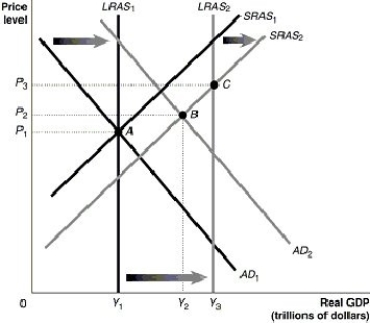 -Refer to Figure 27-7.Given that the economy has moved from A to B in the graph above,which of the following would be the appropriate fiscal policy to achieve potential GDP?
 (Multiple Choice)
4.9/5 (76)
(76) Describe the differences (in sign and relative magnitude)between the government purchases multiplier and the tax multiplier.
(Essay)
4.9/5 (85)
(85) The federal budget was in deficit from 1931 to 1939,except in the year 1937.Given this fact,how do you explain E.Cary Brown's statement,"Fiscal policy,then,seems to have been an unsuccessful recovery device in the 'thirties-not because it did not work,but because it was not tried."
(Essay)
4.8/5 (79)
(79) In the long run,most economists agree that a permanent increase in government spending leads to ________ crowding out of private spending.
(Multiple Choice)
4.9/5 (84)
(84) Which of the following would be considered a fiscal policy action?
(Multiple Choice)
4.9/5 (87)
(87) An increase in government spending increases the supply of money in our economy.
(True/False)
4.9/5 (77)
(77) Active changes in tax and spending by government intended to smooth out the business cycle are called ________,and changes in taxes and spending that occur passively over the business cycle are called ________.
(Multiple Choice)
4.9/5 (73)
(73) 
Filters
- Essay(0)
- Multiple Choice(0)
- Short Answer(0)
- True False(0)
- Matching(0)