



 Chat with AI
Exam 21: Economic Growth, the Financial System, and Business Cycles

Exam 1: Economics: Foundations and Models447 Questions
Exam 2: Trade-Offs, comparative Advantage, and the Market System492 Questions
Exam 3: Where Prices Come From: the Interaction of Demand and Supply476 Questions
Exam 4: Economic Efficiency, government Price Setting, and Taxes420 Questions
Exam 5: Externalities, environmental Policy, and Public Goods263 Questions
Exam 6: Elasticity: the Responsiveness of Demand and Supply294 Questions
Exam 7: The Economics of Health Care338 Questions
Exam 8: Firms,the Stock Market,and Corporate Governance522 Questions
Exam 9: Comparative Advantage and the Gains From International Trade377 Questions
Exam 10: Consumer Choice and Behavioral Economics300 Questions
Exam 11: Technology,production,and Costs327 Questions
Exam 12: Firms in Perfectly Competitive Markets296 Questions
Exam 13: Monopolistic Competition: the Competitive Model in a More Realistic Setting272 Questions
Exam 14: Oligopoly: Firms in Less Competitive Markets258 Questions
Exam 15: Monopoly and Antitrust Policy279 Questions
Exam 16: Pricing Strategy261 Questions
Exam 17: The Markets for Labor and Other Factors of Production281 Questions
Exam 18: Public Choice, taxes, and the Distribution of Income258 Questions
Exam 19: Gdp: Measuring Total Production and Income261 Questions
Exam 20: Unemployment and Inflation291 Questions
Exam 21: Economic Growth, the Financial System, and Business Cycles253 Questions
Exam 22: Long-Run Economic Growth: Sources and Policies262 Questions
Exam 23: Aggregate Expenditure and Output in the Short Run301 Questions
Exam 24: Aggregate Demand and Aggregate Supply Analysis286 Questions
Exam 25: Money,banks,and the Federal Reserve System281 Questions
Exam 26: Monetary Policy275 Questions
Exam 27: Fiscal Policy306 Questions
Exam 28: Inflation, unemployment, and Federal Reserve Policy257 Questions
Exam 29: Macroeconomics in an Open Economy278 Questions
Exam 30: The International Financial System258 Questions
Select questions type


If GDP grew 3% in 1970,2.2% in 1971 and 2.5% in 1972 then,what is the average annual growth rate over this period?

Free
(Multiple Choice)
4.9/5  (81)
(81) Correct Answer: Verified
C
Scenario 21-1
Consider the following data for a closed economy:
Y = $12 trillion
C = $8 trillion
I = $2 trillion
G = $2 trillion
TR = $2 trillion
T = $3 trillion
-Refer to Scenario 21-1.Based on the information above,what is the level of private saving in the economy?
Free
(Multiple Choice)
4.8/5 (91)
(91) Correct Answer:Verified
VerifiedA
Which of the following will increase investment spending in the economy,holding everything else constant?
Free
(Multiple Choice)
4.8/5 (87)
(87) Correct Answer:Verified
VerifiedA
Figure 21-6  -Refer to Figure 21-6.The loanable funds market is in equilibrium,as shown in the figure above.An increase in the supply of loanable funds could result in which of the following combinations of the real interest rate and quantity of loanable funds at a new equilibrium?
 (Multiple Choice)
4.9/5 (78)
(78) Explain why a centrally-planned economy might not grow as rapidly as a market economy.
(Essay)
4.8/5 (65)
(65) Which of the following will increase the real interest rate?
(Multiple Choice)
4.9/5 (71)
(71) How has economist Robert Fogel explained that economic growth is connected to life expectancy? Based on this connection,in what country would you expect to have a longer life expectancy,the United States or India? Explain.
(Essay)
4.8/5 (73)
(73) If you spend more of your income on consumption goods,which of the following will occur?
(Multiple Choice)
4.7/5 (91)
(91) Potential GDP is estimated to grow at a rate of 3.2% in the United States.Actual GDP in the U.S.
(Multiple Choice)
5.0/5 (69)
(69) If GDP grows at a rate of 3% per year,approximately how long will it take for GDP to double in size?
(Multiple Choice)
4.8/5 (76)
(76) Because Corning produces durable goods,the demand for their goods
(Multiple Choice)
4.9/5 (74)
(74) In a closed economy,public saving plus private saving is equal to
(Multiple Choice)
5.0/5 (67)
(67) Figure 21-2 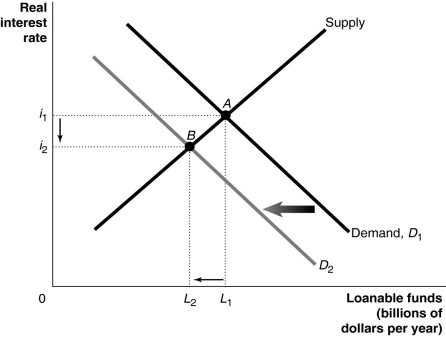 -Refer to Figure 21-2.Which of the following is consistent with the graph depicted above?
 (Multiple Choice)
4.7/5 (66)
(66) Explain and show graphically how an increase in government spending affects the equilibrium interest rate in the market for loanable funds.
(Essay)
4.8/5 (67)
(67) ________ is the ease with which a financial security can be exchanged for money.
(Multiple Choice)
4.9/5 (78)
(78) When the government runs a budget deficit,we would expect to see that
(Multiple Choice)
4.7/5 (73)
(73) 
Filters
- Essay(0)
- Multiple Choice(0)
- Short Answer(0)
- True False(0)
- Matching(0)