



 Chat with AI
Exam 21: Economic Growth, the Financial System, and Business Cycles

Exam 1: Economics: Foundations and Models447 Questions
Exam 2: Trade-Offs, comparative Advantage, and the Market System492 Questions
Exam 3: Where Prices Come From: the Interaction of Demand and Supply476 Questions
Exam 4: Economic Efficiency, government Price Setting, and Taxes420 Questions
Exam 5: Externalities, environmental Policy, and Public Goods263 Questions
Exam 6: Elasticity: the Responsiveness of Demand and Supply294 Questions
Exam 7: The Economics of Health Care338 Questions
Exam 8: Firms,the Stock Market,and Corporate Governance522 Questions
Exam 9: Comparative Advantage and the Gains From International Trade377 Questions
Exam 10: Consumer Choice and Behavioral Economics300 Questions
Exam 11: Technology,production,and Costs327 Questions
Exam 12: Firms in Perfectly Competitive Markets296 Questions
Exam 13: Monopolistic Competition: the Competitive Model in a More Realistic Setting272 Questions
Exam 14: Oligopoly: Firms in Less Competitive Markets258 Questions
Exam 15: Monopoly and Antitrust Policy279 Questions
Exam 16: Pricing Strategy261 Questions
Exam 17: The Markets for Labor and Other Factors of Production281 Questions
Exam 18: Public Choice, taxes, and the Distribution of Income258 Questions
Exam 19: Gdp: Measuring Total Production and Income261 Questions
Exam 20: Unemployment and Inflation291 Questions
Exam 21: Economic Growth, the Financial System, and Business Cycles253 Questions
Exam 22: Long-Run Economic Growth: Sources and Policies262 Questions
Exam 23: Aggregate Expenditure and Output in the Short Run301 Questions
Exam 24: Aggregate Demand and Aggregate Supply Analysis286 Questions
Exam 25: Money,banks,and the Federal Reserve System281 Questions
Exam 26: Monetary Policy275 Questions
Exam 27: Fiscal Policy306 Questions
Exam 28: Inflation, unemployment, and Federal Reserve Policy257 Questions
Exam 29: Macroeconomics in an Open Economy278 Questions
Exam 30: The International Financial System258 Questions
Select questions type


An increase in public saving has what impact on the market for loanable funds?
(Multiple Choice)
4.8/5  (84)
(84) Accumulating a greater number of inputs will ensure that an economy will experience economic growth.
(True/False)
4.7/5 (69)
(69) A government budget surplus from reduced government spending (no change in net taxes)will ________ the level of investment in the economy and ________ the level of saving (private plus public)in the economy.
(Multiple Choice)
4.9/5 (82)
(82) Table 21-2
Year Real GDP (billions of 2000 dollars) 2013 \ 10,100 2014 10,950 2015 11,425 2016 11,300
-Refer to Table 21-2.Using the table above,what is the approximate average annual growth rate from 2013 to 2016?
(Multiple Choice)
4.8/5 (82)
(82) If Ebenezer Scrooge spends rather than saves his vast wealth,he will
(Multiple Choice)
4.8/5 (79)
(79) In an open economy,there is interaction with other economies in terms of both trading of goods and services and borrowing and lending.
(True/False)
4.9/5 (84)
(84) Because ________ in the government budget deficit increase the real interest rate,budget deficits can ________ firm investment.
(Multiple Choice)
4.8/5 (78)
(78) If the growth rate of real GDP rises from 3% to 4% per year,then the number of years required to double real GDP will decrease from
(Multiple Choice)
4.9/5 (66)
(66) Figure 21-5 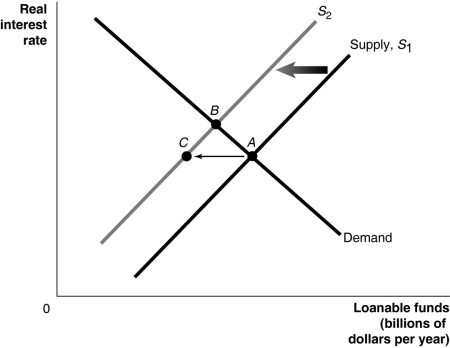 -Refer to Figure 21-5."Crowding out" of firm investment as a result of a budget deficit is illustrated by the movement from ________ in the graph above.
 (Multiple Choice)
4.8/5 (88)
(88) According to the National Bureau of Economic Research,the United States has experienced ________ recessions since 1950.
(Multiple Choice)
4.9/5 (82)
(82) Inflation tends to ________ during the expansion phase of the business cycle and ________ during the recession phase of the business cycle.
(Multiple Choice)
4.8/5 (82)
(82) Economist Robert Fogel has estimated that by the year 2040,individuals in the United States will be spending
(Multiple Choice)
4.9/5 (73)
(73) According to the National Bureau of Economic Research,the recession that began in December 2007
(Multiple Choice)
4.8/5 (88)
(88) Explain what happens to inflation during the business cycle.Give an intuitive explanation as to why inflation changes the way it does over the business cycle.
(Essay)
4.7/5 (83)
(83) If you invest $10,000 in a bond that earns 8% interest per year,how many years will it take to double your money?
(Multiple Choice)
4.8/5 (78)
(78) Use the rule of 70 to illustrate how small differences in growth rates can have a large impact on how rapidly the standard of living in a country increases.
(Essay)
4.9/5 (89)
(89) Purchases of which of the following goods would be dramatically reduced during a recession?
(Multiple Choice)
4.9/5 (76)
(76) 
Filters
- Essay(0)
- Multiple Choice(0)
- Short Answer(0)
- True False(0)
- Matching(0)