



 Chat with AI
Exam 21: Economic Growth, the Financial System, and Business Cycles

Exam 1: Economics: Foundations and Models447 Questions
Exam 2: Trade-Offs, comparative Advantage, and the Market System492 Questions
Exam 3: Where Prices Come From: the Interaction of Demand and Supply476 Questions
Exam 4: Economic Efficiency, government Price Setting, and Taxes420 Questions
Exam 5: Externalities, environmental Policy, and Public Goods263 Questions
Exam 6: Elasticity: the Responsiveness of Demand and Supply294 Questions
Exam 7: The Economics of Health Care338 Questions
Exam 8: Firms,the Stock Market,and Corporate Governance522 Questions
Exam 9: Comparative Advantage and the Gains From International Trade377 Questions
Exam 10: Consumer Choice and Behavioral Economics300 Questions
Exam 11: Technology,production,and Costs327 Questions
Exam 12: Firms in Perfectly Competitive Markets296 Questions
Exam 13: Monopolistic Competition: the Competitive Model in a More Realistic Setting272 Questions
Exam 14: Oligopoly: Firms in Less Competitive Markets258 Questions
Exam 15: Monopoly and Antitrust Policy279 Questions
Exam 16: Pricing Strategy261 Questions
Exam 17: The Markets for Labor and Other Factors of Production281 Questions
Exam 18: Public Choice, taxes, and the Distribution of Income258 Questions
Exam 19: Gdp: Measuring Total Production and Income261 Questions
Exam 20: Unemployment and Inflation291 Questions
Exam 21: Economic Growth, the Financial System, and Business Cycles253 Questions
Exam 22: Long-Run Economic Growth: Sources and Policies262 Questions
Exam 23: Aggregate Expenditure and Output in the Short Run301 Questions
Exam 24: Aggregate Demand and Aggregate Supply Analysis286 Questions
Exam 25: Money,banks,and the Federal Reserve System281 Questions
Exam 26: Monetary Policy275 Questions
Exam 27: Fiscal Policy306 Questions
Exam 28: Inflation, unemployment, and Federal Reserve Policy257 Questions
Exam 29: Macroeconomics in an Open Economy278 Questions
Exam 30: The International Financial System258 Questions
Select questions type


Economists have not found a way to predict when recessions will begin and end.
(True/False)
4.9/5  (95)
(95) Which of the following does not describe governmental policy actions that are helpful in supporting growth in an economy? Governmental policies that
(Multiple Choice)
4.9/5 (77)
(77) Which of the following is most likely to be able to sustain economic growth in an economy?
(Multiple Choice)
4.8/5 (74)
(74) Increasing the amount of consumption spending and reducing the amount of savings ________ investment expenditures,and ________ long-run economic growth in the economy.
(Multiple Choice)
4.9/5 (82)
(82) If real GDP grows by 3% in 2014,3.2% in 2015,and 2.5% in 2016,what is the average annual growth rate of real GDP?
(Multiple Choice)
4.8/5 (82)
(82) In a closed economy,which of the following components of GDP is not included?
(Multiple Choice)
4.7/5 (74)
(74) At the end of an expansion,wages of workers are usually rising faster than prices.
(True/False)
4.7/5 (71)
(71) If technological change increases the profitability of new investment for firms,then the ________ curve for loanable funds will shift to the ________ and the equilibrium real interest rate will ________.
(Multiple Choice)
4.9/5 (74)
(74) Which of the following would encourage economic growth through increases in the capital stock?
(Multiple Choice)
5.0/5 (80)
(80) Figure 21-4 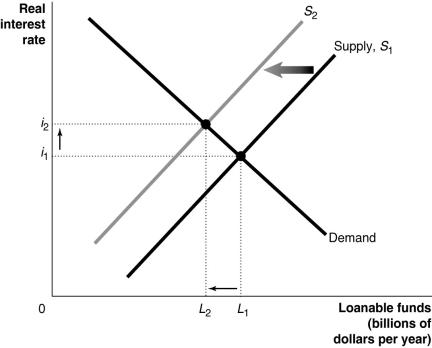 -Refer to Figure 21-4.Which of the following is consistent with the graph depicted?
 (Multiple Choice)
4.9/5 (78)
(78) Use the equations for public and private saving to demonstrate how total saving in the economy equals investment.
(Essay)
4.9/5 (94)
(94) Explain how unemployment changes over the business cycle.Why do these changes occur?
(Essay)
4.8/5 (89)
(89) If there is public dissaving,investment spending in the economy will decline,holding everything else constant.
(True/False)
4.8/5 (91)
(91) Empirical evidence shows that the impact of government budget deficits and surpluses on the equilibrium interest rate is quite large.
(True/False)
4.7/5 (72)
(72) According to the "Rule of 70," it will take 4 years for real GDP per capita to double when the growth rate of real GDP per capita is
(Multiple Choice)
4.7/5 (93)
(93) At the end of World War II in 1945,many economists and business managers expected that the U.S.economy would enter a severe recession.At that time,Sears and Montgomery Ward were the two largest department store chains in the country.Sears CEO Robert Wood expected continuing prosperity and opened new stores.Montgomery Ward CEO Sewell Avery expected falling incomes and rising unemployment and closed a number of existing stores.The results of their actions were seen during the late 1940s,when
(Multiple Choice)
4.8/5 (91)
(91) 
Filters
- Essay(0)
- Multiple Choice(0)
- Short Answer(0)
- True False(0)
- Matching(0)