



 Chat with AI
Exam 27: Fiscal Policy

Exam 1: Economics: Foundations and Models447 Questions
Exam 2: Trade-Offs, comparative Advantage, and the Market System492 Questions
Exam 3: Where Prices Come From: the Interaction of Demand and Supply476 Questions
Exam 4: Economic Efficiency, government Price Setting, and Taxes420 Questions
Exam 5: Externalities, environmental Policy, and Public Goods263 Questions
Exam 6: Elasticity: the Responsiveness of Demand and Supply294 Questions
Exam 7: The Economics of Health Care338 Questions
Exam 8: Firms,the Stock Market,and Corporate Governance522 Questions
Exam 9: Comparative Advantage and the Gains From International Trade377 Questions
Exam 10: Consumer Choice and Behavioral Economics300 Questions
Exam 11: Technology,production,and Costs327 Questions
Exam 12: Firms in Perfectly Competitive Markets296 Questions
Exam 13: Monopolistic Competition: the Competitive Model in a More Realistic Setting272 Questions
Exam 14: Oligopoly: Firms in Less Competitive Markets258 Questions
Exam 15: Monopoly and Antitrust Policy279 Questions
Exam 16: Pricing Strategy261 Questions
Exam 17: The Markets for Labor and Other Factors of Production281 Questions
Exam 18: Public Choice, taxes, and the Distribution of Income258 Questions
Exam 19: Gdp: Measuring Total Production and Income261 Questions
Exam 20: Unemployment and Inflation291 Questions
Exam 21: Economic Growth, the Financial System, and Business Cycles253 Questions
Exam 22: Long-Run Economic Growth: Sources and Policies262 Questions
Exam 23: Aggregate Expenditure and Output in the Short Run301 Questions
Exam 24: Aggregate Demand and Aggregate Supply Analysis286 Questions
Exam 25: Money,banks,and the Federal Reserve System281 Questions
Exam 26: Monetary Policy275 Questions
Exam 27: Fiscal Policy306 Questions
Exam 28: Inflation, unemployment, and Federal Reserve Policy257 Questions
Exam 29: Macroeconomics in an Open Economy278 Questions
Exam 30: The International Financial System258 Questions
Select questions type


A one-time tax rebate,which is not expected to be extended in future years,will
(Multiple Choice)
4.9/5  (86)
(86) If real GDP exceeded potential real GDP and inflation was increasing,which of the following would be an appropriate fiscal policy?
(Multiple Choice)
4.8/5 (87)
(87) Expansionary fiscal policy is used to increase aggregate demand in an attempt to fight rising inflation.
(True/False)
4.7/5 (72)
(72) Use the dynamic aggregate demand and aggregate supply model and start with Year 1 in a long-run macroeconomic equilibrium.For Year 2,graph aggregate demand,long-run aggregate supply,and short-run aggregate supply such that the condition of the economy will induce the president and Congress to conduct contractionary fiscal policy.Briefly explain the condition of the economy and what the president and Congress are attempting to do.
(Essay)
4.8/5 (99)
(99) The government purchases multiplier equals the change in ________ divided by the change in ________.
(Multiple Choice)
4.9/5 (87)
(87) A law requiring the government to balance its budget in each year would serve as an automatic destabilizer.
(True/False)
4.9/5 (80)
(80) Suppose real GDP is $14 trillion and potential real GDP is $14.4 trillion.An increase in government purchases of $400 billion would cause real GDP to ________ potential real GDP (assuming a constant price level).
(Multiple Choice)
4.9/5 (68)
(68) Table 27-5
Year Potential Real GDP Real GDP Price Level 1 \ 10.2 trillion \ 10.2 trillion 100 2 10.8 trillion 10.6 trillion 103
-Use the dynamic aggregate demand and aggregate supply model and start with Year 1 in a long-run macroeconomic equilibrium.For Year 2,graph aggregate demand,long-run aggregate supply,and short-run aggregate supply such that the condition of the economy will induce the president and Congress to conduct expansionary fiscal policy.Briefly explain the condition of the economy and what the president and Congress are attempting to do.
(Essay)
4.8/5 (74)
(74) Raising taxes on interest and dividend income will increase the level of investment and economic growth.
(True/False)
4.9/5 (76)
(76) If the federal budget has an actual budget deficit of $100 billion and a cyclically adjusted budget deficit of $75 billion,then the economy
(Multiple Choice)
4.9/5 (76)
(76) Figure 27-12 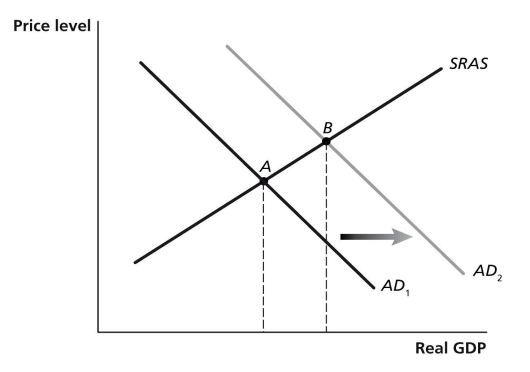 -Refer to Figure 27-12.An increase in government purchases of $200 billion causes aggregate demand to shift ultimately from AD1 to AD2.Assuming a constant price level,the difference in real GDP between point A and point B will be ________ $200 billion.
 (Multiple Choice)
4.9/5 (71)
(71) If the federal budget has an actual budget surplus of $75 billion,but a cyclically adjusted budget surplus of $50 billion,then the economy must be above potential real GDP.
(True/False)
4.9/5 (83)
(83) Suppose the government wants to maintain a balanced budget.To achieve this goal,when the economy falls into recession government would need to ________ taxes,which would cause aggregate demand to ________.
(Multiple Choice)
4.9/5 (92)
(92) Suppose the president is successful in passing a $10 billion tax increase.Assume that taxes are fixed,the economy is closed,and the marginal propensity to consume is 0.8.What happens to equilibrium GDP?
(Multiple Choice)
4.8/5 (88)
(88) An increase in government purchases will increase aggregate demand because
(Multiple Choice)
4.8/5 (80)
(80) Suppose Political Party A proposes a tax cut on business income to stimulate the economy.Political Party B opposes the tax cut on business income asserting that it would only help businesses,not the average working man and woman.If you were hired as an economist for Political Party A,explain how the tax cut on business income would help the average working man and woman.
(Essay)
4.9/5 (89)
(89) Suppose real GDP is $13 trillion,potential real GDP is $13.5 trillion,and Congress and the president plan to use fiscal policy to restore the economy to potential real GDP.Assuming a constant price level,Congress and the president would need to increase government purchases by
(Multiple Choice)
4.8/5 (80)
(80) Suppose that Congress allocates $1 billion to clean up after hurricanes in 2016.It also raises taxes by $1 billion to keep the deficit from growing.If the marginal propensity to consume is 0.9,what is the effect on equilibrium GDP?
(Multiple Choice)
4.8/5 (90)
(90) The federal government debt ________ when the federal government runs a deficit and ________ when the federal government runs a surplus.
(Multiple Choice)
4.9/5 (71)
(71) 
Filters
- Essay(0)
- Multiple Choice(0)
- Short Answer(0)
- True False(0)
- Matching(0)