



 Chat with AI
Exam 30: The International Financial System

Exam 1: Economics: Foundations and Models447 Questions
Exam 2: Trade-Offs, comparative Advantage, and the Market System492 Questions
Exam 3: Where Prices Come From: the Interaction of Demand and Supply476 Questions
Exam 4: Economic Efficiency, government Price Setting, and Taxes420 Questions
Exam 5: Externalities, environmental Policy, and Public Goods263 Questions
Exam 6: Elasticity: the Responsiveness of Demand and Supply294 Questions
Exam 7: The Economics of Health Care338 Questions
Exam 8: Firms,the Stock Market,and Corporate Governance522 Questions
Exam 9: Comparative Advantage and the Gains From International Trade377 Questions
Exam 10: Consumer Choice and Behavioral Economics300 Questions
Exam 11: Technology,production,and Costs327 Questions
Exam 12: Firms in Perfectly Competitive Markets296 Questions
Exam 13: Monopolistic Competition: the Competitive Model in a More Realistic Setting272 Questions
Exam 14: Oligopoly: Firms in Less Competitive Markets258 Questions
Exam 15: Monopoly and Antitrust Policy279 Questions
Exam 16: Pricing Strategy261 Questions
Exam 17: The Markets for Labor and Other Factors of Production281 Questions
Exam 18: Public Choice, taxes, and the Distribution of Income258 Questions
Exam 19: Gdp: Measuring Total Production and Income261 Questions
Exam 20: Unemployment and Inflation291 Questions
Exam 21: Economic Growth, the Financial System, and Business Cycles253 Questions
Exam 22: Long-Run Economic Growth: Sources and Policies262 Questions
Exam 23: Aggregate Expenditure and Output in the Short Run301 Questions
Exam 24: Aggregate Demand and Aggregate Supply Analysis286 Questions
Exam 25: Money,banks,and the Federal Reserve System281 Questions
Exam 26: Monetary Policy275 Questions
Exam 27: Fiscal Policy306 Questions
Exam 28: Inflation, unemployment, and Federal Reserve Policy257 Questions
Exam 29: Macroeconomics in an Open Economy278 Questions
Exam 30: The International Financial System258 Questions
Select questions type


In order to maintain an undervalued yuan to encourage a trade surplus,the Chinese government must buy dollars and increase the supply of yuan.
(True/False)
4.9/5  (71)
(71) International flows of capital increase both efficiency and growth in countries around the world.
(True/False)
4.8/5 (80)
(80) Americans,other than jewelers or rare coin collectors,were not allowed to own gold from the early 1930s until the
(Multiple Choice)
4.9/5 (69)
(69) Suppose the U.S.dollar is backed by one-sixth of an ounce of gold and the British pound is backed by one-third of an ounce of gold.The exchange rate between the U.S.dollar and the British pound equals ________ per pound.
(Multiple Choice)
4.8/5 (80)
(80) The Bulgarian currency,the lev,is pegged to the euro at a rate of 1.96 leva (leva is the plural of lev)to the euro.At the pegged exchange rate,how many euros would be exchanged for one lev?
(Multiple Choice)
4.8/5 (82)
(82) The "Big Mac Theory of Exchange Rates" tests the accuracy of purchasing power parity theory.In July 2015,the Economist reported that the average price of a Big Mac in the United States was $4.79.In Mexico,the average price of a Big Mac at that time was 49 pesos.If the exchange rate between the dollar and the peso was 13.60 pesos per dollar,how would purchasing power parity predict the exchange rate will change in the long run? Support your answer graphically.
(Essay)
4.8/5 (84)
(84) Firms in Thailand that had borrowed dollars while the baht was pegged to the dollar faced interest payments that were ________ than they had planned because the baht had been pegged ________ the equilibrium exchange rate for the baht.
(Multiple Choice)
4.8/5 (72)
(72) Figure 30-10  -Refer to Figure 30-10.Under the Bretton Woods System of exchange rates,if the par exchange rate was $2 per pound in the figure above,and equilibrium persisted at $3,then a revaluation of the currency would have
 (Multiple Choice)
4.9/5 (87)
(87) Under the Bretton Woods system,a fixed exchange rate supported by central banks was known as a(n)________ exchange rate.
(Multiple Choice)
4.9/5 (90)
(90) In what year was the Bretton Woods system of currency exchange set up?
(Multiple Choice)
4.8/5 (80)
(80) A persistent shortage or surplus of a currency under the Bretton Woods system was evidence of
(Multiple Choice)
4.8/5 (81)
(81) What factors are not important in determining exchange rate fluctuations in the long run?
(Multiple Choice)
4.8/5 (72)
(72) U.S.currency continues to be backed by the gold standard to this day.
(True/False)
4.9/5 (75)
(75) What do reports that the dollar is "overvalued" mean? How will foreign exchange markets respond to this information? Support your answer graphically.
(Essay)
4.8/5 (82)
(82) Figure 30-11 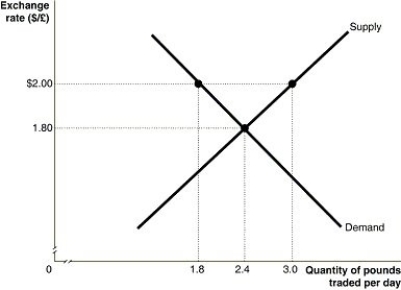 -Refer to Figure 30-11.The graph above depicts supply and demand for British pounds during a trading day.At a fixed exchange rate of $2.00 per pound,the pound is ________ versus the dollar.A ________ of the pound would correct the fundamental disequilibrium that exists in this market.
 (Multiple Choice)
4.8/5 (81)
(81) What are capital controls? Why might a financial crisis lead to a reconsideration of using capital controls,and what problems might result from the reinstatement of capital controls?
(Essay)
4.7/5 (76)
(76) Which of the following would decrease the value of the dollar in the long run?
(Multiple Choice)
4.8/5 (78)
(78) Figure 30-5  -Refer to Figure 30-5.Suppose the Chinese government decides to abandon pegging the yuan to the dollar at a rate which undervalues the yuan.Using the figure above,the equilibrium exchange rate would be ________ and Chinese exports to the United States would ________ in price.
 (Multiple Choice)
4.8/5 (87)
(87) When foreign investors in Thailand began to realize that Thailand could not maintain its peg to the dollar indefinitely,they began to sell off their investments in Thailand and exchange the baht they received for dollars.This reduction in investment by foreigners is termed
(Multiple Choice)
4.8/5 (72)
(72) 
Filters
- Essay(0)
- Multiple Choice(0)
- Short Answer(0)
- True False(0)
- Matching(0)