



 Chat with AI
Exam 30: The International Financial System

Exam 1: Economics: Foundations and Models447 Questions
Exam 2: Trade-Offs, comparative Advantage, and the Market System492 Questions
Exam 3: Where Prices Come From: the Interaction of Demand and Supply476 Questions
Exam 4: Economic Efficiency, government Price Setting, and Taxes420 Questions
Exam 5: Externalities, environmental Policy, and Public Goods263 Questions
Exam 6: Elasticity: the Responsiveness of Demand and Supply294 Questions
Exam 7: The Economics of Health Care338 Questions
Exam 8: Firms,the Stock Market,and Corporate Governance522 Questions
Exam 9: Comparative Advantage and the Gains From International Trade377 Questions
Exam 10: Consumer Choice and Behavioral Economics300 Questions
Exam 11: Technology,production,and Costs327 Questions
Exam 12: Firms in Perfectly Competitive Markets296 Questions
Exam 13: Monopolistic Competition: the Competitive Model in a More Realistic Setting272 Questions
Exam 14: Oligopoly: Firms in Less Competitive Markets258 Questions
Exam 15: Monopoly and Antitrust Policy279 Questions
Exam 16: Pricing Strategy261 Questions
Exam 17: The Markets for Labor and Other Factors of Production281 Questions
Exam 18: Public Choice, taxes, and the Distribution of Income258 Questions
Exam 19: Gdp: Measuring Total Production and Income261 Questions
Exam 20: Unemployment and Inflation291 Questions
Exam 21: Economic Growth, the Financial System, and Business Cycles253 Questions
Exam 22: Long-Run Economic Growth: Sources and Policies262 Questions
Exam 23: Aggregate Expenditure and Output in the Short Run301 Questions
Exam 24: Aggregate Demand and Aggregate Supply Analysis286 Questions
Exam 25: Money,banks,and the Federal Reserve System281 Questions
Exam 26: Monetary Policy275 Questions
Exam 27: Fiscal Policy306 Questions
Exam 28: Inflation, unemployment, and Federal Reserve Policy257 Questions
Exam 29: Macroeconomics in an Open Economy278 Questions
Exam 30: The International Financial System258 Questions
Select questions type


If,at the current exchange rate between the dollar and the South African rand of 6.92 rand per dollar,the dollar is "undervalued," how do you expect demand and supply in the foreign exchange markets to respond?
(Multiple Choice)
4.7/5  (86)
(86) Under the Bretton Woods system,U.S.dollars were redeemable for ________ only if the dollars were presented by a foreign central bank.
(Multiple Choice)
4.8/5 (87)
(87) During what period of time did the United States most consistently adhere to the gold standard?
(Multiple Choice)
4.8/5 (88)
(88) As foreign investors began to sell off investments they had made in Thailand,they traded in their baht for dollars.The result of this was
(Multiple Choice)
4.9/5 (73)
(73) An easy way to determine if a currency is undervalued at a point in time is to use the model of purchasing power parity.
(True/False)
4.9/5 (86)
(86) Figure 30-8 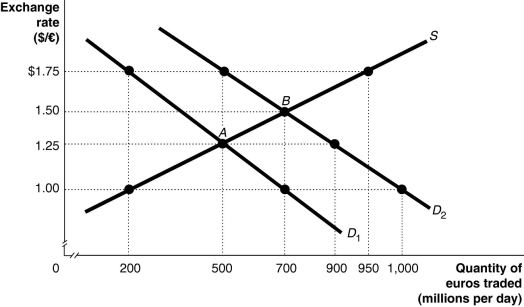 -Refer to Figure 30-8.The equilibrium exchange rate is originally at A,$1.25/euro.Suppose the European Central Bank pegs its currency at $1.00/euro.Speculators expect that the value of the euro will rise and this shifts the demand curve for euro to D2.If the European Central Bank abandons the peg,the equilibrium exchange rate would be
 (Multiple Choice)
4.8/5 (92)
(92) All of the following are considered among the four most important determinants in explaining exchange rate fluctuations in the long run except
(Multiple Choice)
4.8/5 (93)
(93) Expanding,contracting,and managing the money supply is easier for a central bank under the gold standard.
(True/False)
4.9/5 (84)
(84) In 1931,the first major country to abandon the gold standard-in order to increase its policy options in face of the Great Depression-was
(Multiple Choice)
4.9/5 (67)
(67) The fixed exchange rate system set up in the 1940s was the
(Multiple Choice)
4.9/5 (82)
(82) By the late 1950s,dollars held by foreign central banks exceeded the official dollar value of U.S.gold reserves.
(True/False)
4.9/5 (76)
(76) The ________ system of currency exchange was set up in 1944.
(Multiple Choice)
4.8/5 (76)
(76) If the GDP deflator in the United States is 114,and the GDP deflator in Ukraine is 142,which of the following exchange rates would the theory of purchasing power parity predict in the long run? (The Ukrainian currency is the hryvnia. )
(Multiple Choice)
4.9/5 (81)
(81) Under the Bretton Woods exchange rate system,the U.S.government agreed to buy or sell gold at a fixed price of ________ per ounce.
(Multiple Choice)
5.0/5 (84)
(84) Suppose the United States decides to go back on the gold standard.This should
(Multiple Choice)
4.8/5 (94)
(94) If a country sets a pegged exchange rate that is below the equilibrium exchange rate,how can the country maintain the peg?
(Multiple Choice)
4.7/5 (68)
(68) If,at the current exchange rate between the dollar and the Norwegian kroner of 5.78 kroner per dollar,the dollar is "overvalued," how do you expect demand and supply in the foreign exchange markets to respond?
(Multiple Choice)
4.9/5 (74)
(74) In a fixed exchange rate system,speculation regarding an expected revaluation or devaluation of a currency makes it more difficult to maintain the existing exchange rate.
(True/False)
4.7/5 (75)
(75) If speculators believe a currency is undervalued,their trades in international exchange markets will
(Multiple Choice)
4.8/5 (68)
(68) 
Filters
- Essay(0)
- Multiple Choice(0)
- Short Answer(0)
- True False(0)
- Matching(0)