



 Chat with AI
Exam 2: Trade-Offs, comparative Advantage, and the Market System

Exam 1: Economics: Foundations and Models447 Questions
Exam 2: Trade-Offs, comparative Advantage, and the Market System492 Questions
Exam 3: Where Prices Come From: the Interaction of Demand and Supply476 Questions
Exam 4: Economic Efficiency, government Price Setting, and Taxes420 Questions
Exam 5: Externalities, environmental Policy, and Public Goods263 Questions
Exam 6: Elasticity: the Responsiveness of Demand and Supply294 Questions
Exam 7: The Economics of Health Care338 Questions
Exam 8: Firms,the Stock Market,and Corporate Governance522 Questions
Exam 9: Comparative Advantage and the Gains From International Trade377 Questions
Exam 10: Consumer Choice and Behavioral Economics300 Questions
Exam 11: Technology,production,and Costs327 Questions
Exam 12: Firms in Perfectly Competitive Markets296 Questions
Exam 13: Monopolistic Competition: the Competitive Model in a More Realistic Setting272 Questions
Exam 14: Oligopoly: Firms in Less Competitive Markets258 Questions
Exam 15: Monopoly and Antitrust Policy279 Questions
Exam 16: Pricing Strategy261 Questions
Exam 17: The Markets for Labor and Other Factors of Production281 Questions
Exam 18: Public Choice, taxes, and the Distribution of Income258 Questions
Exam 19: Gdp: Measuring Total Production and Income261 Questions
Exam 20: Unemployment and Inflation291 Questions
Exam 21: Economic Growth, the Financial System, and Business Cycles253 Questions
Exam 22: Long-Run Economic Growth: Sources and Policies262 Questions
Exam 23: Aggregate Expenditure and Output in the Short Run301 Questions
Exam 24: Aggregate Demand and Aggregate Supply Analysis286 Questions
Exam 25: Money,banks,and the Federal Reserve System281 Questions
Exam 26: Monetary Policy275 Questions
Exam 27: Fiscal Policy306 Questions
Exam 28: Inflation, unemployment, and Federal Reserve Policy257 Questions
Exam 29: Macroeconomics in an Open Economy278 Questions
Exam 30: The International Financial System258 Questions
Select questions type


In a two-good,two country world,if one country has an absolute advantage in the production of both goods,it cannot benefit by trading with the other country.
(True/False)
4.8/5  (68)
(68) Minnie Mickey Hats 40 50 Urrbrellas 10 5 Table 2-18 shows the output per week of two people,Minnie and Mickey.They can either devote their time to making hats or making umbrellas.
-Refer to Table 2-18.Which of the following statements is true?
(Multiple Choice)
4.9/5 (69)
(69) It is not possible to have an absolute advantage in producing a good or service without having a comparative advantage.
(True/False)
5.0/5 (78)
(78) In a two-good,two country world,if one country has a comparative advantage in the production of one good,it can benefit by trading with the other country.
(True/False)
4.7/5 (80)
(80) To compete in the automobile market,Tesla must make many strategic decisions such as whether to introduce a new car model,how to sell and service its cars,and where to advertise.At Tesla's Fremont,California plant,managers must decide on the monthly production quantities of their S and X models.In making this decision,the managers
(Multiple Choice)
5.0/5 (88)
(88) Izzy Amador is a highly talented tattoo artist.She has chosen to specialize in tattoo art because of all of the following except
(Multiple Choice)
4.8/5 (96)
(96) The payment received by suppliers of entrepreneurial skills is called profit.
(True/False)
4.8/5 (85)
(85) Wilma Betty Statues 12 14 Benches 4 7 Table 2-19 shows the output per month of two people,Wilma and Betty.They can either devote their time to making marble statues or making marble benches.
-Refer to Table 2-19.What is Betty's opportunity cost of making a bench?
(Multiple Choice)
4.9/5 (70)
(70) An outward shift of a nation's production possibilities frontier can occur due to
(Multiple Choice)
4.8/5 (81)
(81) The payment received by suppliers of entrepreneurial skills is called wages.
(True/False)
4.9/5 (84)
(84) Any output combination along a production possibility frontier is associated with overused or unattainable resources.
(True/False)
4.9/5 (76)
(76) In the circular flow model,households supply resources such as labor services in the product market.
(True/False)
5.0/5 (77)
(77) Figure 2-16 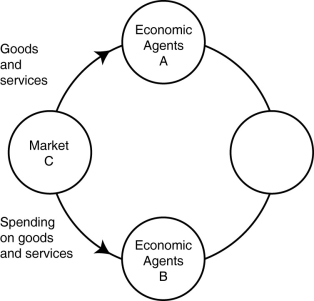 -Refer to Figure 2-16.One segment of the circular flow diagram in the figure shows the flow of goods and services from market C to economic agents A.What is market C and who are economic agents A?
 (Multiple Choice)
4.9/5 (72)
(72)  Figure 2-4 shows various points on three different production possibilities frontiers for a nation.
-Refer to Figure 2-4.A movement from Y to Z
Figure 2-4 shows various points on three different production possibilities frontiers for a nation.
-Refer to Figure 2-4.A movement from Y to Z (Multiple Choice)
4.8/5 (80)
(80) Carmelita can perform either a combination of 35 manicures and 70 pedicures or a combination of 50 manicures and 45 pedicures.If she now performs 35 manicures and 70 pedicures,what is the opportunity cost of performing an additional 15 manicures?
(Multiple Choice)
4.9/5 (85)
(85) In the circular flow model,households demand resources such as labor services in the product market.
(True/False)
4.7/5 (69)
(69) Figure 2-5  -Refer to Figure 2-5.If the economy is currently producing at point Y,what is the opportunity cost of moving to point X?
 (Multiple Choice)
4.7/5 (69)
(69) 
Filters
- Essay(0)
- Multiple Choice(0)
- Short Answer(0)
- True False(0)
- Matching(0)