



 Chat with AI
Exam 2: Trade-Offs, comparative Advantage, and the Market System

Exam 1: Economics: Foundations and Models447 Questions
Exam 2: Trade-Offs, comparative Advantage, and the Market System492 Questions
Exam 3: Where Prices Come From: the Interaction of Demand and Supply476 Questions
Exam 4: Economic Efficiency, government Price Setting, and Taxes420 Questions
Exam 5: Externalities, environmental Policy, and Public Goods263 Questions
Exam 6: Elasticity: the Responsiveness of Demand and Supply294 Questions
Exam 7: The Economics of Health Care338 Questions
Exam 8: Firms,the Stock Market,and Corporate Governance522 Questions
Exam 9: Comparative Advantage and the Gains From International Trade377 Questions
Exam 10: Consumer Choice and Behavioral Economics300 Questions
Exam 11: Technology,production,and Costs327 Questions
Exam 12: Firms in Perfectly Competitive Markets296 Questions
Exam 13: Monopolistic Competition: the Competitive Model in a More Realistic Setting272 Questions
Exam 14: Oligopoly: Firms in Less Competitive Markets258 Questions
Exam 15: Monopoly and Antitrust Policy279 Questions
Exam 16: Pricing Strategy261 Questions
Exam 17: The Markets for Labor and Other Factors of Production281 Questions
Exam 18: Public Choice, taxes, and the Distribution of Income258 Questions
Exam 19: Gdp: Measuring Total Production and Income261 Questions
Exam 20: Unemployment and Inflation291 Questions
Exam 21: Economic Growth, the Financial System, and Business Cycles253 Questions
Exam 22: Long-Run Economic Growth: Sources and Policies262 Questions
Exam 23: Aggregate Expenditure and Output in the Short Run301 Questions
Exam 24: Aggregate Demand and Aggregate Supply Analysis286 Questions
Exam 25: Money,banks,and the Federal Reserve System281 Questions
Exam 26: Monetary Policy275 Questions
Exam 27: Fiscal Policy306 Questions
Exam 28: Inflation, unemployment, and Federal Reserve Policy257 Questions
Exam 29: Macroeconomics in an Open Economy278 Questions
Exam 30: The International Financial System258 Questions
Select questions type


Fred Barney Pogo Sticks 24 28 Unicycles 8 14 Table 2-10 shows the output per month of two people,Fred and Barney.They can either devote their time to making pogo sticks or making unicycles.
-Refer to Table 2-10.What is Barney's opportunity cost of making a unicycle?
(Multiple Choice)
5.0/5  (87)
(87) The attainable production points on a production possibilities curve are
(Multiple Choice)
4.9/5 (82)
(82)  Figure 2-13 shows the production possibilities frontiers for Costa Rica and Guatemala.Each country produces two goods,pineapples and coconuts.
-Refer to Figure 2-13.What is the opportunity cost of producing 1 ton of coconuts in Guatemala?
Figure 2-13 shows the production possibilities frontiers for Costa Rica and Guatemala.Each country produces two goods,pineapples and coconuts.
-Refer to Figure 2-13.What is the opportunity cost of producing 1 ton of coconuts in Guatemala? (Multiple Choice)
4.9/5 (74)
(74) Suppose that in Germany,the opportunity cost of producing a gallon of beer is 5 gallons of wine.In Italy,the opportunity cost of producing a gallon of beer is 3 gallons of wine.
a.What is the opportunity cost of producing a gallon of wine for Germany?
b.What is the opportunity cost of producing a gallon of wine for Italy?
c.Which country has a comparative advantage in the production of beer?
d.Which country has a comparative advantage in the production of wine?
(Essay)
5.0/5 (94)
(94)  Figure 2-12 shows the production possibilities frontiers for Tahiti and Bora Bora.Each country produces two goods,milk and honey.
-Refer to Figure 2-12.Which country has a comparative advantage in the production of honey?
Figure 2-12 shows the production possibilities frontiers for Tahiti and Bora Bora.Each country produces two goods,milk and honey.
-Refer to Figure 2-12.Which country has a comparative advantage in the production of honey? (Multiple Choice)
4.8/5 (65)
(65) If a country is producing efficiently and is on the production possibilities frontier,the only way to produce more of one good is with an advance in technology.
(True/False)
4.9/5 (79)
(79) 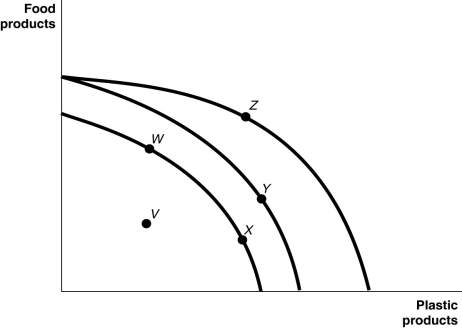 Figure 2-4 shows various points on three different production possibilities frontiers for a nation.
-Refer to Figure 2-4.Consider the following events: a.a decrease in the unemployment rate
B.general technological advancement
C.an increase in consumer wealth
Which of the events listed above could cause a movement from V to W?
Figure 2-4 shows various points on three different production possibilities frontiers for a nation.
-Refer to Figure 2-4.Consider the following events: a.a decrease in the unemployment rate
B.general technological advancement
C.an increase in consumer wealth
Which of the events listed above could cause a movement from V to W? (Multiple Choice)
4.9/5 (98)
(98)
James Lucy Wagons 16 18 Tricycles 32 24 Table 2-17 shows the output per week of two people,James and Lucy.They can either devote their time to making wagons or making tricycles.
-Refer to Table 2-17.Which of the following statements is true?
(Multiple Choice)
4.8/5 (79)
(79) If additional units of a good could be produced at a constant opportunity cost,the production
possibilities frontier would be bowed outward (concave).
(True/False)
4.9/5 (70)
(70) Suppose there is some unemployment in the economy and society decides that it wants more of one good.Which of the following statements is true?
(Multiple Choice)
4.8/5 (74)
(74) If the opportunity cost of producing more of one good remains the same as more of that good is produced,then the production method is inefficient.
(True/False)
4.8/5 (81)
(81)  Apple recently announced that the company is exploring the electric vehicle market,and is looking to produce vehicles as early as 2020.Assume Apple chooses to produce both traditional electric-engine vehicles and self-driving electric-engine vehicles.Figure 2-7 shows changes to its production possibilities frontier in response to new developments and different strategic production decisions.
-Refer to Figure 2-7.Assume a technological advancement greatly reduces the cost to produce self-driving vehicles.This is best represented by the
Apple recently announced that the company is exploring the electric vehicle market,and is looking to produce vehicles as early as 2020.Assume Apple chooses to produce both traditional electric-engine vehicles and self-driving electric-engine vehicles.Figure 2-7 shows changes to its production possibilities frontier in response to new developments and different strategic production decisions.
-Refer to Figure 2-7.Assume a technological advancement greatly reduces the cost to produce self-driving vehicles.This is best represented by the (Multiple Choice)
4.8/5 (63)
(63) The principle of ________ is that the economic cost of using a factor of production is the alternative use of that factor that is given up.
(Multiple Choice)
4.9/5 (82)
(82) One Wristwatch Rice (per pound) Japan 50 hours 2 hours Thailand 30 hours 1.5 hours Table 2-20 shows the number of labor hours required to produce a wristwatch and a pound of rice in Japan and Thailand.
-Refer to Table 2-20.If the two countries specialize and trade,who should export wristwatches?
(Multiple Choice)
4.9/5 (78)
(78) Table 2-4
Production Choices for Dina's Diner
Choice Quantity of Sliders Produced Quantity of Hot Wings Produced A 80 0 B 60 25 C 40 50 D 20 75 E 0 100
-Refer to Table 2-4.Dina faces ________ opportunity costs in the production of sliders and hot wings.
(Multiple Choice)
4.8/5 (80)
(80) Figure 2-4 shows various points on three different production possibilities frontiers for a nation.
-Refer to Figure 2-4.Consider the following events: a.an increase in the unemployment rate
B.general technological advancement
C.an increase in consumer wealth
Which of the events listed above could cause a movement from Z to V?
Figure 2-4 shows various points on three different production possibilities frontiers for a nation.
-Refer to Figure 2-4.Consider the following events: a.an increase in the unemployment rate
B.general technological advancement
C.an increase in consumer wealth
Which of the events listed above could cause a movement from Z to V? (Multiple Choice)
4.9/5 (75)
(75) Adam Smith's behavioral assumption about humans was that people
(Multiple Choice)
4.9/5 (78)
(78) 
Filters
- Essay(0)
- Multiple Choice(0)
- Short Answer(0)
- True False(0)
- Matching(0)