



 Chat with AI
Exam 2: Trade-Offs, comparative Advantage, and the Market System

Exam 1: Economics: Foundations and Models447 Questions
Exam 2: Trade-Offs, comparative Advantage, and the Market System492 Questions
Exam 3: Where Prices Come From: the Interaction of Demand and Supply476 Questions
Exam 4: Economic Efficiency, government Price Setting, and Taxes420 Questions
Exam 5: Externalities, environmental Policy, and Public Goods263 Questions
Exam 6: Elasticity: the Responsiveness of Demand and Supply294 Questions
Exam 7: The Economics of Health Care338 Questions
Exam 8: Firms,the Stock Market,and Corporate Governance522 Questions
Exam 9: Comparative Advantage and the Gains From International Trade377 Questions
Exam 10: Consumer Choice and Behavioral Economics300 Questions
Exam 11: Technology,production,and Costs327 Questions
Exam 12: Firms in Perfectly Competitive Markets296 Questions
Exam 13: Monopolistic Competition: the Competitive Model in a More Realistic Setting272 Questions
Exam 14: Oligopoly: Firms in Less Competitive Markets258 Questions
Exam 15: Monopoly and Antitrust Policy279 Questions
Exam 16: Pricing Strategy261 Questions
Exam 17: The Markets for Labor and Other Factors of Production281 Questions
Exam 18: Public Choice, taxes, and the Distribution of Income258 Questions
Exam 19: Gdp: Measuring Total Production and Income261 Questions
Exam 20: Unemployment and Inflation291 Questions
Exam 21: Economic Growth, the Financial System, and Business Cycles253 Questions
Exam 22: Long-Run Economic Growth: Sources and Policies262 Questions
Exam 23: Aggregate Expenditure and Output in the Short Run301 Questions
Exam 24: Aggregate Demand and Aggregate Supply Analysis286 Questions
Exam 25: Money,banks,and the Federal Reserve System281 Questions
Exam 26: Monetary Policy275 Questions
Exam 27: Fiscal Policy306 Questions
Exam 28: Inflation, unemployment, and Federal Reserve Policy257 Questions
Exam 29: Macroeconomics in an Open Economy278 Questions
Exam 30: The International Financial System258 Questions
Select questions type


Any output combination outside a production possibilities frontier is associated with unused or
underutilized resources.
(True/False)
4.9/5  (83)
(83) Figure 2-10  -Refer to Figure 2-10.If the economy is currently producing at point C,what is the opportunity cost of moving to point B?
 (Multiple Choice)
4.8/5 (82)
(82) In a report made to the U.S.Congress in 2001,the National Academy of Sciences cautioned that if fuel economy encourages the production of smaller and lighter cars,"Some additional traffic fatalities would be expected." This statement suggests that
(Multiple Choice)
4.9/5 (93)
(93) For each pound of salami that Hungary produces,it gives up the opportunity to make 10 bottles of beer.Slovakia can produce 1 pound of salami for every 8 bottles of beer it produces.Which of the following is true about the comparative advantage between the two countries?
(Multiple Choice)
4.9/5 (90)
(90) In a free market there are virtually no restrictions,or at best few restrictions,on how a good or service can be produced or sold.
(True/False)
4.9/5 (76)
(76) Consider a country that produces only two goods: bird feeders and binoculars.Suppose it is possible for this country to increase its production of bird feeders without producing fewer binoculars.In this case,its current output combination is inefficient.
(True/False)
4.8/5 (87)
(87) If the best lawyer in town is also the best at operating a word processor,then according to economic reasoning,this person should
(Multiple Choice)
4.8/5 (76)
(76) Figure 2-15
 -Refer to Figure 2-15.One segment of the circular flow diagram in the figure shows the flow of wages and salaries from market K to economic agents M.What is market K and who are economic agents M?
 (Multiple Choice)
4.9/5 (80)
(80)  Figure 2-13 shows the production possibilities frontiers for Costa Rica and Guatemala.Each country produces two goods,pineapples and coconuts.
-Refer to Figure 2-13.Which country has a comparative advantage in the production of pineapples?
Figure 2-13 shows the production possibilities frontiers for Costa Rica and Guatemala.Each country produces two goods,pineapples and coconuts.
-Refer to Figure 2-13.Which country has a comparative advantage in the production of pineapples? (Multiple Choice)
4.8/5 (74)
(74)  Figure 2-8 above shows the production possibilities frontier for Vidalia,a nation that produces two goods,roses and orchids.
-Refer to Figure 2-8.What is the opportunity cost of one dozen roses?
Figure 2-8 above shows the production possibilities frontier for Vidalia,a nation that produces two goods,roses and orchids.
-Refer to Figure 2-8.What is the opportunity cost of one dozen roses? (Multiple Choice)
4.9/5 (69)
(69) Article Summary
On October 5,2015,12 nations,including the United States,reached an agreement on the Trans-Pacific Partnership (TPP)treaty,a free-trade agreement that has been negotiated in total secrecy for more than five years.One of the more controversial parts of the agreement deals with intellectual property rights,with details of this provision released to the public by the Website Wikileaks.According to Wikileaks,the intellectual property rights section of the TPP contains regulations that would potentially have "wide-ranging effects on internet services,medicines,publishers,civil liberties,and biological patents." Included in these regulations is the potential to extend patents on pharmaceuticals which could delay the development of less expensive,generic versions of the patented drugs.
-Refer to the Article Summary.If the 12 nations that are a part of the TPP do agree to these stricter pharmaceutical patent laws as a way to increase intellectual property rights,all of the following would most likely occur except
(Multiple Choice)
4.8/5 (78)
(78) 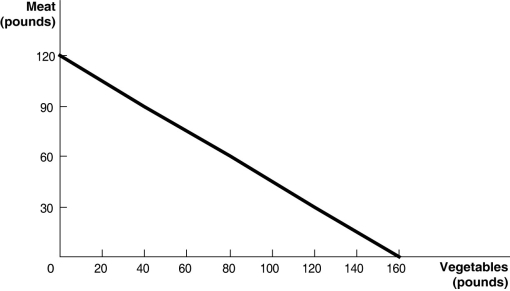 Figure 2-2 above shows the production possibilities frontier for Mendonca,an agrarian nation that produces two goods,meat and vegetables.
-Refer to Figure 2-2.The linear production possibilities frontier in the figure indicates that
Figure 2-2 above shows the production possibilities frontier for Mendonca,an agrarian nation that produces two goods,meat and vegetables.
-Refer to Figure 2-2.The linear production possibilities frontier in the figure indicates that (Multiple Choice)
4.9/5 (81)
(81) One Wristwatch Rice (per pound) Japan 50 hours 2 hours Thailand 30 hours 1.5 hours Table 2-20 shows the number of labor hours required to produce a wristwatch and a pound of rice in Japan and Thailand.
-Refer to Table 2-20.What is Thailand's opportunity cost of producing one wristwatch?
(Multiple Choice)
4.9/5 (78)
(78)
One Cande One Sailbat Guaternala 10 hours 60 hours Honduras 15 hours 75 hours Table 2-12 shows the number of labor hours required to produce a canoe and a sailboat in Guatemala and Honduras.
-Refer to Table 2-12.What is Honduras's opportunity cost of producing one canoe?
(Multiple Choice)
4.8/5 (81)
(81) An inward shift of the production possibilities frontier represents
(Multiple Choice)
4.9/5 (71)
(71) All of the following are examples of spending on factors of production in the circular flow model except
(Multiple Choice)
4.9/5 (79)
(79) A student comments to his roommate that the only way he will be able to pass his final exams is to not sleep for the next three days.This statement suggests that
(Multiple Choice)
4.8/5 (81)
(81) George Jack Lawns Mowed 10 6 Gardens Cultivated 5 4 Table 2-15 shows the output per day of two gardeners,George and Jack.They can either devote their time to mowing lawns or cultivating gardens.
-Refer to Table 2-15.What is George's opportunity cost of cultivating a garden?
(Multiple Choice)
4.9/5 (85)
(85) 
Filters
- Essay(0)
- Multiple Choice(0)
- Short Answer(0)
- True False(0)
- Matching(0)