



 Chat with AI
Exam 2: Trade-Offs, comparative Advantage, and the Market System

Exam 1: Economics: Foundations and Models447 Questions
Exam 2: Trade-Offs, comparative Advantage, and the Market System492 Questions
Exam 3: Where Prices Come From: the Interaction of Demand and Supply476 Questions
Exam 4: Economic Efficiency, government Price Setting, and Taxes420 Questions
Exam 5: Externalities, environmental Policy, and Public Goods263 Questions
Exam 6: Elasticity: the Responsiveness of Demand and Supply294 Questions
Exam 7: The Economics of Health Care338 Questions
Exam 8: Firms,the Stock Market,and Corporate Governance522 Questions
Exam 9: Comparative Advantage and the Gains From International Trade377 Questions
Exam 10: Consumer Choice and Behavioral Economics300 Questions
Exam 11: Technology,production,and Costs327 Questions
Exam 12: Firms in Perfectly Competitive Markets296 Questions
Exam 13: Monopolistic Competition: the Competitive Model in a More Realistic Setting272 Questions
Exam 14: Oligopoly: Firms in Less Competitive Markets258 Questions
Exam 15: Monopoly and Antitrust Policy279 Questions
Exam 16: Pricing Strategy261 Questions
Exam 17: The Markets for Labor and Other Factors of Production281 Questions
Exam 18: Public Choice, taxes, and the Distribution of Income258 Questions
Exam 19: Gdp: Measuring Total Production and Income261 Questions
Exam 20: Unemployment and Inflation291 Questions
Exam 21: Economic Growth, the Financial System, and Business Cycles253 Questions
Exam 22: Long-Run Economic Growth: Sources and Policies262 Questions
Exam 23: Aggregate Expenditure and Output in the Short Run301 Questions
Exam 24: Aggregate Demand and Aggregate Supply Analysis286 Questions
Exam 25: Money,banks,and the Federal Reserve System281 Questions
Exam 26: Monetary Policy275 Questions
Exam 27: Fiscal Policy306 Questions
Exam 28: Inflation, unemployment, and Federal Reserve Policy257 Questions
Exam 29: Macroeconomics in an Open Economy278 Questions
Exam 30: The International Financial System258 Questions
Select questions type


Serena Haley Bracelets 8 9 Necklaces 16 12 Table 2-9 shows the output per week of two jewelers,Serena and Haley.They can either devote their time to making bracelets or making necklaces.
-Refer to Table 2-9.Which of the following statements is true?
(Multiple Choice)
4.9/5  (68)
(68)  Figure 2-12 shows the production possibilities frontiers for Tahiti and Bora Bora.Each country produces two goods,milk and honey.
-Refer to Figure 2-12.What is the opportunity cost of producing one gallon of milk in Bora Bora?
Figure 2-12 shows the production possibilities frontiers for Tahiti and Bora Bora.Each country produces two goods,milk and honey.
-Refer to Figure 2-12.What is the opportunity cost of producing one gallon of milk in Bora Bora? (Multiple Choice)
4.9/5 (100)
(100) Figure 2-18  -Refer to Figure 2-18.Which two arrows in the diagram depict the following transaction: Stanley purchases the novel,"Night of Sorrows" for his summer reading pleasure.
 (Multiple Choice)
4.7/5 (86)
(86) Specializing in the production of a good or service in which one has a comparative advantage enables a country to do which of the following?
(Multiple Choice)
4.9/5 (70)
(70) Table 2-4
Production Choices for Dina's Diner
Choice Quantity of Sliders Produced Quantity of Hot Wings Produced A 80 0 B 60 25 C 40 50 D 20 75 E 0 100
-Refer to Table 2-4.Assume Dina's Diner only produces sliders and hot wings.A combination of 50 sliders and 50 hot wings would appear
(Multiple Choice)
4.8/5 (79)
(79)
One Cell Phone Lumber (per board foot) Estonia 40 hours 8 hours Finland 16 hours 4 hours Table 2-16 shows the number of labor hours required to produce a cell phone and a board foot of lumber in Estonia and Finland.
-Refer to Table 2-16.What is Finland's opportunity cost of producing one cell phone?
(Multiple Choice)
4.9/5 (73)
(73) Suppose in Belgium,the opportunity cost of producing a trombone is 8 clarinets.In Denmark,the opportunity cost of producing a trombone is 6 clarinets.
a.What is the opportunity cost of producing a clarinet for Belgium?
b.What is the opportunity cost of producing a clarinet for Denmark?
c.Which country has a comparative advantage in the production of clarinets?
d.Which country has a comparative advantage in the production of trombones?
(Essay)
4.8/5 (79)
(79) If society decides it wants more of one good and ________,then it has to give up some of another good and incur some opportunity costs.
(Multiple Choice)
4.9/5 (73)
(73)
Serena Haley Bracelets 8 9 Necklaces 16 12 Table 2-9 shows the output per week of two jewelers,Serena and Haley.They can either devote their time to making bracelets or making necklaces.
-Refer to Table 2-9.What is Haley's opportunity cost of making a necklace?
(Multiple Choice)
4.8/5 (78)
(78) If additional units of a good are produced at an increasing opportunity cost,the production possibilities frontier would be bowed outward (concave).
(True/False)
4.9/5 (88)
(88)
One Digital Camera Wheat (per pound) China 100 hours 4 hours South Korea 60 hours 3 hours Table 2-11 shows the number of labor hours required to produce a digital camera and a pound of wheat in China and South Korea.
-Refer to Table 2-11.What is South Korea's opportunity cost of producing one pound of wheat?
(Multiple Choice)
4.8/5 (88)
(88) Which of the following is an example of spending on factors of production in the circular flow model?
(Multiple Choice)
5.0/5 (92)
(92)
One Cande One Sailbat Guaternala 10 hours 60 hours Honduras 15 hours 75 hours Table 2-12 shows the number of labor hours required to produce a canoe and a sailboat in Guatemala and Honduras.
-Refer to Table 2-12.What is Guatemala's opportunity cost of producing one canoe?
(Multiple Choice)
4.8/5 (79)
(79) 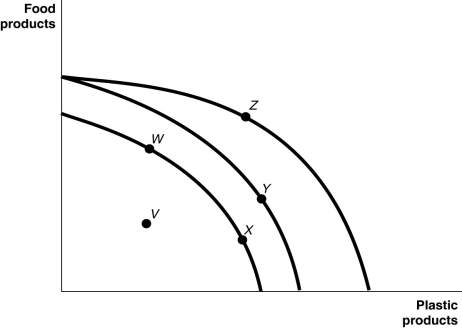 Figure 2-4 shows various points on three different production possibilities frontiers for a nation.
-Refer to Figure 2-4.Consider the following movements: a.from point V to point W
B.from point W to point Y
C.from point Y to point Z
Which of the movements listed above represents economic growth?
Figure 2-4 shows various points on three different production possibilities frontiers for a nation.
-Refer to Figure 2-4.Consider the following movements: a.from point V to point W
B.from point W to point Y
C.from point Y to point Z
Which of the movements listed above represents economic growth? (Multiple Choice)
4.9/5 (91)
(91) What is a production possibilities frontier? What do points along the frontier represent? What do points inside and outside the frontier represent?
(Essay)
4.8/5 (78)
(78)
James Lucy Wagons 16 18 Tricycles 32 24 Table 2-17 shows the output per week of two people,James and Lucy.They can either devote their time to making wagons or making tricycles.
-Refer to Table 2-17.What is James's opportunity cost of making a wagon?
(Multiple Choice)
4.9/5 (73)
(73) 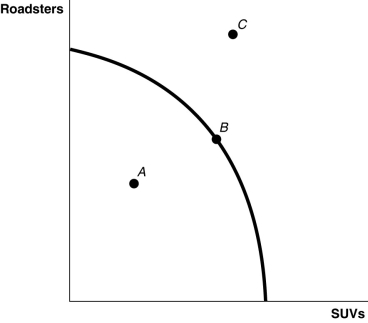 -Refer to Figure 2-1.Point C is
One Wristwatch Rice (per pound) Japan 50 hours 2 hours Thailand 30 hours 1.5 hours Table 2-20 shows the number of labor hours required to produce a wristwatch and a pound of rice in Japan and Thailand.
-Refer to Table 2-20.Does either Japan or Thailand have an absolute advantage and if so,in what product?
(Multiple Choice)
4.7/5 (92)
(92) 
Filters
- Essay(0)
- Multiple Choice(0)
- Short Answer(0)
- True False(0)
- Matching(0)