



 Chat with AI
Exam 2: Trade-Offs, comparative Advantage, and the Market System

Exam 1: Economics: Foundations and Models447 Questions
Exam 2: Trade-Offs, comparative Advantage, and the Market System492 Questions
Exam 3: Where Prices Come From: the Interaction of Demand and Supply476 Questions
Exam 4: Economic Efficiency, government Price Setting, and Taxes420 Questions
Exam 5: Externalities, environmental Policy, and Public Goods263 Questions
Exam 6: Elasticity: the Responsiveness of Demand and Supply294 Questions
Exam 7: The Economics of Health Care338 Questions
Exam 8: Firms,the Stock Market,and Corporate Governance522 Questions
Exam 9: Comparative Advantage and the Gains From International Trade377 Questions
Exam 10: Consumer Choice and Behavioral Economics300 Questions
Exam 11: Technology,production,and Costs327 Questions
Exam 12: Firms in Perfectly Competitive Markets296 Questions
Exam 13: Monopolistic Competition: the Competitive Model in a More Realistic Setting272 Questions
Exam 14: Oligopoly: Firms in Less Competitive Markets258 Questions
Exam 15: Monopoly and Antitrust Policy279 Questions
Exam 16: Pricing Strategy261 Questions
Exam 17: The Markets for Labor and Other Factors of Production281 Questions
Exam 18: Public Choice, taxes, and the Distribution of Income258 Questions
Exam 19: Gdp: Measuring Total Production and Income261 Questions
Exam 20: Unemployment and Inflation291 Questions
Exam 21: Economic Growth, the Financial System, and Business Cycles253 Questions
Exam 22: Long-Run Economic Growth: Sources and Policies262 Questions
Exam 23: Aggregate Expenditure and Output in the Short Run301 Questions
Exam 24: Aggregate Demand and Aggregate Supply Analysis286 Questions
Exam 25: Money,banks,and the Federal Reserve System281 Questions
Exam 26: Monetary Policy275 Questions
Exam 27: Fiscal Policy306 Questions
Exam 28: Inflation, unemployment, and Federal Reserve Policy257 Questions
Exam 29: Macroeconomics in an Open Economy278 Questions
Exam 30: The International Financial System258 Questions
Select questions type


 Figure 2-8 above shows the production possibilities frontier for Vidalia,a nation that produces two goods,roses and orchids.
-Refer to Figure 2-8.What is the opportunity cost of 100 dozen roses?
Figure 2-8 above shows the production possibilities frontier for Vidalia,a nation that produces two goods,roses and orchids.
-Refer to Figure 2-8.What is the opportunity cost of 100 dozen roses? (Multiple Choice)
4.9/5  (80)
(80) Which of the following countries does not come close to the free market benchmark?
(Multiple Choice)
4.8/5 (80)
(80) If Blake can pick more cherries in one hour than Cody,then Blake has a comparative advantage in cherry picking.
(True/False)
4.8/5 (83)
(83)
One Digital Camera Wheat (per pound) China 100 hours 4 hours South Korea 60 hours 3 hours Table 2-11 shows the number of labor hours required to produce a digital camera and a pound of wheat in China and South Korea.
-Refer to Table 2-11.What is China's opportunity cost of producing one digital camera?
(Multiple Choice)
4.7/5 (76)
(76) In the circular flow model,households demand resources such as labor services in the factor market.
(True/False)
4.8/5 (80)
(80) If a nation changes its laws to more actively enforce intellectual property rights,all of the following will most likely take place except
(Multiple Choice)
4.8/5 (72)
(72) Adam Smith's ________ refers to the process by which individuals acting in their own self-interest bring about a market outcome that benefits society as a whole.
(Multiple Choice)
5.0/5 (72)
(72) Any output combination inside a production possibilities frontier is associated with unused or underutilized resources.
(True/False)
4.9/5 (73)
(73) 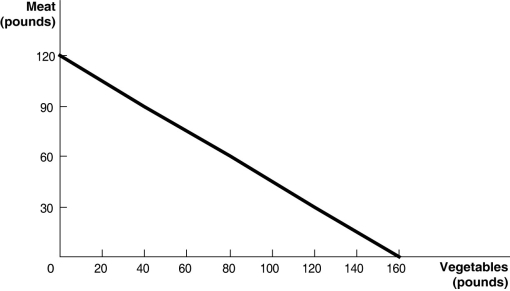 Figure 2-2 above shows the production possibilities frontier for Mendonca,an agrarian nation that produces two goods,meat and vegetables.
-Refer to Figure 2-2.What is the opportunity cost of one pound of meat?
Figure 2-2 above shows the production possibilities frontier for Mendonca,an agrarian nation that produces two goods,meat and vegetables.
-Refer to Figure 2-2.What is the opportunity cost of one pound of meat? (Multiple Choice)
4.9/5 (86)
(86) A production possibilities frontier with a bowed-outward shape indicates
(Multiple Choice)
4.8/5 (82)
(82) 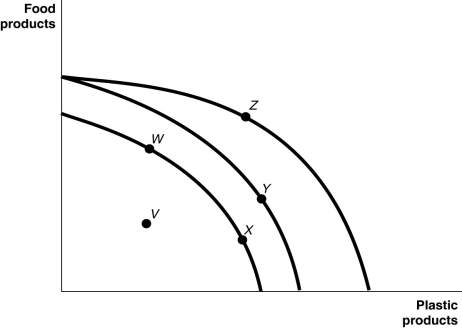 Figure 2-4 shows various points on three different production possibilities frontiers for a nation.
-Refer to Figure 2-4.Consider the following events: a.an increase in the unemployment rate
B.a decrease in a nation's money supply
C.a war that kills a significant portion of a nation's population
Which of the events listed above could cause a movement from Z to X?
Figure 2-4 shows various points on three different production possibilities frontiers for a nation.
-Refer to Figure 2-4.Consider the following events: a.an increase in the unemployment rate
B.a decrease in a nation's money supply
C.a war that kills a significant portion of a nation's population
Which of the events listed above could cause a movement from Z to X? (Multiple Choice)
4.8/5 (78)
(78) Suppose your expenses for this term are as follows: tuition: $28,000,room and board: $9,000,books and other educational supplies: $2,500.Further,during the term,you can only work part-time and earn $16,000 instead of your full-time salary of $42,000.What is the opportunity cost of going to college this term,assuming that your room and board expenses would be the same even if you did not go to college?
(Multiple Choice)
4.9/5 (79)
(79) Figure 2-18  -Refer to Figure 2-18.Which two arrows in the diagram depict the following transaction: Barney earns $250 for selling scissors and razors to Floyd's Barber Shop.
 (Multiple Choice)
4.9/5 (82)
(82) Figure 2-8 above shows the production possibilities frontier for Vidalia,a nation that produces two goods,roses and orchids.
-Refer to Figure 2-8.Suppose Vidalia is currently producing 20 dozen orchids per period.How many roses is it also producing,assuming that resources are fully utilized?
Figure 2-8 above shows the production possibilities frontier for Vidalia,a nation that produces two goods,roses and orchids.
-Refer to Figure 2-8.Suppose Vidalia is currently producing 20 dozen orchids per period.How many roses is it also producing,assuming that resources are fully utilized? (Multiple Choice)
4.9/5 (93)
(93) Sarita can bake either a combination of 25 cakes and 15 pies or a combination of 10 cakes and 20 pies.If she now bakes 10 cakes and 20 pies,what is the opportunity cost of baking an additional 15 cakes?
(Multiple Choice)
4.9/5 (76)
(76) The opportunity cost of going to an outdoor music festival is
(Multiple Choice)
4.9/5 (83)
(83) If you can produce more of something than others with the same resources,you have
(Multiple Choice)
4.9/5 (82)
(82)  Figure 2-11 shows the production possibilities frontiers for Pakistan and Indonesia.Each country produces two goods,cotton and cashews.
-Refer to Figure 2-11.Which country has a comparative advantage in the production of cashews?
Figure 2-11 shows the production possibilities frontiers for Pakistan and Indonesia.Each country produces two goods,cotton and cashews.
-Refer to Figure 2-11.Which country has a comparative advantage in the production of cashews? (Multiple Choice)
4.9/5 (89)
(89) 
Filters
- Essay(0)
- Multiple Choice(0)
- Short Answer(0)
- True False(0)
- Matching(0)