



 Chat with AI
Exam 2: Trade-Offs, comparative Advantage, and the Market System

Exam 1: Economics: Foundations and Models447 Questions
Exam 2: Trade-Offs, comparative Advantage, and the Market System492 Questions
Exam 3: Where Prices Come From: the Interaction of Demand and Supply476 Questions
Exam 4: Economic Efficiency, government Price Setting, and Taxes420 Questions
Exam 5: Externalities, environmental Policy, and Public Goods263 Questions
Exam 6: Elasticity: the Responsiveness of Demand and Supply294 Questions
Exam 7: The Economics of Health Care338 Questions
Exam 8: Firms,the Stock Market,and Corporate Governance522 Questions
Exam 9: Comparative Advantage and the Gains From International Trade377 Questions
Exam 10: Consumer Choice and Behavioral Economics300 Questions
Exam 11: Technology,production,and Costs327 Questions
Exam 12: Firms in Perfectly Competitive Markets296 Questions
Exam 13: Monopolistic Competition: the Competitive Model in a More Realistic Setting272 Questions
Exam 14: Oligopoly: Firms in Less Competitive Markets258 Questions
Exam 15: Monopoly and Antitrust Policy279 Questions
Exam 16: Pricing Strategy261 Questions
Exam 17: The Markets for Labor and Other Factors of Production281 Questions
Exam 18: Public Choice, taxes, and the Distribution of Income258 Questions
Exam 19: Gdp: Measuring Total Production and Income261 Questions
Exam 20: Unemployment and Inflation291 Questions
Exam 21: Economic Growth, the Financial System, and Business Cycles253 Questions
Exam 22: Long-Run Economic Growth: Sources and Policies262 Questions
Exam 23: Aggregate Expenditure and Output in the Short Run301 Questions
Exam 24: Aggregate Demand and Aggregate Supply Analysis286 Questions
Exam 25: Money,banks,and the Federal Reserve System281 Questions
Exam 26: Monetary Policy275 Questions
Exam 27: Fiscal Policy306 Questions
Exam 28: Inflation, unemployment, and Federal Reserve Policy257 Questions
Exam 29: Macroeconomics in an Open Economy278 Questions
Exam 30: The International Financial System258 Questions
Select questions type


Figure 2-15
 -Refer to Figure 2-15.In the circular flow diagram,market K represents
 (Multiple Choice)
4.9/5  (83)
(83) Bella can produce either a combination of 60 silk roses and 80 silk leaves or a combination of 70 silk roses and 55 silk leaves.If she now produces 60 silk roses and 80 silk leaves,what is the opportunity cost of producing an additional 10 silk roses?
(Multiple Choice)
4.9/5 (79)
(79) Figure 2-6 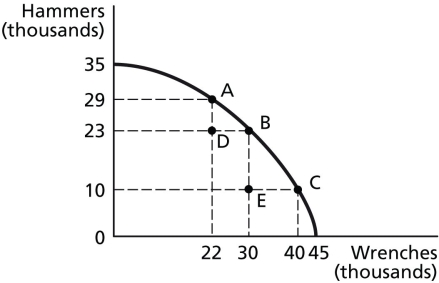 -Refer to Figure 2-6.If the economy is currently producing at point D,what is the opportunity cost of moving to point B?
 (Multiple Choice)
4.9/5 (66)
(66) In the circular flow model,households supply resources such as labor services in the factor market.
(True/False)
4.8/5 (83)
(83) One Motorcycle One Guitar Ireland 20 hours 4 hours Scotland 8 hours 2 hours Table 2-14 shows the number of labor hours required to produce a motorcycle and a guitar in Ireland and Scotland.
-Refer to Table 2-14.If the two countries specialize and trade,who should export motorcycles?
(Multiple Choice)
4.9/5 (69)
(69) Figure 2-18  -Refer to Figure 2-18.Which two arrows in the diagram depict the following transaction: Dorian Gray hires "Wild Oscar," a professional portrait artist,to paint his picture.
 (Multiple Choice)
4.8/5 (81)
(81) George Jack Lawns Mowed 10 6 Gardens Cultivated 5 4 Table 2-15 shows the output per day of two gardeners,George and Jack.They can either devote their time to mowing lawns or cultivating gardens.
-Refer to Table 2-15.What is Jack's opportunity cost of mowing a lawn?
(Multiple Choice)
4.8/5 (83)
(83) Table 2-1
Production choices for Tomaso's Trattoria
Choice Quantity of Pizzas Produced Quantity of Calzones Produced A 48 0 B 36 15 C 24 30 D 12 45 E 0 60
-Refer to Table 2-1.Assume Tomaso's Trattoria only produces pizzas and calzones.A combination of 36 pizzas and 30 calzones would appear
(Multiple Choice)
4.8/5 (76)
(76) The natural resources used in production are made available in the
(Multiple Choice)
4.8/5 (88)
(88)
One Cell Phone Lumber (per board foot) Estonia 40 hours 8 hours Finland 16 hours 4 hours Table 2-16 shows the number of labor hours required to produce a cell phone and a board foot of lumber in Estonia and Finland.
-Refer to Table 2-16.What is Estonia's opportunity cost of producing one cell phone?
(Multiple Choice)
4.9/5 (74)
(74) A major factor contributing to the slow growth rate of less-developed economies is
(Multiple Choice)
4.9/5 (74)
(74) The unattainable points in a production possibilities diagram are
(Multiple Choice)
4.9/5 (76)
(76) Identify whether each of the following transactions will take place in the factor market or in the product market:
a.Shondra buys a Harley-Davidson Softail motorcycle.
b.Aimee works 20 hours a week at a grocery store.
c.Gustavo sells a warehouse to a produce delivery company.
d.Ocean Spray increases employment at its Middleboro,Massachusetts plant.
(Essay)
4.8/5 (77)
(77) One Wristwatch Rice (per pound) Japan 50 hours 2 hours Thailand 30 hours 1.5 hours Table 2-20 shows the number of labor hours required to produce a wristwatch and a pound of rice in Japan and Thailand.
-Refer to Table 2-20.What is Japan's opportunity cost of producing one wristwatch?
(Multiple Choice)
4.7/5 (71)
(71)
One Cell Phone Lumber (per board foot) Estonia 40 hours 8 hours Finland 16 hours 4 hours Table 2-16 shows the number of labor hours required to produce a cell phone and a board foot of lumber in Estonia and Finland.
-Refer to Table 2-16.If the two countries specialize and trade,who should export cell phones?
(Multiple Choice)
4.8/5 (88)
(88) Which of the following is an example of spending on goods and services in the circular flow model?
(Multiple Choice)
4.8/5 (86)
(86) Fred Barney Pogo Sticks 24 28 Unicycles 8 14 Table 2-10 shows the output per month of two people,Fred and Barney.They can either devote their time to making pogo sticks or making unicycles.
-Refer to Table 2-10.What is Fred's opportunity cost of making a unicycle?
(Multiple Choice)
4.8/5 (73)
(73) 
Filters
- Essay(0)
- Multiple Choice(0)
- Short Answer(0)
- True False(0)
- Matching(0)