



 Chat with AI
Exam 10: Consumer Choice and Behavioral Economics

Exam 1: Economics: Foundations and Models447 Questions
Exam 2: Trade-Offs, comparative Advantage, and the Market System492 Questions
Exam 3: Where Prices Come From: the Interaction of Demand and Supply476 Questions
Exam 4: Economic Efficiency, government Price Setting, and Taxes420 Questions
Exam 5: Externalities, environmental Policy, and Public Goods263 Questions
Exam 6: Elasticity: the Responsiveness of Demand and Supply294 Questions
Exam 7: The Economics of Health Care338 Questions
Exam 8: Firms,the Stock Market,and Corporate Governance522 Questions
Exam 9: Comparative Advantage and the Gains From International Trade377 Questions
Exam 10: Consumer Choice and Behavioral Economics300 Questions
Exam 11: Technology,production,and Costs327 Questions
Exam 12: Firms in Perfectly Competitive Markets296 Questions
Exam 13: Monopolistic Competition: the Competitive Model in a More Realistic Setting272 Questions
Exam 14: Oligopoly: Firms in Less Competitive Markets258 Questions
Exam 15: Monopoly and Antitrust Policy279 Questions
Exam 16: Pricing Strategy261 Questions
Exam 17: The Markets for Labor and Other Factors of Production281 Questions
Exam 18: Public Choice, taxes, and the Distribution of Income258 Questions
Exam 19: Gdp: Measuring Total Production and Income261 Questions
Exam 20: Unemployment and Inflation291 Questions
Exam 21: Economic Growth, the Financial System, and Business Cycles253 Questions
Exam 22: Long-Run Economic Growth: Sources and Policies262 Questions
Exam 23: Aggregate Expenditure and Output in the Short Run301 Questions
Exam 24: Aggregate Demand and Aggregate Supply Analysis286 Questions
Exam 25: Money,banks,and the Federal Reserve System281 Questions
Exam 26: Monetary Policy275 Questions
Exam 27: Fiscal Policy306 Questions
Exam 28: Inflation, unemployment, and Federal Reserve Policy257 Questions
Exam 29: Macroeconomics in an Open Economy278 Questions
Exam 30: The International Financial System258 Questions
Select questions type


Quantity of Soup (cups) Total Utility Quantity of Sandwiches Total Utility 1 40 1 45 2 60 2 75 3 72 3 102 4 82 4 120 5 88 5 135 6 90 6 145 Table 10-2 above shows Keira's utility from soup and sandwiches.The price of soup is $2 per cup and the price of a sandwich is $3.Keira has $18 to spend on these two goods.
-Refer to Table 10-2.Holding prices constant,when Keira's income changed from $18 to $23,her utility maximizing bundle changed.Based on your answers to her optimal choices at the two income levels,what type of goods are soup and sandwiches?
(Multiple Choice)
4.9/5  (80)
(80) Figure 10-1 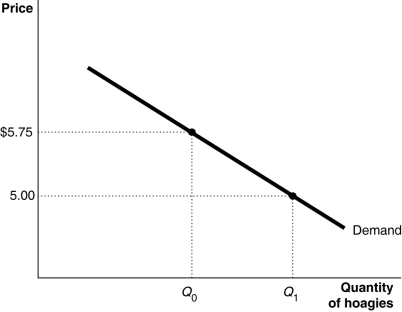 -Refer to Figure 10-1.When the price of hoagies increases from $5.00 to $5.75,quantity demanded decreases from Q1 to Q0.This change in quantity demanded is due to
 (Multiple Choice)
4.8/5 (82)
(82) Terence has $50 per week to spend on Subway sandwiches and milkshakes.The price of a Subway sandwich is $5 and the price of a milkshake is $4.He buys 6 sandwiches and 5 milkshakes.The marginal utility of the 6th sandwich = 25 and the marginal utility of the 5th milkshake = 24.Which of the following is true?
(Multiple Choice)
4.9/5 (86)
(86) A curve that shows combinations of consumption bundles that give a consumer the same utility is called
(Multiple Choice)
4.9/5 (83)
(83) If by purchasing more apples and fewer oranges you increase your total utility,then apples must be cheaper than oranges.
(True/False)
4.7/5 (83)
(83) What did economists Robert Jensen and Nolan Miller determine must be true for a good to be a Giffen good,where the income effect is larger than its substitution effect?
(Essay)
4.9/5 (76)
(76) Which of the following statements describes economists' attitudes regarding the influence of social factors on the choices consumers make?
(Multiple Choice)
4.7/5 (71)
(71) Figure 10-6  The above panels show various combinations of indifference curves and budget constraints for two products: Popcorn and Candy.
-Refer to Figure 10-6.A change in the price of candy only is shown in
The above panels show various combinations of indifference curves and budget constraints for two products: Popcorn and Candy.
-Refer to Figure 10-6.A change in the price of candy only is shown in (Multiple Choice)
5.0/5 (78)
(78) A consumer's utility-maximizing combination of goods is given by the bundle that corresponds to the highest point on his indifference curve.
(True/False)
4.9/5 (90)
(90) Wilbur Rickhiser,a financial advisor,recently told one of his clients: "The biggest mistake you can make is to hold onto a stock for too long in order to avoid a loss.Let's say you bought a stock for $50 per share but that six months later the price fell to $40 after a poor earnings report.Many of my clients in this situation will hold the stock,hoping the price will later rise above $50.In most cases like this the price does not rise and may even fall.You must know when to cut your losses." Which of the following is the best explanation for Rickhiser's advice?
(Multiple Choice)
4.8/5 (91)
(91) Maurice Allais,Reinhard Selten,and Vernon Smith all were awarded the Nobel Prize in Economics in part because
(Multiple Choice)
4.8/5 (73)
(73) Article Summary
The use of celebrities to endorse products remains a popular way for many companies to attract customers and keep their products relevant to their customers.The article discusses five factors that must be examined by a company when choosing a celebrity to endorse its product:
1.The cost of a superstar versus the value of a rising star
2.Finding a good fit between the celebrity and the image of the brand
3.Choosing someone who will promote the brand
4.Identifying valid metrics to measure success
5.The future appeal of the celebrity
Carefully chosen celebrity endorsements have proven to influence customers and enhance a brand's reputation,but as the list indicates,not all celebrities are the right fit for all products.
-Refer to the Article Summary.One explanation for the increase in product sales because of celebrity endorsements is that people seem to receive ________ from goods they believe are popular.
(Multiple Choice)
4.9/5 (79)
(79) Figure 10-8  -Refer to Figure 10-8.If the price of biscotti is $1.50 and the price of a cappuccino is $3.00,what is the slope of the budget constraint?
 (Multiple Choice)
5.0/5 (70)
(70) Suppose the consumer's income increases while the prices of the goods remain constant.Then the
(Multiple Choice)
4.9/5 (89)
(89) Figure 10-4 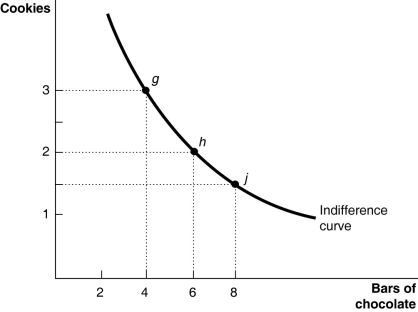 -Refer to Figure 10-4.What is the marginal rate of substitution for one bar of chocolate between h and j?
 (Multiple Choice)
4.8/5 (81)
(81) 
Filters
- Essay(0)
- Multiple Choice(0)
- Short Answer(0)
- True False(0)
- Matching(0)