



 Chat with AI
Exam 10: Consumer Choice and Behavioral Economics

Exam 1: Economics: Foundations and Models447 Questions
Exam 2: Trade-Offs, comparative Advantage, and the Market System492 Questions
Exam 3: Where Prices Come From: the Interaction of Demand and Supply476 Questions
Exam 4: Economic Efficiency, government Price Setting, and Taxes420 Questions
Exam 5: Externalities, environmental Policy, and Public Goods263 Questions
Exam 6: Elasticity: the Responsiveness of Demand and Supply294 Questions
Exam 7: The Economics of Health Care338 Questions
Exam 8: Firms,the Stock Market,and Corporate Governance522 Questions
Exam 9: Comparative Advantage and the Gains From International Trade377 Questions
Exam 10: Consumer Choice and Behavioral Economics300 Questions
Exam 11: Technology,production,and Costs327 Questions
Exam 12: Firms in Perfectly Competitive Markets296 Questions
Exam 13: Monopolistic Competition: the Competitive Model in a More Realistic Setting272 Questions
Exam 14: Oligopoly: Firms in Less Competitive Markets258 Questions
Exam 15: Monopoly and Antitrust Policy279 Questions
Exam 16: Pricing Strategy261 Questions
Exam 17: The Markets for Labor and Other Factors of Production281 Questions
Exam 18: Public Choice, taxes, and the Distribution of Income258 Questions
Exam 19: Gdp: Measuring Total Production and Income261 Questions
Exam 20: Unemployment and Inflation291 Questions
Exam 21: Economic Growth, the Financial System, and Business Cycles253 Questions
Exam 22: Long-Run Economic Growth: Sources and Policies262 Questions
Exam 23: Aggregate Expenditure and Output in the Short Run301 Questions
Exam 24: Aggregate Demand and Aggregate Supply Analysis286 Questions
Exam 25: Money,banks,and the Federal Reserve System281 Questions
Exam 26: Monetary Policy275 Questions
Exam 27: Fiscal Policy306 Questions
Exam 28: Inflation, unemployment, and Federal Reserve Policy257 Questions
Exam 29: Macroeconomics in an Open Economy278 Questions
Exam 30: The International Financial System258 Questions
Select questions type


When the price of summer tank tops falls and you buy more of them because they are relatively less expensive,this is called
(Multiple Choice)
4.8/5  (67)
(67) A network externality refers to a situation in which the usefulness of a product decreases with the number of consumers who use it.
(True/False)
4.8/5 (82)
(82) The observation that people tend to value something more highly when they own it than when they don't is called the
(Multiple Choice)
4.9/5 (75)
(75) Arnie Ziffel has $20 per week to spend on any combination of pineapples and green tea.The price of a pineapple is $4 and the price of a bottle of green tea is $2.The table below shows Arnie's utility values.Use the table to answer the questions that follow the table.
Marginal Quantity Marginal Quantity of Total Marginal Utility per of Green Total Marginal Utility per Pineapples Utility Utility Dollar Tea Utility Utility Dollar 1 32 1 28 2 52 2 46 3 64 3 54 4 68 4 60 5 70 5 64 6 71 6 66 7 71 7 67
a.Complete the table by filling in the blank spaces.
b.Suppose Arnold purchases 4 pineapples and 2 bottles of green tea.Is he consuming the optimal consumption bundle? If so,explain why.If not,what combination should he buy and why?
(Essay)
4.9/5 (82)
(82) The demand curve for corn is downward sloping.If the price of corn,an inferior good,falls,then
(Multiple Choice)
4.9/5 (74)
(74) The French Bakery ran a special which decreased the price of its croissants from $1.50 to $1.00.Although her money income had not changed,Toni decided to buy 2 croissants instead of her usual 1 bagel and 1 croissant.Toni's actions are explained by which of the following?
(Multiple Choice)
4.9/5 (81)
(81) A study discussed in the Making the Connection feature in the text found that there is ________ that some consumers are not well aware of prices,even for goods they buy regularly.
(Multiple Choice)
4.8/5 (81)
(81) Figure 10-1 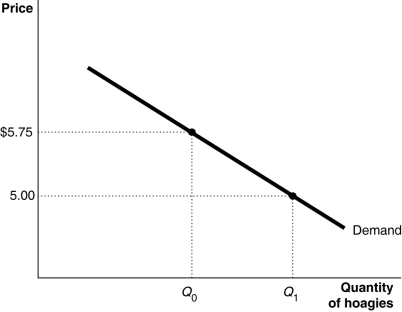 -Refer to Figure 10-1.Which of the following statements is true?
 (Multiple Choice)
4.7/5 (82)
(82) Suppose Joe is maximizing total utility within his budget constraint.If the price of the last pair of jeans purchased is $25 and it yields 100 units of extra satisfaction and the price of the last shirt purchased is $20,then,using the rule of equal marginal utility per dollar spent,the extra satisfaction received from the last shirt must be
(Multiple Choice)
4.8/5 (75)
(75) An increase in income results in an outward shift of an indifference curve.
(True/False)
4.8/5 (66)
(66) The income effect of a decrease in the price of legal services,a normal good,results in
(Multiple Choice)
4.9/5 (86)
(86) Figure 10-6  The above panels show various combinations of indifference curves and budget constraints for two products: Popcorn and Candy.
-Refer to Figure 10-6.Which diagram demonstrates an increase in total utility following a decrease in the price of popcorn?
The above panels show various combinations of indifference curves and budget constraints for two products: Popcorn and Candy.
-Refer to Figure 10-6.Which diagram demonstrates an increase in total utility following a decrease in the price of popcorn? (Multiple Choice)
4.8/5 (78)
(78) Figure 10-6 The above panels show various combinations of indifference curves and budget constraints for two products: Popcorn and Candy.
-Refer to Figure 10-6.A change in income is shown in
The above panels show various combinations of indifference curves and budget constraints for two products: Popcorn and Candy.
-Refer to Figure 10-6.A change in income is shown in (Multiple Choice)
4.8/5 (78)
(78) Quantity of Beer (glasses) Total Utility Quantity of Pizza (slices) Total Utility 1 25 1 20 2 45 2 35 3 60 3 45 4 65 4 50 5 69 5 52 6 70 6 52 Table 10-7 shows Antonio's utility from beer and pizza.
-Refer to Table 10-7.Suppose Antonio has $10 to spend and the price of beer = $2 per glass and the price of pizza = $2 per slice.How many of each good will he consume when he maximizes his utility?
(Multiple Choice)
4.8/5 (91)
(91) The limitation that a consumer's total expenditure on goods and services purchased cannot exceed the income available is referred to as
(Multiple Choice)
4.7/5 (72)
(72) Which of the following is likely to occur as the result of the law of diminishing marginal utility?
(Multiple Choice)
4.8/5 (66)
(66) If marginal utility of apples is diminishing and is a positive amount,consuming one more apple will cause
(Multiple Choice)
4.8/5 (78)
(78) 
Filters
- Essay(0)
- Multiple Choice(0)
- Short Answer(0)
- True False(0)
- Matching(0)