



 Chat with AI
Exam 10: Consumer Choice and Behavioral Economics

Exam 1: Economics: Foundations and Models447 Questions
Exam 2: Trade-Offs, comparative Advantage, and the Market System492 Questions
Exam 3: Where Prices Come From: the Interaction of Demand and Supply476 Questions
Exam 4: Economic Efficiency, government Price Setting, and Taxes420 Questions
Exam 5: Externalities, environmental Policy, and Public Goods263 Questions
Exam 6: Elasticity: the Responsiveness of Demand and Supply294 Questions
Exam 7: The Economics of Health Care338 Questions
Exam 8: Firms,the Stock Market,and Corporate Governance522 Questions
Exam 9: Comparative Advantage and the Gains From International Trade377 Questions
Exam 10: Consumer Choice and Behavioral Economics300 Questions
Exam 11: Technology,production,and Costs327 Questions
Exam 12: Firms in Perfectly Competitive Markets296 Questions
Exam 13: Monopolistic Competition: the Competitive Model in a More Realistic Setting272 Questions
Exam 14: Oligopoly: Firms in Less Competitive Markets258 Questions
Exam 15: Monopoly and Antitrust Policy279 Questions
Exam 16: Pricing Strategy261 Questions
Exam 17: The Markets for Labor and Other Factors of Production281 Questions
Exam 18: Public Choice, taxes, and the Distribution of Income258 Questions
Exam 19: Gdp: Measuring Total Production and Income261 Questions
Exam 20: Unemployment and Inflation291 Questions
Exam 21: Economic Growth, the Financial System, and Business Cycles253 Questions
Exam 22: Long-Run Economic Growth: Sources and Policies262 Questions
Exam 23: Aggregate Expenditure and Output in the Short Run301 Questions
Exam 24: Aggregate Demand and Aggregate Supply Analysis286 Questions
Exam 25: Money,banks,and the Federal Reserve System281 Questions
Exam 26: Monetary Policy275 Questions
Exam 27: Fiscal Policy306 Questions
Exam 28: Inflation, unemployment, and Federal Reserve Policy257 Questions
Exam 29: Macroeconomics in an Open Economy278 Questions
Exam 30: The International Financial System258 Questions
Select questions type


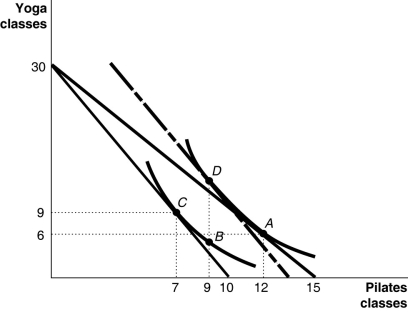 Manuri has $300 to spend on Pilates classes and Yoga classes.The price of a group Pilates class is $20 and the price of a group Yoga class is $10.Manuri's optimal bundle is given by "A" in Figure 10-7.
-Refer to Figure 10-7.Suppose the price of Pilates sessions rise to $30 while income and the price of Yoga sessions remain unchanged.The substitution effect of this price change is represented by the movement from
Manuri has $300 to spend on Pilates classes and Yoga classes.The price of a group Pilates class is $20 and the price of a group Yoga class is $10.Manuri's optimal bundle is given by "A" in Figure 10-7.
-Refer to Figure 10-7.Suppose the price of Pilates sessions rise to $30 while income and the price of Yoga sessions remain unchanged.The substitution effect of this price change is represented by the movement from (Multiple Choice)
4.8/5  (74)
(74) The income effect of a decrease in the price of macaroni and cheese (assume this is an inferior good)results in
(Multiple Choice)
4.7/5 (82)
(82) Marv Pilson has $50 worth of groceries in a shopping cart at his local Shop 'n Save.Assume that the marginal utility per dollar of the liter bottles of soft drink in Marv's cart equals 50.The marginal utility per dollar of the boxes of cereal in Marv's cart equals 20.Marv has only $50 to spend,but has not yet paid for his groceries.How can Marv increase his total utility without spending more than $50?
(Multiple Choice)
4.9/5 (83)
(83) Psychologists Daniel Kahneman and Amos Tversky conducted the following experiments by asking a sample of people the following questions: Scenario A: "Imagine that you have decided to see a play and paid the admission price of $10 per ticket.As you enter the theater you discover that you have lost the ticket.The seat was not marked and the ticket cannot be recovered.Would you pay $10 for another ticket?"
Scenario B: "Imagine that you have decided to see a play where admission is $10 per ticket.As you enter the theater you discover that you have lost a $10 bill.Would you still pay $10 for a ticket for the play?"
As long as additional tickets are available,there's no meaningful difference between losing $10 in cash before buying a ticket,and losing the $10 ticket after buying it.In both cases,you are out $10.Yet,far more subjects (88 percent)in Scenario B say they would pay $10 for another ticket and see the play while in Scenario A,only 46 percent of the subjects say they would be willing to spend another $10 to see the play.
Which of the following is the best explanation for the results of the experiment?
(Multiple Choice)
4.9/5 (80)
(80) Which of the following is a common mistake made by consumers?
(Multiple Choice)
4.9/5 (72)
(72) What is the common feature displayed by the following items?
A.eating in a newly opened "fusion" cuisine restaurant
B.attending a Red Sox game in Fenway Park
C.wearing Lucky Brand designer jeans
(Multiple Choice)
4.7/5 (75)
(75) Consider a downward-sloping demand curve.When the price of an inferior good decreases,the income and substitution effects
(Multiple Choice)
4.8/5 (77)
(77) Adhira buys chocolates and almonds.She has 3 bars of chocolates and 4 bags of almonds.The marginal utility of the third chocolate bar is 18 units of utility and the marginal utility from the fourth bag of almonds is also 18.Is Adhira maximizing her utility?
(Multiple Choice)
4.9/5 (79)
(79) Some online penny auctions charge a fee,such as $1,for every bid placed.Why should these costs of $1 per bid be considered sunk costs? Would it be smart for someone who has "already invested $5 in bidding costs" to keep bidding to "protect his or her sunk investments"? Why or why not?
(Essay)
4.9/5 (83)
(83) Goods with upward sloping demand curves are referred to as
(Multiple Choice)
4.8/5 (88)
(88) Results of the ultimatum game indicate that most people value fairness enough that they will refuse to participate in a transaction they consider unfair,even if they are worse off financially as a result.
(True/False)
4.8/5 (89)
(89) Some economists have argued that path dependence and switching costs can lead to market failure.Which of the following is an example of this argument?
(Multiple Choice)
4.8/5 (64)
(64) Quantity of Soup (cups) Total Utility Quantity of Sandwiches Total Utility 1 40 1 45 2 60 2 75 3 72 3 102 4 82 4 120 5 88 5 135 6 90 6 145 Table 10-2 above shows Keira's utility from soup and sandwiches.The price of soup is $2 per cup and the price of a sandwich is $3.Keira has $18 to spend on these two goods.
-Refer to Table 10-2.Suppose Keira's income increases from $18 to $23 but prices have not changed.What is her utility maximizing bundle now?
(Multiple Choice)
4.7/5 (87)
(87) If,when you consume another piece of candy,your marginal utility is zero,then
(Multiple Choice)
4.8/5 (58)
(58) Figure 10-5  -Refer to Figure 10-5.Which of the following statements is true?
 (Multiple Choice)
4.8/5 (89)
(89) Assume that Anne has $300 to spend on DVDs and CDs.Her optimal consumption of DVDs and CDs is illustrated by a tangency between a budget line and an indifference curve.Now assume that the price of CDs rises but the price of DVDs falls.How can you show that Anne is made better off by these price changes?
(Multiple Choice)
4.9/5 (78)
(78) Figure 10-5
-Refer to Figure 10-5.The consumer can afford consumption bundles
-Refer to Figure 10-5.The consumer can afford consumption bundles (Multiple Choice)
4.9/5 (80)
(80) In a survey of consumers,Daniel Kahneman,Jack Knetsch and Richard Thaler asked their opinion of a hardware store's decision to
(Multiple Choice)
4.8/5 (80)
(80) 
Filters
- Essay(0)
- Multiple Choice(0)
- Short Answer(0)
- True False(0)
- Matching(0)