



 Chat with AI
Exam 26: Monetary Policy

Exam 1: Economics: Foundations and Models447 Questions
Exam 2: Trade-Offs, comparative Advantage, and the Market System492 Questions
Exam 3: Where Prices Come From: the Interaction of Demand and Supply476 Questions
Exam 4: Economic Efficiency, government Price Setting, and Taxes420 Questions
Exam 5: Externalities, environmental Policy, and Public Goods263 Questions
Exam 6: Elasticity: the Responsiveness of Demand and Supply294 Questions
Exam 7: The Economics of Health Care338 Questions
Exam 8: Firms,the Stock Market,and Corporate Governance522 Questions
Exam 9: Comparative Advantage and the Gains From International Trade377 Questions
Exam 10: Consumer Choice and Behavioral Economics300 Questions
Exam 11: Technology,production,and Costs327 Questions
Exam 12: Firms in Perfectly Competitive Markets296 Questions
Exam 13: Monopolistic Competition: the Competitive Model in a More Realistic Setting272 Questions
Exam 14: Oligopoly: Firms in Less Competitive Markets258 Questions
Exam 15: Monopoly and Antitrust Policy279 Questions
Exam 16: Pricing Strategy261 Questions
Exam 17: The Markets for Labor and Other Factors of Production281 Questions
Exam 18: Public Choice, taxes, and the Distribution of Income258 Questions
Exam 19: Gdp: Measuring Total Production and Income261 Questions
Exam 20: Unemployment and Inflation291 Questions
Exam 21: Economic Growth, the Financial System, and Business Cycles253 Questions
Exam 22: Long-Run Economic Growth: Sources and Policies262 Questions
Exam 23: Aggregate Expenditure and Output in the Short Run301 Questions
Exam 24: Aggregate Demand and Aggregate Supply Analysis286 Questions
Exam 25: Money,banks,and the Federal Reserve System281 Questions
Exam 26: Monetary Policy275 Questions
Exam 27: Fiscal Policy306 Questions
Exam 28: Inflation, unemployment, and Federal Reserve Policy257 Questions
Exam 29: Macroeconomics in an Open Economy278 Questions
Exam 30: The International Financial System258 Questions
Select questions type


Expansionary monetary policy refers to the Fed's increasing the money supply and increasing interest rates to increase real GDP.
(True/False)
4.9/5  (86)
(86) Rising nominal GDP will increase the demand for money and short-term interest rates.
(True/False)
4.8/5 (80)
(80) A decrease in interest rates can ________ the demand for stocks as stocks become relatively ________ attractive investments as compared to bonds.
(Multiple Choice)
4.9/5 (83)
(83) Suppose that the economy is producing below potential GDP and the Fed implements the correct change in monetary policy,but not until after the economy has passed the trough of the recession.Then
(Multiple Choice)
4.9/5 (71)
(71) Most of the pressure for a monetary growth rule has disappeared because since 1980
(Multiple Choice)
4.9/5 (79)
(79) Suppose you buy a house for $250,000.One year later,the market price for the house has fallen to $200,000.What is the return on your investment in the house if you made a down payment of 10 percent and took out a mortgage loan for the other 90 percent?
(Essay)
4.9/5 (77)
(77) Which of the following is true about the Federal Reserve and its ability to prevent recessions? The Federal Reserve
(Multiple Choice)
4.7/5 (78)
(78) Under the monetary growth rule proposed by the monetarists,the money supply would grow each year at a constant rate equal to the long-run rate of growth of
(Multiple Choice)
4.8/5 (74)
(74) Figure 26-3 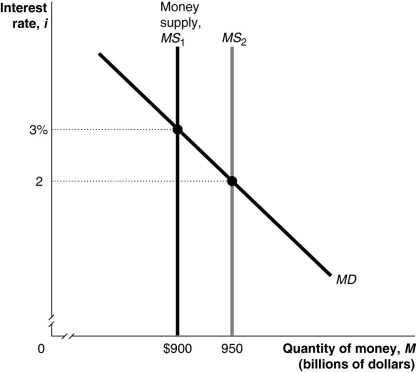 -Refer to Figure 26-3.In the figure above,when the money supply shifts from MS1 to MS2,at the interest rate of 3 percent households and firms will
 (Multiple Choice)
4.8/5 (77)
(77) Maintaining a strong dollar in international currency markets is not one of the four monetary policy goals of the Fed listed in the textbook.
(True/False)
4.8/5 (77)
(77) According to the Taylor rule,does the target for the federal funds rate respond differently for an increase in inflation caused by an increase in aggregate demand and for an increase in inflation caused by a decrease in short-run aggregate supply? Explain whether there is or is not a difference in how the target for the federal funds rate changes.
(Essay)
4.8/5 (87)
(87) Write out the expression for the Taylor rule.Use the Taylor rule to explain how a decline in real GDP below potential GDP will affect the Federal Reserve's target for the federal funds rate.
(Essay)
4.8/5 (64)
(64) Table 26-8
Year Potential Real GDP Real GDP Price Level 2013 \ 13.5 trillion \ 13.5 trillion 142 2014 14.0 trillion 14.4 trillion 150
-Refer to Table 26-8.The hypothetical information in the table shows what the values for real GDP and the price level would have been in 2014 if the Federal Reserve did not use monetary policy:
a.If the Fed wanted to keep real GDP at its potential level in 2014,should it have used an expansionary policy or a contractionary policy? Should the trading desk have bought T-bills or sold them?
b.Suppose the Fed's policy was successful in keeping real GDP at its potential level in 2014.State whether each of the following would be higher or lower than if the Fed had taken no action:
(i)Real GDP
(ii)Full-employment real GDP
(iii)The inflation rate
(iv)The unemployment rate
c.Draw an aggregate demand and aggregate supply graph to illustrate your answer.Be sure that your graph contains LRAS curves for 2013 and 2014;SRAS curves 2013 and 2014;AD curve for 2013 and 2014,with and without monetary policy actions;and equilibrium real GDP and the price level in 2014 with and without policy.
(Essay)
4.9/5 (86)
(86) Firms that participate in regular open market transactions with ________ are called primary dealers.
(Multiple Choice)
5.0/5 (75)
(75) If the amount you owe on your house is less than the price of the house,you have
(Multiple Choice)
4.8/5 (73)
(73) According to the Taylor rule,the Fed should set the target for the federal funds rate equal to the sum of the equilibrium real federal funds rate,the current inflation rate,one-half times the ________,and one-half times the ________.
(Multiple Choice)
5.0/5 (87)
(87) Monetary policy could be procyclical if the Federal Reserve
(Multiple Choice)
4.9/5 (77)
(77) The Federal Reserve responded to the 2008 financial crisis in several ways.Which of the following is not one of the ways the Fed responded?
(Multiple Choice)
4.8/5 (66)
(66) 
Filters
- Essay(0)
- Multiple Choice(0)
- Short Answer(0)
- True False(0)
- Matching(0)