



 Chat with AI
Exam 26: Monetary Policy

Exam 1: Economics: Foundations and Models447 Questions
Exam 2: Trade-Offs, comparative Advantage, and the Market System492 Questions
Exam 3: Where Prices Come From: the Interaction of Demand and Supply476 Questions
Exam 4: Economic Efficiency, government Price Setting, and Taxes420 Questions
Exam 5: Externalities, environmental Policy, and Public Goods263 Questions
Exam 6: Elasticity: the Responsiveness of Demand and Supply294 Questions
Exam 7: The Economics of Health Care338 Questions
Exam 8: Firms,the Stock Market,and Corporate Governance522 Questions
Exam 9: Comparative Advantage and the Gains From International Trade377 Questions
Exam 10: Consumer Choice and Behavioral Economics300 Questions
Exam 11: Technology,production,and Costs327 Questions
Exam 12: Firms in Perfectly Competitive Markets296 Questions
Exam 13: Monopolistic Competition: the Competitive Model in a More Realistic Setting272 Questions
Exam 14: Oligopoly: Firms in Less Competitive Markets258 Questions
Exam 15: Monopoly and Antitrust Policy279 Questions
Exam 16: Pricing Strategy261 Questions
Exam 17: The Markets for Labor and Other Factors of Production281 Questions
Exam 18: Public Choice, taxes, and the Distribution of Income258 Questions
Exam 19: Gdp: Measuring Total Production and Income261 Questions
Exam 20: Unemployment and Inflation291 Questions
Exam 21: Economic Growth, the Financial System, and Business Cycles253 Questions
Exam 22: Long-Run Economic Growth: Sources and Policies262 Questions
Exam 23: Aggregate Expenditure and Output in the Short Run301 Questions
Exam 24: Aggregate Demand and Aggregate Supply Analysis286 Questions
Exam 25: Money,banks,and the Federal Reserve System281 Questions
Exam 26: Monetary Policy275 Questions
Exam 27: Fiscal Policy306 Questions
Exam 28: Inflation, unemployment, and Federal Reserve Policy257 Questions
Exam 29: Macroeconomics in an Open Economy278 Questions
Exam 30: The International Financial System258 Questions
Select questions type


An argument in favor of the Federal Reserve adopting inflation targeting is that in the long run,the Fed can have an impact on inflation but not on real GDP.
(True/False)
4.9/5  (87)
(87) Figure 26-6 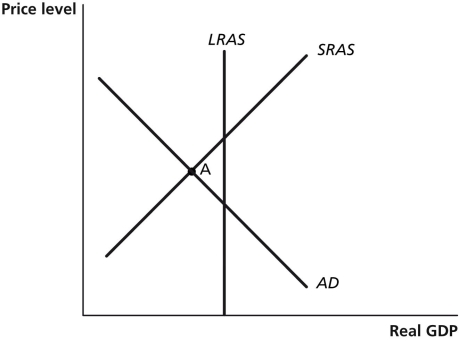 -Refer to Figure 26-6.In the figure above,if the economy is at point A,the appropriate monetary policy by the Federal Reserve would be to
 (Multiple Choice)
4.9/5 (77)
(77) Which of the following would most likely induce the Federal Reserve to conduct expansionary monetary policy? A significant decrease in
(Multiple Choice)
4.8/5 (77)
(77) Figure 26-4 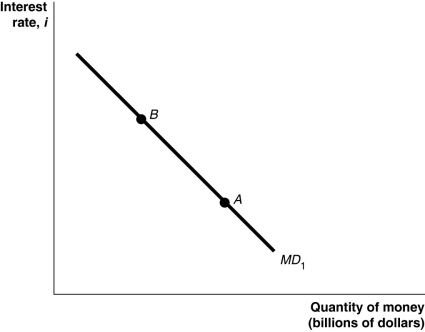 -Refer to Figure 26-4.In the figure above,a movement from point A to point B would be caused by
 (Multiple Choice)
4.8/5 (90)
(90) Figure 26-11 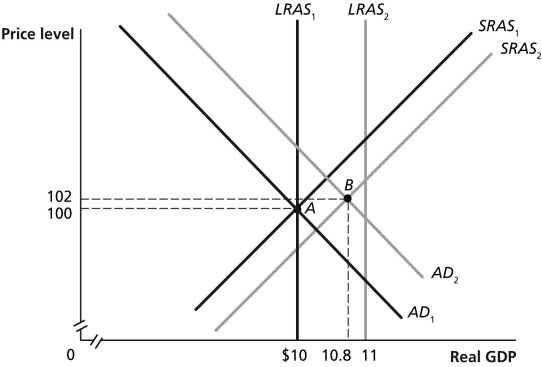 -Refer to Figure 26-11.In the dynamic model of AD-AS in the figure above,if the economy is at point A in year 1 and is expected to go to point B in year 2,the Federal Reserve would most likely
 (Multiple Choice)
4.9/5 (78)
(78) Table 26-1
Year Potential Real GDP Real GDP Price Level 2016 \ 18.2 trillion \ 18.2 trillion 145 2017 18.6 trillion 18.5 trillion 147
-Refer to Table 26-1.The hypothetical information in the table shows what the values for real GDP and the price level will be in 2017 if the Fed does not use monetary policy.Which of the following policies makes sense if the Fed wants to keep real GDP at its potential level in 2017?
(Multiple Choice)
4.7/5 (75)
(75) Expansionary monetary policy to prevent real GDP from falling below potential real GDP would cause the inflation rate to be relatively ________ and real GDP to be relatively ________.
(Multiple Choice)
4.9/5 (77)
(77) The money market model is concerned with ________ and the loanable funds market model is concerned with ________.
(Multiple Choice)
4.7/5 (72)
(72) When the price of a financial asset ________ its interest rate will ________.
(Multiple Choice)
4.8/5 (79)
(79) Use the dynamic aggregate demand and aggregate supply model and start with Year 1 in long-run macroeconomic equilibrium.For Year 2,graph aggregate demand,long-run aggregate supply,and short-run aggregate supply such that the condition of the economy will induce the Federal Reserve to conduct a contractionary monetary policy.Briefly explain the condition of the economy and what the Federal Reserve is attempting to do.
(Essay)
4.9/5 (89)
(89) With the Troubled Asset Relief Program (TARP),the Treasury provided funds to banks in exchange for stock.
(True/False)
4.8/5 (93)
(93) The dynamic aggregate demand and aggregate supply model accounts for the price level rising every year.
(True/False)
4.9/5 (83)
(83) Using the Taylor rule,if the current inflation rate equals the target inflation rate and real GDP is greater than potential GDP,then the federal funds target rate ________ the sum of the current inflation rate plus the real equilibrium federal funds rate.
(Multiple Choice)
4.7/5 (82)
(82) An increase in the domestic interest rate relative to other interest rates should
(Multiple Choice)
4.9/5 (60)
(60) The body that is responsible for dating the beginning and ending dates for a recession is
(Multiple Choice)
4.8/5 (89)
(89) The Federal Reserve's two main ________ are the money supply and the interest rate.
(Multiple Choice)
4.7/5 (87)
(87) Figure 26-11
-Refer to Figure 26-11.In the dynamic model of AD-AS in the figure above,if the economy is at point A in year 1 and is expected to go to point B in year 2,and the Federal Reserve pursues no policy,then at point B
-Refer to Figure 26-11.In the dynamic model of AD-AS in the figure above,if the economy is at point A in year 1 and is expected to go to point B in year 2,and the Federal Reserve pursues no policy,then at point B (Multiple Choice)
4.7/5 (84)
(84) Article Summary
Concerned about low inflation,Federal Reserve Bank of Minneapolis President Narayana Kocherlakota said the Fed needed a more aggressive stimulus policy than the setting of near-zero interest rates,and added that negative interest rates could be an effective policy tool.In a September 2015 interview,Kocherlakota stated "Given the inflation outlook,given how low inflation is expected to be,to ensure the credibility of our inflation target,taking a more accommodative stance in September would have been totally justified." While the Federal Open Market Committee chose to hold rates near zero in their September 2015 meeting,Fed Chair Janet Yellen announced that a rate increase would be warranted by the end of the year,and that "negative interest rates was not something that we considered very seriously at all today."
-Refer to the Article Summary.Implementing a negative interest rate policy,as was advocated by the president of the Federal Reserve Bank of Minneapolis,would be an example of ________ monetary policy designed to ________ aggregate demand.
(Multiple Choice)
4.8/5 (72)
(72) 
Filters
- Essay(0)
- Multiple Choice(0)
- Short Answer(0)
- True False(0)
- Matching(0)