



 Chat with AI
Exam 26: Monetary Policy

Exam 1: Economics: Foundations and Models447 Questions
Exam 2: Trade-Offs, comparative Advantage, and the Market System492 Questions
Exam 3: Where Prices Come From: the Interaction of Demand and Supply476 Questions
Exam 4: Economic Efficiency, government Price Setting, and Taxes420 Questions
Exam 5: Externalities, environmental Policy, and Public Goods263 Questions
Exam 6: Elasticity: the Responsiveness of Demand and Supply294 Questions
Exam 7: The Economics of Health Care338 Questions
Exam 8: Firms,the Stock Market,and Corporate Governance522 Questions
Exam 9: Comparative Advantage and the Gains From International Trade377 Questions
Exam 10: Consumer Choice and Behavioral Economics300 Questions
Exam 11: Technology,production,and Costs327 Questions
Exam 12: Firms in Perfectly Competitive Markets296 Questions
Exam 13: Monopolistic Competition: the Competitive Model in a More Realistic Setting272 Questions
Exam 14: Oligopoly: Firms in Less Competitive Markets258 Questions
Exam 15: Monopoly and Antitrust Policy279 Questions
Exam 16: Pricing Strategy261 Questions
Exam 17: The Markets for Labor and Other Factors of Production281 Questions
Exam 18: Public Choice, taxes, and the Distribution of Income258 Questions
Exam 19: Gdp: Measuring Total Production and Income261 Questions
Exam 20: Unemployment and Inflation291 Questions
Exam 21: Economic Growth, the Financial System, and Business Cycles253 Questions
Exam 22: Long-Run Economic Growth: Sources and Policies262 Questions
Exam 23: Aggregate Expenditure and Output in the Short Run301 Questions
Exam 24: Aggregate Demand and Aggregate Supply Analysis286 Questions
Exam 25: Money,banks,and the Federal Reserve System281 Questions
Exam 26: Monetary Policy275 Questions
Exam 27: Fiscal Policy306 Questions
Exam 28: Inflation, unemployment, and Federal Reserve Policy257 Questions
Exam 29: Macroeconomics in an Open Economy278 Questions
Exam 30: The International Financial System258 Questions
Select questions type


Suppose the equilibrium real federal funds rate is 2 percent,the target rate of inflation is 2 percent,the current inflation rate is 4 percent,and real GDP is 2 percent above potential real GDP.If the weights for the inflation gap and the output gap are both 1/2,then according to the Taylor rule the federal funds target rate equals
(Multiple Choice)
4.9/5  (84)
(84) The Federal Reserve does not target both the money supply and an interest rate because
(Multiple Choice)
4.8/5 (83)
(83) An increase in the interest rate should ________ the demand for dollars and the value of the dollar,and net exports should ________.
(Multiple Choice)
4.9/5 (95)
(95) The main goal of monetary policy for recent Fed Chairmen has been to maintain high employment in labor markets.
(True/False)
5.0/5 (81)
(81) Suppose that households became mistrustful of the banking system and decide to decrease their checking account balances and increase their holdings of currency.Using the money demand and money supply model and assuming everything else is held constant,the equilibrium interest rate should
(Multiple Choice)
4.8/5 (86)
(86) Inflation targeting refers to conducting ________ policy so as to commit the central bank to achieving a ________.
(Multiple Choice)
4.7/5 (74)
(74) Which of the following explains why mortgages weren't considered securities prior to 1970?
(Multiple Choice)
4.8/5 (72)
(72) Since World War II,the Federal Reserve has not been involved in carrying out monetary policy.
(True/False)
4.9/5 (94)
(94) Figure 26-2 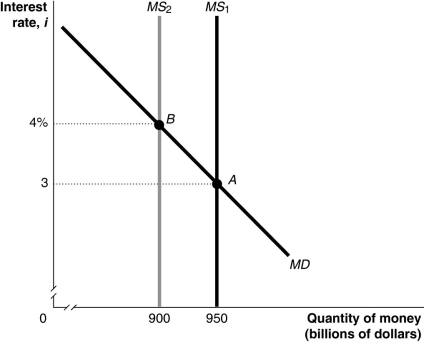 -Refer to Figure 26-2.In the figure above,the movement from point A to point B in the money market would be caused by
 (Multiple Choice)
4.9/5 (89)
(89) The money demand curve,against possible levels of interest rates,has a
(Multiple Choice)
4.7/5 (87)
(87) Figure 26-9 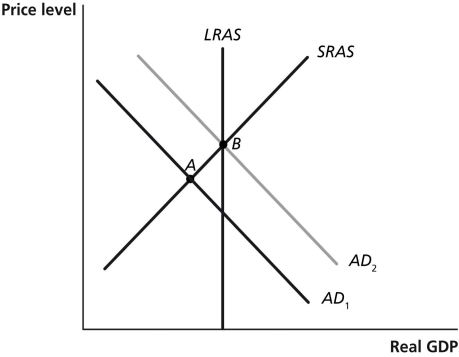 -Refer to Figure 26-9.In the figure above suppose the economy is initially at point A.The movement of the economy to point B as shown in the graph illustrates the effect of which of the following policy actions by the Federal Reserve?
 (Multiple Choice)
4.8/5 (82)
(82) Using the Taylor rule,if the current inflation rate equals the target inflation rate and real GDP equals potential GDP,then the federal funds target rate equals the
(Multiple Choice)
4.9/5 (72)
(72) If the Fed raises the interest rate,this will ________ inflation and ________ real GDP in the short run.
(Multiple Choice)
4.8/5 (69)
(69) The Taylor rule predicted a federal funds rate which was ________ that set when Paul Volcker was chairman of the Fed,and a rate which was ________ that set when Arthur Burns chaired the Fed.
(Multiple Choice)
4.8/5 (75)
(75) 
Filters
- Essay(0)
- Multiple Choice(0)
- Short Answer(0)
- True False(0)
- Matching(0)