



 Chat with AI
Exam 26: Monetary Policy

Exam 1: Economics: Foundations and Models447 Questions
Exam 2: Trade-Offs, comparative Advantage, and the Market System492 Questions
Exam 3: Where Prices Come From: the Interaction of Demand and Supply476 Questions
Exam 4: Economic Efficiency, government Price Setting, and Taxes420 Questions
Exam 5: Externalities, environmental Policy, and Public Goods263 Questions
Exam 6: Elasticity: the Responsiveness of Demand and Supply294 Questions
Exam 7: The Economics of Health Care338 Questions
Exam 8: Firms,the Stock Market,and Corporate Governance522 Questions
Exam 9: Comparative Advantage and the Gains From International Trade377 Questions
Exam 10: Consumer Choice and Behavioral Economics300 Questions
Exam 11: Technology,production,and Costs327 Questions
Exam 12: Firms in Perfectly Competitive Markets296 Questions
Exam 13: Monopolistic Competition: the Competitive Model in a More Realistic Setting272 Questions
Exam 14: Oligopoly: Firms in Less Competitive Markets258 Questions
Exam 15: Monopoly and Antitrust Policy279 Questions
Exam 16: Pricing Strategy261 Questions
Exam 17: The Markets for Labor and Other Factors of Production281 Questions
Exam 18: Public Choice, taxes, and the Distribution of Income258 Questions
Exam 19: Gdp: Measuring Total Production and Income261 Questions
Exam 20: Unemployment and Inflation291 Questions
Exam 21: Economic Growth, the Financial System, and Business Cycles253 Questions
Exam 22: Long-Run Economic Growth: Sources and Policies262 Questions
Exam 23: Aggregate Expenditure and Output in the Short Run301 Questions
Exam 24: Aggregate Demand and Aggregate Supply Analysis286 Questions
Exam 25: Money,banks,and the Federal Reserve System281 Questions
Exam 26: Monetary Policy275 Questions
Exam 27: Fiscal Policy306 Questions
Exam 28: Inflation, unemployment, and Federal Reserve Policy257 Questions
Exam 29: Macroeconomics in an Open Economy278 Questions
Exam 30: The International Financial System258 Questions
Select questions type


By the 2000s,investment banks had become significant participants in the secondary market for mortgages.
(True/False)
4.8/5  (82)
(82) Which of the following will lead to a decrease in the equilibrium interest rate in the economy?
(Multiple Choice)
4.8/5 (73)
(73) Figure 26-8 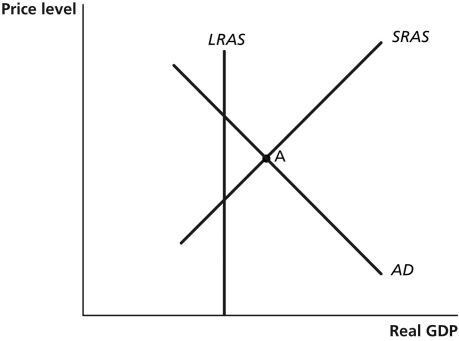 -Refer to Figure 26-8.In the figure above,if the economy is at point A,the appropriate monetary policy by the Federal Reserve would be to
 (Multiple Choice)
5.0/5 (87)
(87) Does the money demand curve have a positive slope or a negative slope? Why does it have this slope? Explain why an increase in the variable on the vertical axis of the money demand curve causes either an increase or a decrease in the variable on the horizontal axis of the money demand curve.
(Essay)
4.7/5 (71)
(71) A borrower defaults on a loan when he stops making payments on the loan.
(True/False)
4.8/5 (74)
(74) When the Federal Reserve decreases the money supply,at the previous equilibrium interest rate households and firms will now want to
(Multiple Choice)
4.9/5 (52)
(52) The Fed can simultaneously reduce the inflation rate and stimulate growth through lowering interest rates.
(True/False)
4.9/5 (90)
(90) Which of the following is not an argument against inflation targeting?
(Multiple Choice)
4.8/5 (95)
(95) Figure 26-5 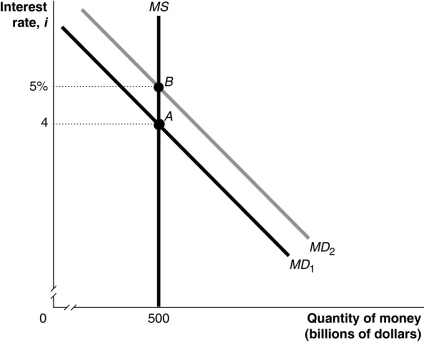 -Refer to Figure 26-5.In the figure above,the movement from point A to point B in the money market would be caused by
 (Multiple Choice)
4.8/5 (90)
(90) What actions should the Fed take if it believes the economy is about to fall into recession?
(Essay)
4.9/5 (87)
(87) The Fed seeks to promote stability of financial markets because
(Multiple Choice)
4.9/5 (83)
(83) By the height of the housing bubble in 2005 and early 2006,lenders had greatly loosened the standards for obtaining a mortgage loan,with many mortgages being granted to ________ borrowers with flawed credit histories and ________ borrowers who did not document their incomes.
(Multiple Choice)
4.8/5 (84)
(84) A monetary policy target is a variable that the Fed can affect directly,which then affects one or more of the Fed's policy goals.
(True/False)
4.9/5 (77)
(77) Beginning in 2008,The Federal Reserve and the U.S.Treasury Department responded to the financial crisis by intervening in financial markets in unprecedented ways.Briefly summarize the actions of the Fed and Treasury.
(Essay)
4.9/5 (80)
(80) From an initial long-run macroeconomic equilibrium,if the Federal Reserve anticipated that next year aggregate demand would grow significantly slower than long-run aggregate supply,then the Federal Reserve would most likely
(Multiple Choice)
4.8/5 (72)
(72) If the Federal Reserve targets the interest rate and the money demand curve shifts to the left,then the Fed
(Multiple Choice)
4.8/5 (71)
(71) 
Filters
- Essay(0)
- Multiple Choice(0)
- Short Answer(0)
- True False(0)
- Matching(0)