



 Chat with AI
Exam 26: Monetary Policy

Exam 1: Economics: Foundations and Models447 Questions
Exam 2: Trade-Offs, comparative Advantage, and the Market System492 Questions
Exam 3: Where Prices Come From: the Interaction of Demand and Supply476 Questions
Exam 4: Economic Efficiency, government Price Setting, and Taxes420 Questions
Exam 5: Externalities, environmental Policy, and Public Goods263 Questions
Exam 6: Elasticity: the Responsiveness of Demand and Supply294 Questions
Exam 7: The Economics of Health Care338 Questions
Exam 8: Firms,the Stock Market,and Corporate Governance522 Questions
Exam 9: Comparative Advantage and the Gains From International Trade377 Questions
Exam 10: Consumer Choice and Behavioral Economics300 Questions
Exam 11: Technology,production,and Costs327 Questions
Exam 12: Firms in Perfectly Competitive Markets296 Questions
Exam 13: Monopolistic Competition: the Competitive Model in a More Realistic Setting272 Questions
Exam 14: Oligopoly: Firms in Less Competitive Markets258 Questions
Exam 15: Monopoly and Antitrust Policy279 Questions
Exam 16: Pricing Strategy261 Questions
Exam 17: The Markets for Labor and Other Factors of Production281 Questions
Exam 18: Public Choice, taxes, and the Distribution of Income258 Questions
Exam 19: Gdp: Measuring Total Production and Income261 Questions
Exam 20: Unemployment and Inflation291 Questions
Exam 21: Economic Growth, the Financial System, and Business Cycles253 Questions
Exam 22: Long-Run Economic Growth: Sources and Policies262 Questions
Exam 23: Aggregate Expenditure and Output in the Short Run301 Questions
Exam 24: Aggregate Demand and Aggregate Supply Analysis286 Questions
Exam 25: Money,banks,and the Federal Reserve System281 Questions
Exam 26: Monetary Policy275 Questions
Exam 27: Fiscal Policy306 Questions
Exam 28: Inflation, unemployment, and Federal Reserve Policy257 Questions
Exam 29: Macroeconomics in an Open Economy278 Questions
Exam 30: The International Financial System258 Questions
Select questions type


Give an example of a monetary policy target.Explain why the Fed uses policy targets.
(Essay)
5.0/5  (85)
(85) From an initial long-run macroeconomic equilibrium,if the Federal Reserve anticipated that next year aggregate demand would grow significantly slower than long-run aggregate supply,then the Federal Reserve would most likely
(Multiple Choice)
4.9/5 (78)
(78) What actions should the Fed take if it believes the economy is about to experience a high rate of inflation?
(Essay)
4.9/5 (99)
(99) Using the money demand and money supply model,an increase in money demand would cause the equilibrium interest rate to
(Multiple Choice)
4.8/5 (76)
(76) Contractionary monetary policy on the part of the Fed results in
(Multiple Choice)
4.9/5 (73)
(73) In 2015,some banks in Europe had to make interest payments to borrowers rather than receive interest payments from borrowers.Which of the following statements describes this situation?
(Multiple Choice)
4.9/5 (82)
(82) Figure 26-12 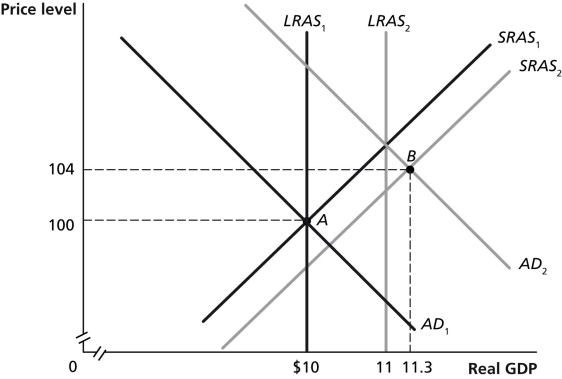 -Refer to Figure 26-12.In the dynamic AD-AS model,if the economy is at point A in year 1 and is expected to go to point B in year 2,and the Federal Reserve pursues no policy,then at point B
 (Multiple Choice)
4.9/5 (79)
(79) Table 26-7
Year Potential Real GDP Real GDP Price Level 2012 \ 14.2 trillion \ 14.2 trillion 154 2013 14.8 trillion 14.6 trillion 156
-Refer to Table 26-7.Suppose the table above illustrates the values of real and potential GDP and the price level if the Fed did not vote to change their current policy to be more contractionary or expansionary.Suppose that the Fed used an appropriate policy and was successful in keeping real GDP at potential in 2013.Draw an aggregate demand and supply curve to illustrate your answer.
(Essay)
4.8/5 (74)
(74) Using the money demand and money supply model,an open market sale of Treasury securities by the Federal Reserve would cause the equilibrium interest rate to
(Multiple Choice)
4.8/5 (79)
(79) Article Summary
Concerned about low inflation,Federal Reserve Bank of Minneapolis President Narayana Kocherlakota said the Fed needed a more aggressive stimulus policy than the setting of near-zero interest rates,and added that negative interest rates could be an effective policy tool.In a September 2015 interview,Kocherlakota stated "Given the inflation outlook,given how low inflation is expected to be,to ensure the credibility of our inflation target,taking a more accommodative stance in September would have been totally justified." While the Federal Open Market Committee chose to hold rates near zero in their September 2015 meeting,Fed Chair Janet Yellen announced that a rate increase would be warranted by the end of the year,and that "negative interest rates was not something that we considered very seriously at all today."
-Refer to the Article Summary.When Fed Chair Janet Yellen announced that a rate increase would be warranted by the end of the year,she was was referring to the
(Multiple Choice)
5.0/5 (89)
(89) Figure 26-7  -Refer to Figure 26-7.Suppose the economy is in short-run equilibrium above potential GDP,the unemployment rate is very low,and wages and prices are rising.Using the static AD-AS model in the figure above,the correct Fed policy for this situation would be depicted as a movement from
 (Multiple Choice)
4.9/5 (75)
(75) If the Federal Reserve targets the money supply,and the money demand curve shifts to the left,then the Fed
(Multiple Choice)
4.8/5 (62)
(62) Figure 26-1 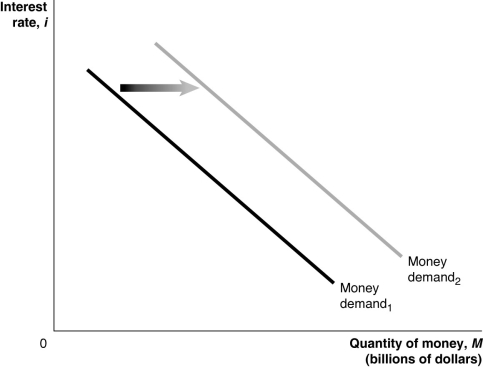 -Refer to Figure 26-1.In the figure above,the money demand curve would move from Money demand1 to Money demand2 if
 (Multiple Choice)
4.9/5 (78)
(78) Figure 26-7
-Refer to Figure 26-7.Suppose the Fed sells Treasury Bills in pursuit of contractionary monetary policy.Using the static AD-AS model in the figure above,this situation would be depicted as a movement from
-Refer to Figure 26-7.Suppose the Fed sells Treasury Bills in pursuit of contractionary monetary policy.Using the static AD-AS model in the figure above,this situation would be depicted as a movement from (Multiple Choice)
4.9/5 (78)
(78) One of the monetary policy goals of the Federal Reserve is price stability.
(True/False)
4.7/5 (85)
(85) The Taylor rule helps explain the relationship between the Fed's ________ and ________.
(Multiple Choice)
5.0/5 (78)
(78) 
Filters
- Essay(0)
- Multiple Choice(0)
- Short Answer(0)
- True False(0)
- Matching(0)