



 Chat with AI
Exam 19: Nuclear Chemistry: Applications to Energy and Medicine

Exam 1: Matter and Energy: The Origin of the Universe103 Questions
Exam 2: Atoms, Ions, and Molecules: Matter Starts Here144 Questions
Exam 3: Stoichiometry: Mass, Formulas, and Reactions141 Questions
Exam 4: Solution Chemistry: The Hydrosphere148 Questions
Exam 5: Thermochemistry: Energy Changes in Reactions139 Questions
Exam 6: Properties of Gases: The Air We Breathe164 Questions
Exam 7: A Quantum Model of Atoms: Waves and Particles166 Questions
Exam 8: Chemical Bonds: What Makes a Gas a Greenhouse Gas156 Questions
Exam 9: Molecular Geometry: Shape Determines Function188 Questions
Exam 10: Intermolecular Forces: The Uniqueness of Water165 Questions
Exam 11: Solutions: Properties and Behavior150 Questions
Exam 12: Solids: Crystals, Alloys, and Polymers130 Questions
Exam 13: Chemical Kinetics: Reactions in the Atmosphere155 Questions
Exam 14: Chemical Equilibrium: How Much Product Does a Reaction Really Make111 Questions
Exam 15: Acidbase Equilibria: Proton Transfer in Biological Systems122 Questions
Exam 16: Additional Aqueous Equilibria: Chemistry and the Oceans127 Questions
Exam 17: Thermodynamics: Spontaneous and Nonspontaneous Reactions and Processes186 Questions
Exam 18: Electrochemistry: The Quest for Clean Energy167 Questions
Exam 19: Nuclear Chemistry: Applications to Energy and Medicine165 Questions
Exam 20: Organic and Biological Molecules: the Compounds of Life168 Questions
Exam 21: The Main Group Elements: Life and the Periodic Table96 Questions
Exam 22: Transition Metals: Biological and Medical Applications142 Questions
Select questions type


Particles emitted in radioactive decay have different penetrating power. The penetration depths of two particles, labeled X and Y, in a column of water are shown below. The Y particle most likely is not ________ 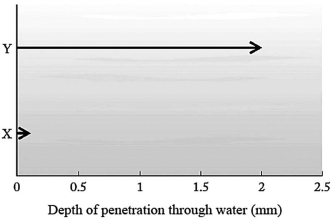
(Multiple Choice)
4.9/5  (77)
(77) Tritium (3H) is used in glowing "EXIT" signs located where there is no electricity for lightbulbs. If the half-life of tritium is 12.26 years, what percentage of the original quantity of the isotope is left in the sign after 18.5 years?
(Multiple Choice)
4.8/5 (79)
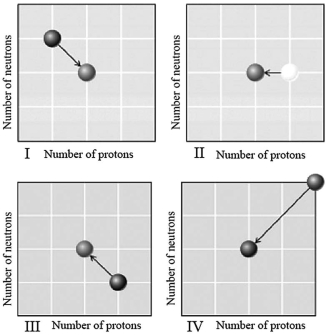
(79) 
When an atom of uranium-235 captures a neutron, the product, uranium-236, is unstable and splits into two lighter nuclides. One of these fission reactions produces cesium, rubidium, and 2 neutrons. Write a balanced reaction equation for this fission process.
(Essay)
4.8/5 (76)
(76) The major fissionable isotope of uranium used in nuclear power plants is ________
(Multiple Choice)
4.9/5 (86)
(86) When an atom of uranium-235 captures a neutron, the product, uranium-236, is unstable and splits into two lighter nuclides. One of these fission reactions produces barium, krypton, and 3 neutrons. Write a balanced reaction equation for this fission process.
(Essay)
4.9/5 (70)
(70) Uranium-235 enrichment involves separations of isotopes of UF6 based on ________
(Multiple Choice)
4.9/5 (84)
(84) Radon-220 decays to polonium-216. What particle is emitted?
(Multiple Choice)
4.8/5 (74)
(74) Fluorine-18 is a radioactive isotope used as a tracer atom in drugs in the human body. How much fluorine-18 was originally used in a drug sample if there is only 0.124 mg left in a sample after 2.5 h? (The half-life of fluorine-18 is 110 minutes.)
(Multiple Choice)
4.8/5 (80)
(80) In a Geiger counter, which is used to detect radioactivity, a particle produced by radioactive decay ________
(Multiple Choice)
4.8/5 (82)
(82) Which graph below describes the decay of two radioactive nuclides, P and Q, when the half-life of Q is shorter than the half-life of P? In these graphs ln[N(0)/N(t)] is plotted on the y-axis, with time (t) on the x-axis. N(0) = number of radioactive nuclides present at time = 0, and N(t) = number present at time = t.
(Multiple Choice)
4.8/5 (73)
(73) Carbon-14 measurements on the linen wrappings from the Book of Isaiah on the Dead Sea Scrolls indicated that the scrolls contained about 79.5% of the carbon-14 found in living tissue. Approximately how old are these scrolls? The half-life of carbon-14 is 5,730 years.
(Multiple Choice)
4.7/5 (76)
(76) Electricity is produced from nuclear reactions by ________
(Multiple Choice)
4.8/5 (82)
(82) Exposure to ionizing radiation usually is measured in units of milliSieverts (mSv). For example, one mammogram produces an exposure of 0.4 mSv. A sievert accounts for ________
(Multiple Choice)
4.9/5 (79)
(79) Which type of radiation has the lowest penetration ability?
(Multiple Choice)
4.9/5 (89)
(89) 
Filters
- Essay(0)
- Multiple Choice(0)
- Short Answer(0)
- True False(0)
- Matching(0)