



 Chat with AI
Exam 19: Nuclear Chemistry: Applications to Energy and Medicine

Exam 1: Matter and Energy: The Origin of the Universe103 Questions
Exam 2: Atoms, Ions, and Molecules: Matter Starts Here144 Questions
Exam 3: Stoichiometry: Mass, Formulas, and Reactions141 Questions
Exam 4: Solution Chemistry: The Hydrosphere148 Questions
Exam 5: Thermochemistry: Energy Changes in Reactions139 Questions
Exam 6: Properties of Gases: The Air We Breathe164 Questions
Exam 7: A Quantum Model of Atoms: Waves and Particles166 Questions
Exam 8: Chemical Bonds: What Makes a Gas a Greenhouse Gas156 Questions
Exam 9: Molecular Geometry: Shape Determines Function188 Questions
Exam 10: Intermolecular Forces: The Uniqueness of Water165 Questions
Exam 11: Solutions: Properties and Behavior150 Questions
Exam 12: Solids: Crystals, Alloys, and Polymers130 Questions
Exam 13: Chemical Kinetics: Reactions in the Atmosphere155 Questions
Exam 14: Chemical Equilibrium: How Much Product Does a Reaction Really Make111 Questions
Exam 15: Acidbase Equilibria: Proton Transfer in Biological Systems122 Questions
Exam 16: Additional Aqueous Equilibria: Chemistry and the Oceans127 Questions
Exam 17: Thermodynamics: Spontaneous and Nonspontaneous Reactions and Processes186 Questions
Exam 18: Electrochemistry: The Quest for Clean Energy167 Questions
Exam 19: Nuclear Chemistry: Applications to Energy and Medicine165 Questions
Exam 20: Organic and Biological Molecules: the Compounds of Life168 Questions
Exam 21: The Main Group Elements: Life and the Periodic Table96 Questions
Exam 22: Transition Metals: Biological and Medical Applications142 Questions
Select questions type


Two of the units used to measure biological effects of radioactivity are sievert and rem. What are these units used to measure?
(Essay)
4.9/5  (83)
(83) The isotope "belt of stability" is an area in a plot of ________
(Multiple Choice)
4.9/5 (67)
(67) Uranium-238 (  ) decays to form thorium-234 (
 ) with a half-life of 4.5 10 9 years. How many years will it take for 75% of the uranium-238 to decay?
) decays to form thorium-234 ( ) with a half-life of 4.5 10 9 years. How many years will it take for 75% of the uranium-238 to decay? (Multiple Choice)
4.8/5 (90)
(90) Which process is not part of the pathway that produces 4He nuclides in our sun?
(Multiple Choice)
4.9/5 (79)
(79) Which reactant and product would balance the following nuclear reaction equation? reactant 12 C 11B product
(Multiple Choice)
4.9/5 (82)
(82) When carbon and oxygen combine in a combustion reaction, 394 kJ of energy are released for each mole of carbon dioxide that is produced. Compare this amount with the energy released in our sun when 1 mole of helium-4 is produced from 4 protons. 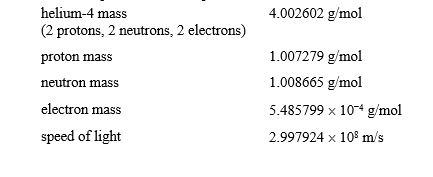
(Essay)
4.7/5 (79)
(79) Crews of commercial airlines are exposed to a higher level of background cosmic radiation during flight time than they would receive on the ground. A single round-trip, coast-to-coast flight gives a dose of about 0.012 rems. If a stewardess made 200 such flights in one year, how would her annual dose compare with a normal annual exposure on the ground of 3.6 mSv? (100 rem = 1 Sv)
(Multiple Choice)
4.8/5 (85)
(85) Calculate the nuclear binding energy per nucleon for the copper-63 isotope. Here are some helpful data: 
(Short Answer)
4.9/5 (74)
(74) Though uranium-238, an alpha emitter, is radioactive, it can be worked with safely in a glovebox with no additional precautions. Offer an explanation.
(Essay)
4.9/5 (77)
(77) Uranium-238 decays to lead-206 through a series of nuclear reactions. Only particles and particles are emitted. How many particles are emitted?
(Multiple Choice)
4.9/5 (73)
(73) Prozac (fluoxetine hydrochloride) is a selective serotonin reuptake inhibitor (SSRI) used to treat depression. Its function in the brain can be studied by using radiolabeled 18F instead of natural abundance fluorine in its structure. The positron emission is detected by a PET scan. The half-life of 18F is 109.7 minutes. If radiolabeled Prozac were administered to a patient for a PET scan at 8:00 A.M. on Monday, at what time would its activity reach 10% of the original activity?
(Multiple Choice)
4.9/5 (80)
(80) Radiation seed therapy is a common method for treating some prostate cancers and brain tumors. Iodine-125, which decays by electron capture followed by gamma ray emission with a half-life of 59.4 days, is one isotope used for this treatment. If a tumor were seeded with 1.00 g of iodine-125 (124.90 g/mol), what would the initial radioactivity level be? Note: 1 Ci = 3.70 1010/s.
(Multiple Choice)
4.8/5 (89)
(89) Radiation seed therapy is a common method for treating some prostate cancers and brain tumors. Palladium-103, which decays by electron capture and gamma ray emission with a half-life of 17.0 days, is one isotope used for this treatment. How much palladium-103 (102.91 g/mol) is needed to produce an initial radioactivity level of 1.30 mCi? Note: 1 Ci = 3.70 1010/s.
(Multiple Choice)
4.9/5 (87)
(87) Which element has stable isotopes with the largest ratio of neutrons to protons?
(Multiple Choice)
4.9/5 (78)
(78) What units are used to measure the activity of a radioactive sample?
(Short Answer)
4.8/5 (93)
(93) Particles emitted in radioactive decay have different penetrating power. The penetration depths of two particles, labeled X and Y, in a column of water are shown below. Which of the following statements could not be true? 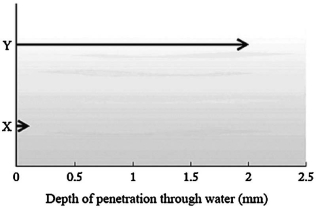
(Multiple Choice)
4.8/5 (86)
(86) Small traces of radioactive substances, mainly from the food we eat, are present in the human body. The most abundant radioisotope in the body is potassium-40. A person weighing 70 kg contains about 150 g of potassium, and about 0.01% of this amount is potassium-40. The half-life of potassium-40 is 1.25 109 years. Estimate the rate at which radiation is produced by the decay of potassium-40 in the body.
(Multiple Choice)
5.0/5 (70)
(70) Among other problems with smoking, there is a danger from radiation, according to the following report. "Tobacco plants are grown in soils with high phosphate fertilizers that are naturally contaminated with the alpha-particle emitting radionuclide polonium-210. In one year, the average smoker will irradiate the bronchial epithelium with 8 to 9 rem, the equivalent dose of radiation from 250 to 300 chest X-ray films per year" (Pediatrics, September 1993, p. 464). How does this annual dose from tobacco compare to an average annual dose of 3.6 mSv that a nonsmoker receives from background radiation? (1 Sv = 100 rem)
(Multiple Choice)
4.8/5 (77)
(77) 
Filters
- Essay(0)
- Multiple Choice(0)
- Short Answer(0)
- True False(0)
- Matching(0)