



 Chat with AI
Exam 19: Nuclear Chemistry: Applications to Energy and Medicine

Exam 1: Matter and Energy: The Origin of the Universe103 Questions
Exam 2: Atoms, Ions, and Molecules: Matter Starts Here144 Questions
Exam 3: Stoichiometry: Mass, Formulas, and Reactions141 Questions
Exam 4: Solution Chemistry: The Hydrosphere148 Questions
Exam 5: Thermochemistry: Energy Changes in Reactions139 Questions
Exam 6: Properties of Gases: The Air We Breathe164 Questions
Exam 7: A Quantum Model of Atoms: Waves and Particles166 Questions
Exam 8: Chemical Bonds: What Makes a Gas a Greenhouse Gas156 Questions
Exam 9: Molecular Geometry: Shape Determines Function188 Questions
Exam 10: Intermolecular Forces: The Uniqueness of Water165 Questions
Exam 11: Solutions: Properties and Behavior150 Questions
Exam 12: Solids: Crystals, Alloys, and Polymers130 Questions
Exam 13: Chemical Kinetics: Reactions in the Atmosphere155 Questions
Exam 14: Chemical Equilibrium: How Much Product Does a Reaction Really Make111 Questions
Exam 15: Acidbase Equilibria: Proton Transfer in Biological Systems122 Questions
Exam 16: Additional Aqueous Equilibria: Chemistry and the Oceans127 Questions
Exam 17: Thermodynamics: Spontaneous and Nonspontaneous Reactions and Processes186 Questions
Exam 18: Electrochemistry: The Quest for Clean Energy167 Questions
Exam 19: Nuclear Chemistry: Applications to Energy and Medicine165 Questions
Exam 20: Organic and Biological Molecules: the Compounds of Life168 Questions
Exam 21: The Main Group Elements: Life and the Periodic Table96 Questions
Exam 22: Transition Metals: Biological and Medical Applications142 Questions
Select questions type


Extremely high temperatures are required to initiate nuclear fusion, but then energy is released by nuclear fusion. This is analogous to ________
(Multiple Choice)
4.9/5  (76)
(76) Which statement is not correct? In hydrogen fusion in our sun, ________
(Multiple Choice)
4.8/5 (74)
(74) Balance the following nuclear equation by supplying the missing nuclide. 
(Short Answer)
4.8/5 (79)
(79) Radiation seed therapy is a common method for treating some prostate cancers and brain tumors. Cesium-131 is a new isotope being proposed for this treatment. Cesium-131 decays with a half-life of 9.7 days by emitting X-rays with a photon energy of 29,000 eV. What mass of cesium-131 would have to be embedded in a 15 g tumor to produce a radiation dose of 115 Gy in 3 weeks' time (21 days)? Note: 1 Gy = 1 J/kg, and 1 eV = 1.60 1019 J.
(Multiple Choice)
4.8/5 (74)
(74) The difference between the uranium used in an atomic bomb and that used in a nuclear power plant is that ________
(Multiple Choice)
4.9/5 (76)
(76) A nerdy Scotch-drinking physicist, Nicola, suspected that the 50-year-old Scotch she purchased was misrepresented. Reasoning that water must contain the radioactive hydrogen isotope, tritium, because this isotope is produced in the atmosphere by cosmic rays, she decided she could use the tritium concentration in the Scotch to determine when it was bottled. She found that the tritium concentration in the Scotch was only 64% that of the tritium concentration in the water on the Isle of Islay where the Scotch was bottled. How old, really, was this 50-year-old Scotch? The half-life of tritium is 12.3 years.
(Short Answer)
4.9/5 (79)
(79) 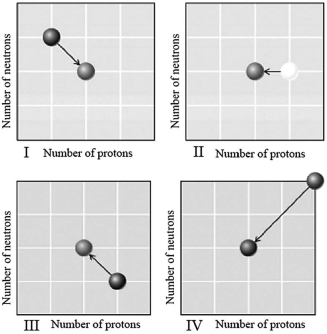
In 1913, an element was known to "emanate" from radium-226 by emission and then to decay to polonium-218, also by emission. What was the unknown element?
(Multiple Choice)
4.9/5 (80)
(80) Cobalt-56 decays by emitting a positron. What is the product?
(Multiple Choice)
4.9/5 (85)
(85) Phosphorus-32 is a radioactive isotope used as a tracer in the liver. How much phosphorus-32 was originally used if there is only 3.50 mg left in a sample after 288 h? (The half-life of phosphorus-32 is 14.3 days.)
(Multiple Choice)
4.8/5 (73)
(73) Polonium-210, which decays by emission, is a fatal toxin. What is the product nuclide from this nuclear process?
(Multiple Choice)
4.9/5 (71)
(71) Paxil (paroxetine) is a selective serotonin reuptake inhibitor (SSRI) used to treat depression. Its function in the brain can be studied by using radiolabeled 18F instead of natural abundance fluorine in its structure. The positron emission is detected by a PET scan. The half-life of 18F is 109.7 minutes. If radiolabeled Paxil were administered to a patient for a PET scan at 10:00 A.M. on a Wednesday, at what time would its activity reach 27% of the original activity?
(Multiple Choice)
4.9/5 (96)
(96) Tritium (3H) is used in glowing "EXIT" signs conveniently located where there is no electricity for lightbulbs. What decay route is likely for tritium?
(Multiple Choice)
4.8/5 (80)
(80) Fluorine-18 is an isotope commonly used in radioimaging, due in part to the short half-life (~2 hours) of the isotope. What type of emission process is likely for fluorine-18?
(Multiple Choice)
5.0/5 (73)
(73) Compare the energy released by the collisions and annihilation of (1) an electron and a positron and (2) a proton and an antiproton.
(Multiple Choice)
4.7/5 (76)
(76) Which type of radiation has the greatest penetration ability?
(Multiple Choice)
4.8/5 (83)
(83) The purpose of control rods in a fission reactor is to ________
(Multiple Choice)
4.9/5 (94)
(94) How many half-lives did a radioactive sample complete if 2.5 g of a sample remains from 20 g of initial material?
(Multiple Choice)
4.8/5 (74)
(74) 
Filters
- Essay(0)
- Multiple Choice(0)
- Short Answer(0)
- True False(0)
- Matching(0)