



 Chat with AI
Exam 6: Taxes and Subsidies

Exam 1: The Big Ideas253 Questions
Exam 2: The Power of Trade and Comparative239 Questions
Exam 3: Supply and Demand249 Questions
Exam 4: Equilibrium256 Questions
Exam 5: Elasticity and Its Applications271 Questions
Exam 6: Taxes and Subsidies225 Questions
Exam 7: The Price System275 Questions
Exam 8: Price Ceilings and Floors327 Questions
Exam 9: International Trade195 Questions
Exam 10: Externalities- When the Price Is Not Right273 Questions
Exam 11: Costs and Profit Maximization Under Competition217 Questions
Exam 12: Competition and the Invisible Hand144 Questions
Exam 13: Monopoly233 Questions
Exam 14: Price Discrimination262 Questions
Exam 15: Oligopoly and Game Theory218 Questions
Exam 16: Competing for Monopoly160 Questions
Exam 17: Monopolistic Competition and Advertising113 Questions
Exam 18: Labor Markets262 Questions
Exam 19: Public Goods and the Tragedy of the Commons244 Questions
Exam 20: Political Economy and Public Choice306 Questions
Exam 21: Economics, Ethics, and Public Policy241 Questions
Exam 22: Managing Incentives263 Questions
Exam 23: Stock Markets and Personal Finance271 Questions
Exam 24: Price Discrimination151 Questions
Exam 25: Consumer Choice145 Questions
Select questions type


The supply of financial capital is very mobile. People can move their bank and brokerage accounts around the world and invest in foreign corporations with a click of the mouse. Therefore, taxes on financial capital:
(Multiple Choice)
4.8/5  (74)
(74) In Free Market Environmentalism, economists Terry Anderson and Donald Leal write, "Subsidized irrigation . . . encourages farmers to break prairie sod and plant crops in arid regions. Rather than choosing drought-resistant crops that might be more appropriate in an environment undergoing global warming, farmers intensify the use of pesticides and chemical fertilizers to increase their yields. . ." (pp. 163-164). Which of the following explains the deadweight loss from irrigation subsidies?
(Multiple Choice)
4.9/5 (83)
(83) In the eighteenth century, the British Crown instituted a Stamp Tax, a commodity tax on, among other things, newspapers. During this period in history, newspapers were one of the few ways people could learn about world events, and entering the newspaper industry was relatively easy. With this in mind, who likely paid more of the tax: consumers or producers?
(Multiple Choice)
4.8/5 (65)
(65) Use the following to answer questions:
Figure: Tax on Consumers of Gadgets 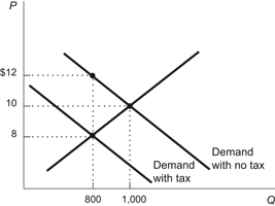 -(Figure: Tax on Consumers of Gadgets) Refer to the figure. What is the amount of the deadweight loss caused by the imposition of the tax on gadgets?
 (Multiple Choice)
4.9/5 (85)
(85) Suppose that there is a tax of $5 per unit, and the demand curve is more elastic than the supply curve. Which of the following statements could be TRUE?
(Multiple Choice)
4.9/5 (82)
(82) Figure: Soda Market  Legislators impose a tax of $0.70 on soda that reduces the quantity of soda sold from 130,000 cans of soda to 100,000, cans. How much of the $0.70 tax per can will producers pay?
 (Multiple Choice)
4.9/5 (67)
(67) Suppose that sellers require $6.70 per unit to sell 800 units. If a $2 tax per unit is placed on sellers, the sellers will require _______ per unit to sell 800 units, causing the supply curve ________.
(Multiple Choice)
4.8/5 (100)
(100) Unlike taxes, who gets the subsidy depends on who gets the check from the government.
(True/False)
4.9/5 (84)
(84) Which of the following statements is TRUE regarding subsidy?
(Multiple Choice)
4.8/5 (81)
(81) Use the following to answer questions:
Figure: Deadweight Loss 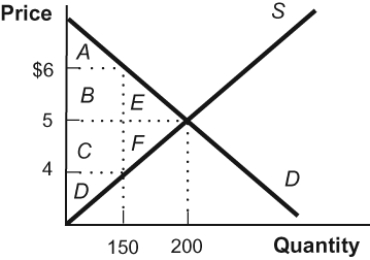 -(Figure: Deadweight Loss) Which of the areas in this figure represents the deadweight loss resulting from a $2 tax?
 (Multiple Choice)
4.8/5 (89)
(89) Laws requiring employers to provide health insurance to their employees put the burden of health insurance costs:
(Multiple Choice)
4.8/5 (90)
(90) Use the following to answer questions:
Figure: Demand Tax  -(Figure: Demand Tax) The figure illustrates a market for gasoline with a $1 tax imposed on the buyers. What price do buyers pay for a gallon of gasoline in this market?
 (Multiple Choice)
4.7/5 (78)
(78) Without taxes, the market price per bag of apples is $5. With a $2 tax per bag of apples, buyers now pay $5.75 per bag. What is the final price per bag of apples received by sellers?
(Multiple Choice)
4.8/5 (80)
(80) If buyers are required to pay a tax on top of the price, buyers' willingness to pay will:
(Multiple Choice)
4.7/5 (78)
(78) Use the following to answer questions:
Figure: Tax on Sellers  -(Figure: Tax on Sellers) Refer to the figure. Suppose the imposition of a per-unit tax on sellers shifts the supply curve from S0 to S1. With the tax, buyers pay ________ and sellers receive ________.
 (Multiple Choice)
4.8/5 (70)
(70) Use the following to answer questions:
Figure: Taxes and Deadweight Loss 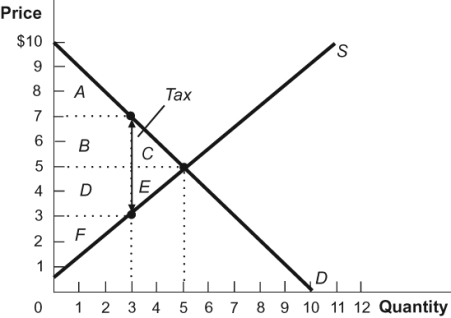 -(Figure: Taxes and Deadweight Loss) In the diagram, the deadweight loss is ______ and government tax revenue is ______.
 (Multiple Choice)
4.7/5 (83)
(83) Use the following to answer questions:
Figure: Commodity Tax on Suppliers 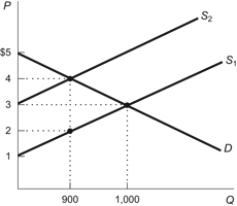 -(Figure: Commodity Tax on Suppliers) Refer to the figure. If a tax shifts the supply curve from S1 to S2, the value of deadweight loss is:
 (Multiple Choice)
4.8/5 (74)
(74) 
Filters
- Essay(0)
- Multiple Choice(0)
- Short Answer(0)
- True False(0)
- Matching(0)