



 Chat with AI
Exam 14: Price Discrimination

Exam 1: The Big Ideas253 Questions
Exam 2: The Power of Trade and Comparative239 Questions
Exam 3: Supply and Demand249 Questions
Exam 4: Equilibrium256 Questions
Exam 5: Elasticity and Its Applications271 Questions
Exam 6: Taxes and Subsidies225 Questions
Exam 7: The Price System275 Questions
Exam 8: Price Ceilings and Floors327 Questions
Exam 9: International Trade195 Questions
Exam 10: Externalities- When the Price Is Not Right273 Questions
Exam 11: Costs and Profit Maximization Under Competition217 Questions
Exam 12: Competition and the Invisible Hand144 Questions
Exam 13: Monopoly233 Questions
Exam 14: Price Discrimination262 Questions
Exam 15: Oligopoly and Game Theory218 Questions
Exam 16: Competing for Monopoly160 Questions
Exam 17: Monopolistic Competition and Advertising113 Questions
Exam 18: Labor Markets262 Questions
Exam 19: Public Goods and the Tragedy of the Commons244 Questions
Exam 20: Political Economy and Public Choice306 Questions
Exam 21: Economics, Ethics, and Public Policy241 Questions
Exam 22: Managing Incentives263 Questions
Exam 23: Stock Markets and Personal Finance271 Questions
Exam 24: Price Discrimination151 Questions
Exam 25: Consumer Choice145 Questions
Select questions type


Senior citizens tend to have a more elastic demand for movie theatre tickets, and thus typically pay a lower price.

Free
(True/False)
4.8/5  (87)
(87) Correct Answer: Verified
False
Microsoft Word and Microsoft Excel are typically:
Free
(Multiple Choice)
4.8/5 (75)
(75) Correct Answer:Verified
VerifiedB
Perfect price discrimination results in:
Free
(Multiple Choice)
4.9/5 (78)
(78) Correct Answer:Verified
VerifiedB
Use the following to answer questions:
Figure: Price-Discriminating Monopolist 2 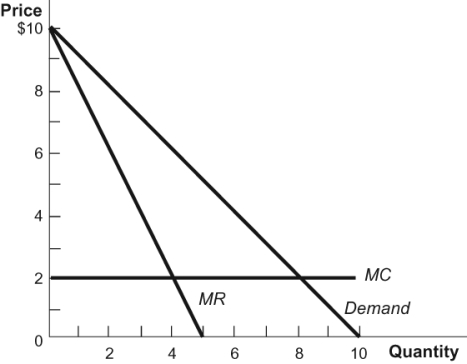 -(Figure: Price-Discriminating Monopolist 2) Consumer surplus with a single-price monopoly is ______, and consumer surplus with a perfect price discrimination is ______.
 (Multiple Choice)
4.7/5 (79)
(79) Figure: Canada & Europe 
 A monopolist sells its output in two markets: Canada and Europe, as shown in these figures. To maximize profits, the monopolist should:
 (Multiple Choice)
5.0/5 (88)
(88) Which of the following does NOT represent a benefit that can be achieved from bundling?
(Multiple Choice)
4.9/5 (85)
(85) If a monopolist is able to perfectly price discriminate, then:
(Multiple Choice)
4.9/5 (83)
(83) The more a firm knows about ________ the easier it is for the firm to ________.
(Multiple Choice)
4.7/5 (78)
(78) Which of the following best explains why it is so difficult for firms to perfectly price discriminate?
(Multiple Choice)
4.7/5 (90)
(90) If cable TV packages were unbundled, the price per channel would rise.
(True/False)
4.8/5 (79)
(79) Suppose that the government made it legal to submit false tax returns on college aid applications. What do you predict would happen to the price of attending college?
(Multiple Choice)
4.8/5 (70)
(70) Which of the following statements is TRUE regarding arbitrage?
(Multiple Choice)
4.8/5 (80)
(80) Which of the following is an example of price discrimination?
(Multiple Choice)
4.9/5 (85)
(85) Suppose that there are four consumers whose maximum willingnesses to pay for a good are $20, $15, $8, and $4, respectively. A firm can produce and sell the good at a constant marginal cost of $6. If the firm practiced perfect price discrimination, its total revenues would equal:
(Multiple Choice)
4.7/5 (78)
(78) Which of the following is an example of price discrimination through tying?
(Multiple Choice)
4.9/5 (84)
(84) A subtle form of price discrimination is for firms to offer:
(Multiple Choice)
4.9/5 (72)
(72) Tying is an example of price discrimination in which customers must buy a second product from the same firm that sold the first product.
(True/False)
4.8/5 (74)
(74) 
Filters
- Essay(0)
- Multiple Choice(0)
- Short Answer(0)
- True False(0)
- Matching(0)