



 Chat with AI
Exam 14: Price Discrimination

Exam 1: The Big Ideas253 Questions
Exam 2: The Power of Trade and Comparative239 Questions
Exam 3: Supply and Demand249 Questions
Exam 4: Equilibrium256 Questions
Exam 5: Elasticity and Its Applications271 Questions
Exam 6: Taxes and Subsidies225 Questions
Exam 7: The Price System275 Questions
Exam 8: Price Ceilings and Floors327 Questions
Exam 9: International Trade195 Questions
Exam 10: Externalities- When the Price Is Not Right273 Questions
Exam 11: Costs and Profit Maximization Under Competition217 Questions
Exam 12: Competition and the Invisible Hand144 Questions
Exam 13: Monopoly233 Questions
Exam 14: Price Discrimination262 Questions
Exam 15: Oligopoly and Game Theory218 Questions
Exam 16: Competing for Monopoly160 Questions
Exam 17: Monopolistic Competition and Advertising113 Questions
Exam 18: Labor Markets262 Questions
Exam 19: Public Goods and the Tragedy of the Commons244 Questions
Exam 20: Political Economy and Public Choice306 Questions
Exam 21: Economics, Ethics, and Public Policy241 Questions
Exam 22: Managing Incentives263 Questions
Exam 23: Stock Markets and Personal Finance271 Questions
Exam 24: Price Discrimination151 Questions
Exam 25: Consumer Choice145 Questions
Select questions type


Taking advantage of price differences for the same good by buying low in one market and selling high in another market is called:
(Multiple Choice)
4.8/5  (69)
(69) Companies rarely make money on the game consoles (for example, Xbox and PlayStation): most of the money made is from selling the games themselves, which cannot be used on other game consoles. How does this allow these companies to price discriminate?
(Multiple Choice)
4.8/5 (93)
(93) Explain the two basic principles of successful price discrimination.
(Essay)
4.8/5 (88)
(88) Karl values Word at $100 and Excel at $40, and Adam values Word at $20 and Excel at $90. How much more does the seller make if it bundles than if it sells the products individually?
(Multiple Choice)
4.8/5 (80)
(80) In which of the following industries may price discrimination be good?
(Multiple Choice)
5.0/5 (84)
(84) To which of the following groups would a monopolist typically charge the lowest price?
(Multiple Choice)
4.8/5 (89)
(89) Use the following to answer questions:
Figure: Price-Discriminating Monopolist 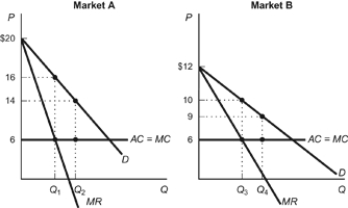 -(Figure: Price-Discriminating Monopolist) Refer to the figure. Based on the demand curves for a monopolist's product in two different markets-Market A and Market B-if the monopolist were to charge a uniform price PU between the two markets, in which range would the price fall?
 (Multiple Choice)
4.9/5 (73)
(73) Perfect price discrimination is always bad, while imperfect price discrimination can be either good or bad.
(True/False)
4.8/5 (82)
(82) Use the following to answer questions:
Figure: Monopolist 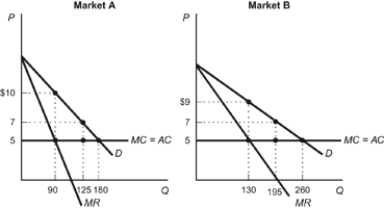 -(Figure: Monopolist) Refer to the figure. Based on the demand curves for a monopolist's product in two different markets-Market A and Market B-what price should the monopolist charge in Market A?
 (Multiple Choice)
4.9/5 (78)
(78) Jonathan values Word at $100 and Excel at $90, and Ashley values Word at $80 and Excel at $60. Why does bundling fail to raise the seller's profits in this case?
(Multiple Choice)
4.9/5 (79)
(79) Which of the following statements is TRUE?
I. Perfect price discrimination maximizes consumer surplus.
II. Perfect price discrimination maximizes gains from trade.
III. Under perfect price discrimination, the monopolist produces until price equals marginal cost.
(Multiple Choice)
4.8/5 (90)
(90) Which of the following would be most difficult to arbitrage?
(Multiple Choice)
5.0/5 (76)
(76) 
Filters
- Essay(0)
- Multiple Choice(0)
- Short Answer(0)
- True False(0)
- Matching(0)