



 Chat with AI
Exam 14: Price Discrimination

Exam 1: The Big Ideas253 Questions
Exam 2: The Power of Trade and Comparative239 Questions
Exam 3: Supply and Demand249 Questions
Exam 4: Equilibrium256 Questions
Exam 5: Elasticity and Its Applications271 Questions
Exam 6: Taxes and Subsidies225 Questions
Exam 7: The Price System275 Questions
Exam 8: Price Ceilings and Floors327 Questions
Exam 9: International Trade195 Questions
Exam 10: Externalities- When the Price Is Not Right273 Questions
Exam 11: Costs and Profit Maximization Under Competition217 Questions
Exam 12: Competition and the Invisible Hand144 Questions
Exam 13: Monopoly233 Questions
Exam 14: Price Discrimination262 Questions
Exam 15: Oligopoly and Game Theory218 Questions
Exam 16: Competing for Monopoly160 Questions
Exam 17: Monopolistic Competition and Advertising113 Questions
Exam 18: Labor Markets262 Questions
Exam 19: Public Goods and the Tragedy of the Commons244 Questions
Exam 20: Political Economy and Public Choice306 Questions
Exam 21: Economics, Ethics, and Public Policy241 Questions
Exam 22: Managing Incentives263 Questions
Exam 23: Stock Markets and Personal Finance271 Questions
Exam 24: Price Discrimination151 Questions
Exam 25: Consumer Choice145 Questions
Select questions type


The textbook for your economics class is available in an American version and in a much cheaper Indian version that has the same text but no colors for the graphs (the difference in prices is much higher than the difference in costs). Why is this the case?
(Multiple Choice)
4.7/5  (86)
(86) Tying is a form of price discrimination in which one good called the base good is tied to a second good called the variable good.
(True/False)
4.8/5 (81)
(81) A museum in Russia has two entrances: one for locals (written in Russian) and one for tourists (written in English). People who enter through the entrance written in Russian will end up paying 81.93 Rubles ($3.00). English-speaking tourists will use the entrance written in English, but they will end up paying 409.67 Rubles ($15.00). This practice is an example of:
(Multiple Choice)
4.9/5 (67)
(67) The optimal price for a monopolist facing different demand curves in two separate markets will be:
(Multiple Choice)
4.9/5 (73)
(73) Price discrimination is used when a seller faces different demand curves in different markets because:
(Multiple Choice)
4.8/5 (80)
(80) To maximize profit, a monopolist should charge a higher price in the market with the more inelastic demand curve.
(True/False)
4.9/5 (77)
(77) Writing in 1849, Jules Dupuit observed why the rail companies actively made third-class accommodations terrible, including removing the roof from the car and having nonupholstered seats:
"It is not because of the several thousand francs which they would have to spend to cover the third-class wagons or to upholster the benches that a particular railway has uncovered carriages and wooden benches; it would happily sacrifice this for the sake of its popularity. . . It hurts the poor not because it wants them to personally suffer, but to scare the rich."
How does "scaring the rich" illustrate price discrimination?
(Multiple Choice)
4.7/5 (75)
(75) Which of the following is an example of price discrimination?
(Multiple Choice)
4.9/5 (70)
(70) Suppose that Southwestern Airlines flight 171 will depart BWI for Detroit in 3 hours. The marginal cost and average cost of flying a customer are $35 and $68, respectively. Southwestern Airlines can increase its profits by selling a ticket for no less than:
(Multiple Choice)
5.0/5 (84)
(84) Cable television operators sell ______ access to channels.
(Multiple Choice)
4.8/5 (77)
(77) The pricing spread at Williams College was such that tuition rates varied by a magnitude of:
(Multiple Choice)
4.7/5 (72)
(72) Consumers are ________ with price discrimination than with single pricing.
(Multiple Choice)
4.8/5 (81)
(81) Compared with imperfect price discrimination, deadweight loss under a nondiscriminating monopoly is:
(Multiple Choice)
4.8/5 (74)
(74) Bundling is a form of price discrimination that may increase economic efficiency, specifically in cases where fixed costs are high and marginal costs are low.
(True/False)
4.8/5 (89)
(89) When two goods must be bought in a package (with a fixed ratio), they are:
(Multiple Choice)
4.9/5 (84)
(84) To maximize profit, a monopolist should charge a lower price in the market with the steeper demand curve.
(True/False)
4.8/5 (70)
(70) Figure: PPD Monopolist 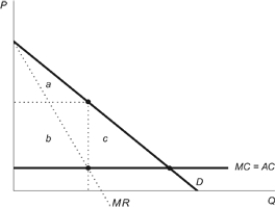 Refer to the figure. A monopolist who cannot price discriminate earns profit equal to area(s) ________, and a monopolist practicing perfect price discrimination earns profit equal to areas ________.
 (Multiple Choice)
4.8/5 (89)
(89) A company that produces men's electric shavers reasons that people who highly value being clean-shaven will buy a lot of replacement blades; on the other hand, people who place a low value on being clean-shaven will rarely buy replacement blades. What type of pricing strategy will maximize profits for this company?
(Multiple Choice)
4.8/5 (76)
(76) 
Filters
- Essay(0)
- Multiple Choice(0)
- Short Answer(0)
- True False(0)
- Matching(0)