



 Chat with AI
Exam 6: Taxes and Subsidies

Exam 1: The Big Ideas253 Questions
Exam 2: The Power of Trade and Comparative239 Questions
Exam 3: Supply and Demand249 Questions
Exam 4: Equilibrium256 Questions
Exam 5: Elasticity and Its Applications271 Questions
Exam 6: Taxes and Subsidies225 Questions
Exam 7: The Price System275 Questions
Exam 8: Price Ceilings and Floors327 Questions
Exam 9: International Trade195 Questions
Exam 10: Externalities- When the Price Is Not Right273 Questions
Exam 11: Costs and Profit Maximization Under Competition217 Questions
Exam 12: Competition and the Invisible Hand144 Questions
Exam 13: Monopoly233 Questions
Exam 14: Price Discrimination262 Questions
Exam 15: Oligopoly and Game Theory218 Questions
Exam 16: Competing for Monopoly160 Questions
Exam 17: Monopolistic Competition and Advertising113 Questions
Exam 18: Labor Markets262 Questions
Exam 19: Public Goods and the Tragedy of the Commons244 Questions
Exam 20: Political Economy and Public Choice306 Questions
Exam 21: Economics, Ethics, and Public Policy241 Questions
Exam 22: Managing Incentives263 Questions
Exam 23: Stock Markets and Personal Finance271 Questions
Exam 24: Price Discrimination151 Questions
Exam 25: Consumer Choice145 Questions
Select questions type


Not only do both wage subsidies and minimum wages increase wages, but:

Free
(Multiple Choice)
4.8/5  (84)
(84) Correct Answer: Verified
C
What do subsidies and commodity taxes have in common?
Free
(Multiple Choice)
4.8/5 (76)
(76) Correct Answer:Verified
VerifiedC
Using demand and supply diagrams show the difference between a tax imposed on sellers and a tax imposed on buyers. In each diagram, identify the equilibrium price and quantity with no tax, equilibrium quantity with the tax, price paid by buyers, and price received by sellers.
Free
(Essay)
4.8/5 (82)
(82) Correct Answer:Verified
VerifiedNote in the following diagrams, that equilibrium prices begin at the same level and that prices paid by the buyers are the same as are prices received by the sellers. Similarly, Qs with no tax is the same in both diagrams as is Qs with taxes. 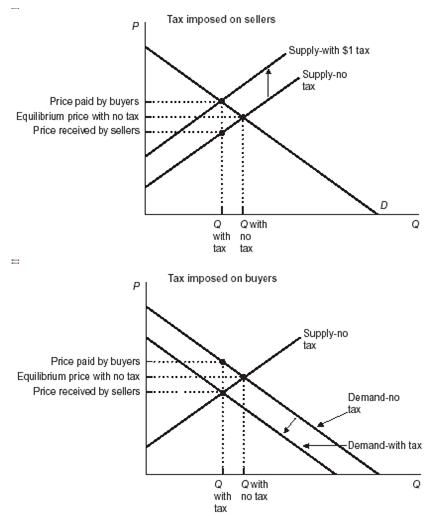
A market is described by the equations Qd = 100 - P, and Qs = P. A tax of $10 is placed on the seller of the product such that he will receive less to take home than the original equilibrium price. Therefore, the new supply equation becomes Qs = (P - T). Does the seller pay the whole $10 of the tax burden? How much does the seller pay? How much does the buyer pay? Why do they split the burden in this way?
(Essay)
4.7/5 (71)
(71) Which form of taxation hurts apple growers more: a $1 per bushel production tax or a $1 per bushel consumption tax?
(Multiple Choice)
4.9/5 (92)
(92) Figure: Soda Market 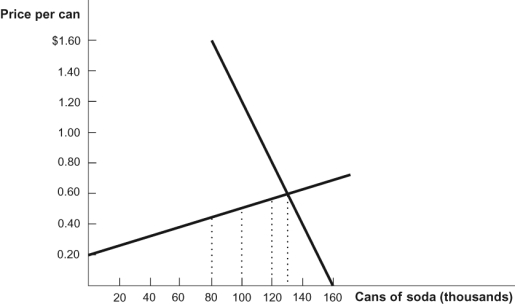 How much consumer surplus is lost because of a 70¢ tax?
 (Multiple Choice)
4.9/5 (100)
(100) By law, workers pay half the Social Security tax and employers pay the other half. Is this a fair way to allocate the tax?
(Multiple Choice)
4.8/5 (80)
(80) Use the following to answer questions:
Figure: Demand and Supply with Subsidy 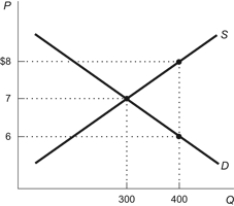 -(Figure: Supply and Demand with Subsidy) Refer to the figure. Suppose a subsidy allows sellers to receive their product at the price of $8 with a quantity of 400 units. What is the dollar amount of the subsidy per unit of the good?
 (Multiple Choice)
4.7/5 (62)
(62) If buyers pay $10 per unit and sellers receive $8.50 per unit, the tax is $1.50 per unit.
(True/False)
4.7/5 (74)
(74) Use the following to answer questions:
Figure: Tax on Buyers 2  -(Figure: Tax on Buyers 2) In the diagram, the size of the tax is:
 (Multiple Choice)
4.9/5 (90)
(90) Why has the Earned Income Tax Credit (EITC) increased employment among single mothers?
(Multiple Choice)
4.8/5 (80)
(80) Suppose the government requires firms to buy insurance against hair loss for their employees. Workers will end up paying for this coverage in the form of lower wages.
(True/False)
4.8/5 (86)
(86) Use the following to answer questions:
Figure: Tax on Sellers  -(Figure: Tax on Sellers) If a $3 tax per unit purchased was placed on buyers instead of sellers, buyers would pay ________ and sellers would receive ________.
 (Multiple Choice)
4.7/5 (74)
(74) Which of the following statements is correct for a specific good or service?
(Multiple Choice)
4.9/5 (88)
(88) Figure: Two Demand Curves 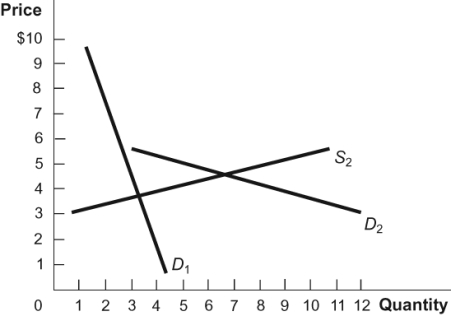 In this figure, the benefits of a subsidy will be greater for sellers facing demand curve ______, the ______ demand.
 (Multiple Choice)
4.8/5 (84)
(84) The government can choose between taxing buyers of grapes at $1.00 per pound or taxing the sellers of grapes at $1.00 per pound. Which of the following statements is TRUE?
I. The choice most beneficial to buyers is placing the $1.00 tax on sellers.
II. The choice most beneficial to sellers is placing the $1.00 tax on buyers.
III. Either choice will have the same effect on both buyers and sellers.
(Multiple Choice)
4.9/5 (79)
(79) If the demand curve for a good is perfectly inelastic, any commodity tax that is imposed on that market will be entirely paid by the consumer.
(True/False)
4.9/5 (85)
(85) Figure: Tax on Consumers of Gadgets  According to the figure, what is the amount of the tax that has been imposed on gadgets?
 (Multiple Choice)
4.9/5 (82)
(82) 
Filters
- Essay(0)
- Multiple Choice(0)
- Short Answer(0)
- True False(0)
- Matching(0)