



 Chat with AI
Exam 6: Taxes and Subsidies

Exam 1: The Big Ideas253 Questions
Exam 2: The Power of Trade and Comparative239 Questions
Exam 3: Supply and Demand249 Questions
Exam 4: Equilibrium256 Questions
Exam 5: Elasticity and Its Applications271 Questions
Exam 6: Taxes and Subsidies225 Questions
Exam 7: The Price System275 Questions
Exam 8: Price Ceilings and Floors327 Questions
Exam 9: International Trade195 Questions
Exam 10: Externalities- When the Price Is Not Right273 Questions
Exam 11: Costs and Profit Maximization Under Competition217 Questions
Exam 12: Competition and the Invisible Hand144 Questions
Exam 13: Monopoly233 Questions
Exam 14: Price Discrimination262 Questions
Exam 15: Oligopoly and Game Theory218 Questions
Exam 16: Competing for Monopoly160 Questions
Exam 17: Monopolistic Competition and Advertising113 Questions
Exam 18: Labor Markets262 Questions
Exam 19: Public Goods and the Tragedy of the Commons244 Questions
Exam 20: Political Economy and Public Choice306 Questions
Exam 21: Economics, Ethics, and Public Policy241 Questions
Exam 22: Managing Incentives263 Questions
Exam 23: Stock Markets and Personal Finance271 Questions
Exam 24: Price Discrimination151 Questions
Exam 25: Consumer Choice145 Questions
Select questions type


Who bears most of the burden of a mandate requiring employers to provide health insurance?
(Multiple Choice)
4.9/5  (81)
(81) Consider the market for gasoline, a good with a relatively low elasticity of demand. Who will bear the majority of a tax imposed on gasoline?
(Multiple Choice)
4.9/5 (86)
(86) If the demand and supply curves have equal slopes in absolute value, the burden of a commodity tax will be split equally regardless of on whom the tax is placed.
(True/False)
4.9/5 (72)
(72) Explain in your own words why the imposition of a tax results in a deadweight loss. Given this, should we eliminate all taxes on goods/services because they result in deadweight losses? Explain why or why not.
(Essay)
4.9/5 (84)
(84) Use the following to answer questions:
Figure: Supply and Demand with Subsidy 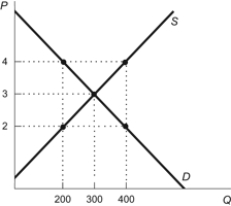 -(Figure: Supply and Demand with Subsidy) Refer to the figure. With a $2-per-unit subsidy, the price received by sellers is ________ and the price paid by consumers is ________.
 (Multiple Choice)
4.9/5 (86)
(86) When the federal government provided a subsidy to first-time homebuyers, we expect that it helped first-time homebuyers and home sellers.
(True/False)
4.8/5 (78)
(78) Assume you are a critic of subsidies for water used in agriculture. Create an argument (using economic theory) that outlines WHY you believe these subsidies to be inefficient.
(Essay)
4.8/5 (88)
(88) The question of who pays the greater amount of a commodity tax is determined by:
(Multiple Choice)
5.0/5 (63)
(63) Which of the following statements is NOT true for a case in which the demand for labor is more elastic than the supply of labor?
(Multiple Choice)
4.8/5 (80)
(80) Nobel Prize-winning economist Edmund Phelps's plan to institute wage subsidies would:
(Multiple Choice)
4.8/5 (86)
(86) As demand becomes more elastic, ceteris paribus, the deadweight loss from a tax:
(Multiple Choice)
4.7/5 (66)
(66) Why are there more births in the United States in late December than in early January?
(Multiple Choice)
4.9/5 (68)
(68) For a given set of supply and demand curves, the horizontal location of the tax wedge depends on:
(Multiple Choice)
4.7/5 (72)
(72) Figure: Commodity Tax with Elastic Demand  According to the figure, who bears the greater burden of a commodity tax?
 (Multiple Choice)
5.0/5 (69)
(69) 
Filters
- Essay(0)
- Multiple Choice(0)
- Short Answer(0)
- True False(0)
- Matching(0)