



 Chat with AI
Exam 6: Taxes and Subsidies

Exam 1: The Big Ideas253 Questions
Exam 2: The Power of Trade and Comparative239 Questions
Exam 3: Supply and Demand249 Questions
Exam 4: Equilibrium256 Questions
Exam 5: Elasticity and Its Applications271 Questions
Exam 6: Taxes and Subsidies225 Questions
Exam 7: The Price System275 Questions
Exam 8: Price Ceilings and Floors327 Questions
Exam 9: International Trade195 Questions
Exam 10: Externalities- When the Price Is Not Right273 Questions
Exam 11: Costs and Profit Maximization Under Competition217 Questions
Exam 12: Competition and the Invisible Hand144 Questions
Exam 13: Monopoly233 Questions
Exam 14: Price Discrimination262 Questions
Exam 15: Oligopoly and Game Theory218 Questions
Exam 16: Competing for Monopoly160 Questions
Exam 17: Monopolistic Competition and Advertising113 Questions
Exam 18: Labor Markets262 Questions
Exam 19: Public Goods and the Tragedy of the Commons244 Questions
Exam 20: Political Economy and Public Choice306 Questions
Exam 21: Economics, Ethics, and Public Policy241 Questions
Exam 22: Managing Incentives263 Questions
Exam 23: Stock Markets and Personal Finance271 Questions
Exam 24: Price Discrimination151 Questions
Exam 25: Consumer Choice145 Questions
Select questions type


If a $2 tax on cigarettes decreases both consumer and producer surplus:
(Multiple Choice)
4.9/5  (75)
(75) Use the following to answer questions:
Figure: Taxes and Deadweight Loss 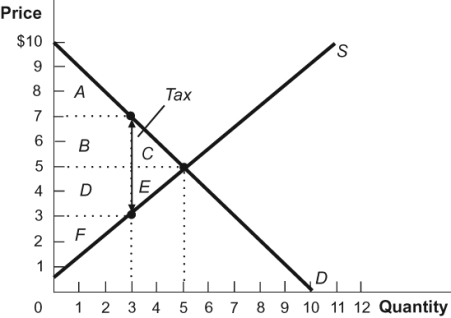 -(Figure: Taxes and Deadweight Loss) In the diagram, producer surpluses before and after the tax are ______ and ______, respectively.
 (Multiple Choice)
4.8/5 (64)
(64) Use the following to answer questions:
Figure: Tax on Supply and Demand  -(Figure: Tax on Supply and Demand) According to the figure, if the tax is placed on buyers, the equilibrium is at Point:
 (Multiple Choice)
4.7/5 (84)
(84) When demand is more elastic than supply, buyers bear more of the tax burden.
(True/False)
4.8/5 (76)
(76) If demand is more elastic than supply, the majority of a tax is paid by the buyers.
(True/False)
4.8/5 (66)
(66) Use the following to answer questions:
Figure: Demand and Supply with Subsidy 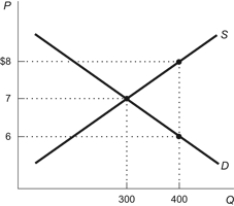 -(Figure: Supply and Demand with Subsidy) Refer to the figure. What is the total cost of the subsidy for taxpayers?
 (Multiple Choice)
4.9/5 (72)
(72) Use the following to answer questions:
Figure: Supply Tax  -(Figure: Supply Tax) In the accompanying pizza market, with a $2 tax imposed on the sellers, how much of the tax is paid by the buyers and how much of the tax burden is borne by the sellers?
 (Multiple Choice)
4.9/5 (75)
(75) Martin's maximum willingness to pay for an electric boat motor is $250. Because of a tax, the price of the motor increases from $230 to $280. The deadweight loss of the tax attributable to Martin is:
(Multiple Choice)
4.7/5 (87)
(87) Suppose the demand for pizza is inelastic and the supply of pizza is elastic, and the demand for cigarettes is inelastic and the supply of cigarettes is elastic. If a tax were levied on the sellers of both of these commodities, we would expect that the burden of:
(Multiple Choice)
4.8/5 (88)
(88) Use the following to answer questions:
Figure: Deadweight Loss 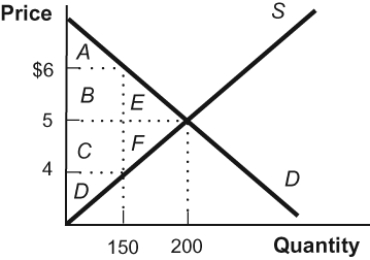 -(Figure: Deadweight Loss) Which of the areas in this figure represents the lost consumer surplus resulting from a $2 tax?
 (Multiple Choice)
4.8/5 (88)
(88) Ceteris paribus, the more elastic the supply curve, the larger the total subsidy.
(True/False)
4.9/5 (74)
(74) If demand is perfectly elastic, then supply receives the full benefit of a subsidy and the subsidy creates no deadweight loss.
(True/False)
4.8/5 (83)
(83) Use the following to answer questions:
Figure: Wage Subsidy  -(Figure: Wage Subsidy) Refer to the figure. If a minimum wage of $8 had been implemented instead of a wage subsidy, how many workers would have been unemployed?
 (Multiple Choice)
4.7/5 (88)
(88) The typical teen-age smoker has a more elastic demand for cigarettes than does a typical older smoker. We expect a given cigarette tax to ______ a teen-age smoker's consumption by______ than an older smoker's consumption.
(Multiple Choice)
4.8/5 (67)
(67) Figure: Elasticities of Supply and Demand  Which combination of demand and supply curves results in the greatest tax burden to buyers?
 (Multiple Choice)
4.9/5 (87)
(87) Use the following to answer questions:
Figure: Wage Subsidy
-(Figure: Wage Subsidy) Refer to the figure. How many additional workers have been hired as a result of the wage subsidy?
-(Figure: Wage Subsidy) Refer to the figure. How many additional workers have been hired as a result of the wage subsidy? (Multiple Choice)
4.9/5 (81)
(81) 
Filters
- Essay(0)
- Multiple Choice(0)
- Short Answer(0)
- True False(0)
- Matching(0)