



 Chat with AI
Exam 6: Taxes and Subsidies

Exam 1: The Big Ideas253 Questions
Exam 2: The Power of Trade and Comparative239 Questions
Exam 3: Supply and Demand249 Questions
Exam 4: Equilibrium256 Questions
Exam 5: Elasticity and Its Applications271 Questions
Exam 6: Taxes and Subsidies225 Questions
Exam 7: The Price System275 Questions
Exam 8: Price Ceilings and Floors327 Questions
Exam 9: International Trade195 Questions
Exam 10: Externalities- When the Price Is Not Right273 Questions
Exam 11: Costs and Profit Maximization Under Competition217 Questions
Exam 12: Competition and the Invisible Hand144 Questions
Exam 13: Monopoly233 Questions
Exam 14: Price Discrimination262 Questions
Exam 15: Oligopoly and Game Theory218 Questions
Exam 16: Competing for Monopoly160 Questions
Exam 17: Monopolistic Competition and Advertising113 Questions
Exam 18: Labor Markets262 Questions
Exam 19: Public Goods and the Tragedy of the Commons244 Questions
Exam 20: Political Economy and Public Choice306 Questions
Exam 21: Economics, Ethics, and Public Policy241 Questions
Exam 22: Managing Incentives263 Questions
Exam 23: Stock Markets and Personal Finance271 Questions
Exam 24: Price Discrimination151 Questions
Exam 25: Consumer Choice145 Questions
Select questions type


Use the following to answer questions:
Figure: Tax Imposed on Sellers  -(Figure: Tax Imposed on Sellers) According to the figure, the equilibrium price and quantity before the $1 tax is imposed are:
 (Multiple Choice)
4.9/5  (77)
(77) If the elasticity of demand is 2 in absolute value, and the elasticity of supply is 1 in absolute value, how much of a tax burden will the buyer bear relative to the seller?
(Multiple Choice)
4.8/5 (72)
(72) If the elasticity of supply is 3 and the elasticity of demand is 1 (in absolute value), buyers will bear less of the tax than sellers.
(True/False)
4.8/5 (76)
(76) Use the following to answer questions:
Figure: Tax Imposed on Sellers
-(Figure: Tax Imposed on Sellers) According to the figure, the price that sellers receive AFTER the tax is imposed is:
-(Figure: Tax Imposed on Sellers) According to the figure, the price that sellers receive AFTER the tax is imposed is: (Multiple Choice)
4.7/5 (80)
(80) As supply becomes more elastic, ceteris paribus, the deadweight loss from a tax:
(Multiple Choice)
4.9/5 (78)
(78) Use the following to answer questions:
Figure: Tax on Sellers of Gadgets  -(Figure: Tax on Sellers of Gadgets) According to the figure, what is the amount of the tax that has been imposed on the sale of gadgets?
 (Multiple Choice)
4.9/5 (80)
(80) Figure Subsidy Wedge 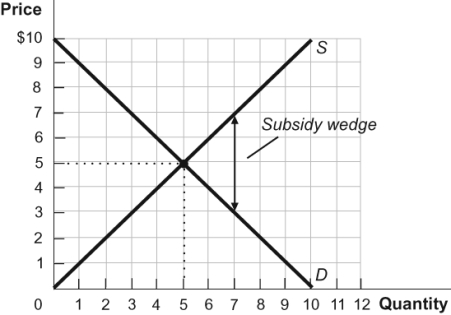 With a $4 subsidy in the figure, buyers pay _____ and sellers receive _____.
 (Multiple Choice)
4.8/5 (76)
(76) A subsidy targeted to raise consumption by a specific amount will cost the most when:
(Multiple Choice)
4.9/5 (78)
(78) 3D printing is an exciting new manufacturing technology that will allow producers to fabricate all kinds of items with a single, small, mobile printer. If the technology succeeds, we won't have as much need for large, immovable factories. What would be the result?
(Multiple Choice)
4.9/5 (66)
(66) Which of the following is correct concerning the burden of a tax imposed on coffee mugs?
(Multiple Choice)
4.9/5 (89)
(89) If a tax is imposed on sellers of a product, the demand curve will:
(Multiple Choice)
5.0/5 (85)
(85) Use the following to answer questions:
Figure: Taxes and Deadweight Loss 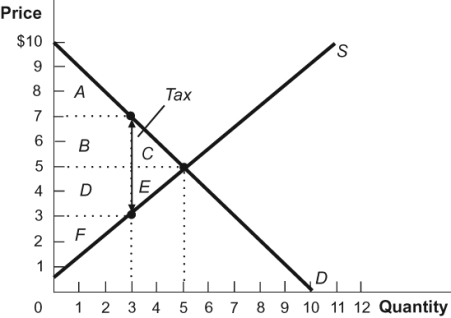 -(Figure: Taxes and Deadweight Loss) In the diagram, consumer surpluses before and after the tax are ______ and ______, respectively.
 (Multiple Choice)
4.8/5 (83)
(83) Use the following to answer questions:
Figure: Tax on Buyers 2  -(Figure: Tax on Buyers 2) In the diagram, the buyers pay _____ without the tax and pay _____ with the tax.
 (Multiple Choice)
4.8/5 (70)
(70) Use the following to answer questions:
Figure: Tax on Sellers  -(Figure: Tax on Sellers) Refer to the figure. Suppose the imposition of a per-unit tax on sellers shifts the supply curve from S0 to S1. The equilibrium quantity sold under the tax is:
 (Multiple Choice)
4.9/5 (89)
(89) Andy and Annie are in a happy relationship. Annie has many substitutes for Andy, but Andy has few substitutes for Annie. Suppose that one of them has to move two hours away for work. Which one of them will do the majority of the driving if they decide to continue their relationship on a long-distance basis?
(Multiple Choice)
4.8/5 (78)
(78) If a tax is imposed on a market with inelastic demand and elastic supply:
(Multiple Choice)
4.8/5 (78)
(78) To increase output, it is more effective to subsidize buyers than sellers.
(True/False)
4.8/5 (90)
(90) Who ultimately pays the tax depends on who writes the check to the government.
(True/False)
4.8/5 (81)
(81) Buyers bear a greater share of a tax burden when a tax is imposed in a market where:
(Multiple Choice)
4.7/5 (79)
(79) 
Filters
- Essay(0)
- Multiple Choice(0)
- Short Answer(0)
- True False(0)
- Matching(0)