



 Chat with AI
Exam 6: Taxes and Subsidies

Exam 1: The Big Ideas253 Questions
Exam 2: The Power of Trade and Comparative239 Questions
Exam 3: Supply and Demand249 Questions
Exam 4: Equilibrium256 Questions
Exam 5: Elasticity and Its Applications271 Questions
Exam 6: Taxes and Subsidies225 Questions
Exam 7: The Price System275 Questions
Exam 8: Price Ceilings and Floors327 Questions
Exam 9: International Trade195 Questions
Exam 10: Externalities- When the Price Is Not Right273 Questions
Exam 11: Costs and Profit Maximization Under Competition217 Questions
Exam 12: Competition and the Invisible Hand144 Questions
Exam 13: Monopoly233 Questions
Exam 14: Price Discrimination262 Questions
Exam 15: Oligopoly and Game Theory218 Questions
Exam 16: Competing for Monopoly160 Questions
Exam 17: Monopolistic Competition and Advertising113 Questions
Exam 18: Labor Markets262 Questions
Exam 19: Public Goods and the Tragedy of the Commons244 Questions
Exam 20: Political Economy and Public Choice306 Questions
Exam 21: Economics, Ethics, and Public Policy241 Questions
Exam 22: Managing Incentives263 Questions
Exam 23: Stock Markets and Personal Finance271 Questions
Exam 24: Price Discrimination151 Questions
Exam 25: Consumer Choice145 Questions
Select questions type


Use the following to answer questions:
Figure: Soda Market  -(Figure: Soda Market) After the imposition of a per-unit tax on production, consumers pay $5.00 per unit and producers receive $4.30 per unit. What is the value of the per unit tax?
 (Multiple Choice)
4.9/5  (76)
(76) Most labor economists believe that the supply of labor is ______ elastic than firms' demand for labor, and therefore ______ bear most of the burden of a payroll tax.
(Multiple Choice)
4.9/5 (91)
(91) If the elasticity of supply is 1, and the elasticity of demand is 3 (in absolute value), then for a tax of $1 buyers will pay:
(Multiple Choice)
4.9/5 (80)
(80) Figure: Tax on Buyers 1  In the diagram, the demand curve that incorporates a $2 tax per unit is:
 (Multiple Choice)
5.0/5 (89)
(89) Which of the following statements is TRUE?
I. Subsidizing buyers is no different than subsidizing sellers.
II. Unlike taxes, subsidies do not create deadweight losses.
III. Subsidies are payments the government makes to either producers or consumers.
IV. Taxpayers pay for subsidies.
(Multiple Choice)
4.7/5 (75)
(75) Use the following to answer questions:
Figure: Demand and Supply with Subsidy 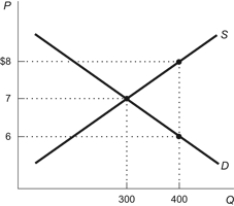 -(Figure: Supply and Demand with Subsidy) Refer to the figure. What is the deadweight loss caused by the subsidy?
 (Multiple Choice)
4.9/5 (75)
(75) The more elastic side of the market can escape more of the tax burden.
(True/False)
4.8/5 (74)
(74) Use the following to answer questions:
Figure: Wage Subsidy  -(Figure: Wage Subsidy) Consider the use of wage subsidies versus the minimum wage. Employment with a wage subsidy is: ________, versus employment with an $8 minimum wage is: ________.
 (Multiple Choice)
4.9/5 (68)
(68) Use the following to answer questions:
Figure: Tax on Sellers  -(Figure: Tax on Sellers) In the diagram, sellers receive _____ without the tax and _____ with the tax.
 (Multiple Choice)
4.8/5 (66)
(66) To be efficient, the revenue from taxation must provide goods that have benefits that ________ the deadweight loss caused by the taxation itself.
(Multiple Choice)
4.9/5 (74)
(74) If the government imposes a per-cigarette tax on smoking, which of the following is most likely to occur?
(Multiple Choice)
4.8/5 (80)
(80) If sellers pay more of a commodity tax than consumers, sellers would receive more of a subsidy than consumers.
(True/False)
4.8/5 (79)
(79) According to Nobel Laureate Edmund Phelps, minimum wages cause higher unemployment, but wage subsidies cause higher employment.
(True/False)
4.7/5 (70)
(70) A Senator stated that, "It is time to put people before profits; that is why I am sponsoring legislation that requires all businesses to purchase health insurance for their workers." Given that the demand for labor is more elastic than the supply of labor, what will be the result of this proposed legislation?
(Multiple Choice)
4.7/5 (75)
(75) Which of the following is the correct answer to the question: Why do smokers pay almost all the taxes assessed on cigarettes?
I. Because cigarettes are addictive, the demand for them is relatively elastic when compared to the supply curve of cigarettes.
II. Because cigarettes are addictive, the demand for them is relatively inelastic when compared to the supply of cigarettes.
III. Cigarette manufacturers can very easily escape a state tax by selling in a different state.
(Multiple Choice)
4.8/5 (76)
(76) A mandate that requires employers to provide health insurance will cause the price of physical capital to:
(Multiple Choice)
4.8/5 (77)
(77) Use the following to answer questions:
Figure: Demand Tax  -(Figure: Demand Tax) The figure illustrates a market for gasoline with a $1 tax imposed on the buyers. What price do sellers receive for a gallon of gasoline in this market?
 (Multiple Choice)
4.8/5 (70)
(70) 
Filters
- Essay(0)
- Multiple Choice(0)
- Short Answer(0)
- True False(0)
- Matching(0)