



 Chat with AI
Exam 6: Taxes and Subsidies

Exam 1: The Big Ideas253 Questions
Exam 2: The Power of Trade and Comparative239 Questions
Exam 3: Supply and Demand249 Questions
Exam 4: Equilibrium256 Questions
Exam 5: Elasticity and Its Applications271 Questions
Exam 6: Taxes and Subsidies225 Questions
Exam 7: The Price System275 Questions
Exam 8: Price Ceilings and Floors327 Questions
Exam 9: International Trade195 Questions
Exam 10: Externalities- When the Price Is Not Right273 Questions
Exam 11: Costs and Profit Maximization Under Competition217 Questions
Exam 12: Competition and the Invisible Hand144 Questions
Exam 13: Monopoly233 Questions
Exam 14: Price Discrimination262 Questions
Exam 15: Oligopoly and Game Theory218 Questions
Exam 16: Competing for Monopoly160 Questions
Exam 17: Monopolistic Competition and Advertising113 Questions
Exam 18: Labor Markets262 Questions
Exam 19: Public Goods and the Tragedy of the Commons244 Questions
Exam 20: Political Economy and Public Choice306 Questions
Exam 21: Economics, Ethics, and Public Policy241 Questions
Exam 22: Managing Incentives263 Questions
Exam 23: Stock Markets and Personal Finance271 Questions
Exam 24: Price Discrimination151 Questions
Exam 25: Consumer Choice145 Questions
Select questions type


The supply of financial capital is very internationally mobile. People can move their bank and brokerage accounts around the world and invest in foreign corporations with a click of the mouse. The supply of labor is less internationally mobile. People have strong ties to the countries in which they live. Assuming that the demand for labor and for financial capital have similar elasticities, which of the following is TRUE?
(Multiple Choice)
4.8/5  (89)
(89) If the elasticity of demand is 1 in absolute value, and the elasticity of supply is 1 in absolute value, how much of a tax burden will the buyer bear relative to the seller?
(Multiple Choice)
4.9/5 (70)
(70) When a payroll tax is enacted or a mandate requires firms to provide health insurance the wage paid to workers ______ and the wage paid by firms ______.
(Multiple Choice)
4.8/5 (85)
(85) Which of the following statements is TRUE? The buyer will pay more of the tax burden if:
I. the good is a luxury good.
II. the good is a necessity.
III. the good has no substitutes.
(Multiple Choice)
4.8/5 (84)
(84) Why do cotton growers spend billions of dollars to dam rivers and transport water hundreds of miles to grow cotton in California deserts?
(Multiple Choice)
4.9/5 (78)
(78) Use the following to answer questions:
Figure: Supply and Demand with Subsidy 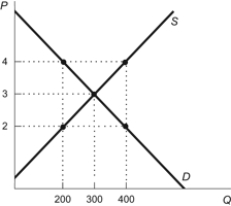 -(Figure: Supply and Demand with Subsidy) Refer to the figure. The deadweight loss from a $2 subsidy is:
 (Multiple Choice)
4.9/5 (82)
(82) Figure: Soda Market 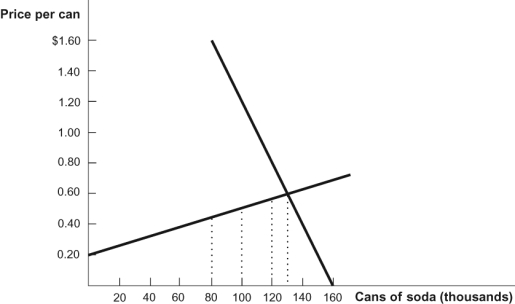 If Congress imposed a subsidy of the same value instead of the 70-cent tax, how much would consumers pay for one can of soda?
 (Multiple Choice)
4.9/5 (65)
(65) Figure: Supply and Demand with Tax on Suppliers 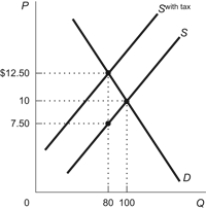 Using the graph shown, answer the following questions.
a. What was the equilibrium price in this market before the tax?
b. What is the amount of the tax?
c. How much of the tax will the buyers pay?
d. How much of the tax will the sellers pay?
e. How much will the buyer pay for the product after the tax is imposed?
f. How much will the seller receive after the tax is imposed?
g. As a result of the tax, what has happened to the level of market activity?
Using the graph shown, answer the following questions.
a. What was the equilibrium price in this market before the tax?
b. What is the amount of the tax?
c. How much of the tax will the buyers pay?
d. How much of the tax will the sellers pay?
e. How much will the buyer pay for the product after the tax is imposed?
f. How much will the seller receive after the tax is imposed?
g. As a result of the tax, what has happened to the level of market activity? (Essay)
4.9/5 (77)
(77) Let the price elasticity of supply for a good be 1.8, and the absolute value of the price elasticity of demand be 1.8. Which of the following is TRUE in this case?
(Multiple Choice)
4.7/5 (75)
(75) The difference between what buyers pay for a unit of a good and what sellers receive is known as the:
(Multiple Choice)
4.8/5 (92)
(92) Taxes reduce the gains from trade, despite increasing consumer and producer surplus.
(True/False)
4.9/5 (79)
(79) In a market with a downward-sloping demand curve and an upward sloping supply curve, a tax placed on sellers will cause sellers to receive a lower price and buyers to pay a higher price.
(True/False)
4.9/5 (71)
(71) Use the following to answer questions:
Figure: Imposition of a Tax 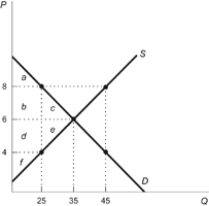 -(Figure: Imposition of a Tax) Refer to the figure. With a $4 tax, the deadweight loss is:
 (Multiple Choice)
4.9/5 (82)
(82) Use the following to answer questions:
Figure: Tax on Buyers 2  -(Figure: Tax on Buyers 2) In the diagram, the sellers receive _____ without the tax and receive _____ with the tax.
 (Multiple Choice)
4.8/5 (71)
(71) Use the following to answer questions:
Figure: Deadweight Loss 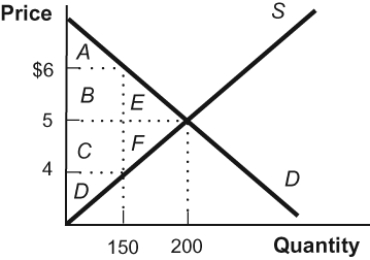 -(Figure: Deadweight Loss) Which of the areas represent the area of government revenue resulting from a $2 tax?
 (Multiple Choice)
4.9/5 (87)
(87) If consumers pay 100 percent of a commodity tax, what could one conclude?
(Multiple Choice)
4.9/5 (80)
(80) 
Filters
- Essay(0)
- Multiple Choice(0)
- Short Answer(0)
- True False(0)
- Matching(0)