



 Chat with AI
Exam 6: Taxes and Subsidies

Exam 1: The Big Ideas253 Questions
Exam 2: The Power of Trade and Comparative239 Questions
Exam 3: Supply and Demand249 Questions
Exam 4: Equilibrium256 Questions
Exam 5: Elasticity and Its Applications271 Questions
Exam 6: Taxes and Subsidies225 Questions
Exam 7: The Price System275 Questions
Exam 8: Price Ceilings and Floors327 Questions
Exam 9: International Trade195 Questions
Exam 10: Externalities- When the Price Is Not Right273 Questions
Exam 11: Costs and Profit Maximization Under Competition217 Questions
Exam 12: Competition and the Invisible Hand144 Questions
Exam 13: Monopoly233 Questions
Exam 14: Price Discrimination262 Questions
Exam 15: Oligopoly and Game Theory218 Questions
Exam 16: Competing for Monopoly160 Questions
Exam 17: Monopolistic Competition and Advertising113 Questions
Exam 18: Labor Markets262 Questions
Exam 19: Public Goods and the Tragedy of the Commons244 Questions
Exam 20: Political Economy and Public Choice306 Questions
Exam 21: Economics, Ethics, and Public Policy241 Questions
Exam 22: Managing Incentives263 Questions
Exam 23: Stock Markets and Personal Finance271 Questions
Exam 24: Price Discrimination151 Questions
Exam 25: Consumer Choice145 Questions
Select questions type


Suppose there is a tax of $50 on bicycles. The supply curve for bicycles slopes upward. The demand curve for bicycles slopes downward. Sellers are required by law to pay the tax. If the tax is reduced from $50 to $10 per bicycle, then the:
(Multiple Choice)
4.8/5  (83)
(83) A market is described by the equations Qd = 40 - 2P, and Qs = -20 + 4P. A tax of $3 is placed on the seller of the product such that the new supply equation becomes Qs = -20 + 4(P - T), where T is the tax in dollars. What is the new price paid by buyers and the new take-home price for the sellers? What is the total amount of the deadweight loss created in this market?
(Essay)
5.0/5 (71)
(71) Suppose that there is a tax of $1 per unit, and the elasticity of supply is 3 and the elasticity of demand is 2 (in absolute value). How much of the $1 tax is paid by sellers?
(Multiple Choice)
5.0/5 (79)
(79) A market is described by the equations Qd = 100 - P, and Qs = P. A subsidy of $10 is awarded to the seller of the product such that the new supply equation becomes Qs = (P + S). What is the quantity of nonbeneficial trades that take place in this market? What is the total cost of the subsidy for taxpayers? What is the total amount of the deadweight loss in this market as a result of the installation of the subsidy?
(Essay)
4.9/5 (78)
(78) Assume that cigarettes sell for $7 per pack in New Jersey and $3 per pack in South Carolina, and New Jersey taxes cigarettes at $3.00 per pack and South Carolina taxes cigarettes at $0.10 per pack. How might cigarette sellers respond to the after-tax price differential between the two states?
(Multiple Choice)
5.0/5 (78)
(78) The government paying farmers to plant more corn is an example of a subsidy.
(True/False)
4.9/5 (72)
(72) Use the following to answer questions:
Figure: Tax on Sellers of Gadgets  -(Figure: Tax on Sellers of Gadgets) According to the figure, what is the tax revenue that the government collects from the tax on gadgets?
 (Multiple Choice)
4.9/5 (81)
(81) Use the following to answer questions:
Figure: Supply and Demand with Subsidy 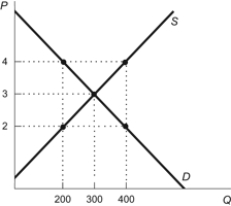 -(Figure: Supply and Demand with Subsidy) Refer to the figure. The quantity traded with a $2 subsidy is:
 (Multiple Choice)
4.7/5 (96)
(96) Which of the following statements is TRUE?
I. A $0.50 tax on each fishing lure sold raises the price per lure by $0.50.
II. A tax on sellers is equivalent to a tax on buyers.
III. A tax on buyers is analyzed by shifting the demand curve up by the amount of the tax.
(Multiple Choice)
4.7/5 (93)
(93) Use the following to answer questions:
Figure: Tax on Consumers of Gadgets 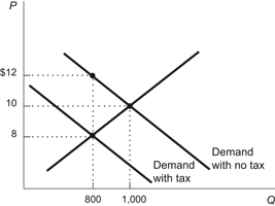 -(Figure: Tax on Consumers of Gadgets) Refer to the figure. What is the tax revenue that the government collects from the tax on gadgets?
 (Multiple Choice)
4.9/5 (81)
(81) Figure: Commodity Tax 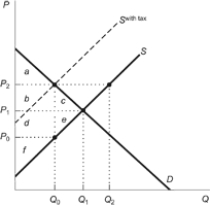 Use the figure to answer the following questions.
a. What is the size of the tax?
b. What is the equilibrium quantity before the tax?
c. What is the equilibrium quantity with the tax?
d. What is the price consumers pay before taxes?
e. What is the price consumers pay with the tax?
f. What is the price sellers receive before taxes?
g. What is the price sellers receive with the tax?
h. What is the deadweight loss of the tax?
i. What is the government tax revenue?
j. What is consumer surplus before the tax?
k. What is consumer surplus with the tax?
l. What is producer surplus before the tax?
m. What is producer surplus with the tax?
Use the figure to answer the following questions.
a. What is the size of the tax?
b. What is the equilibrium quantity before the tax?
c. What is the equilibrium quantity with the tax?
d. What is the price consumers pay before taxes?
e. What is the price consumers pay with the tax?
f. What is the price sellers receive before taxes?
g. What is the price sellers receive with the tax?
h. What is the deadweight loss of the tax?
i. What is the government tax revenue?
j. What is consumer surplus before the tax?
k. What is consumer surplus with the tax?
l. What is producer surplus before the tax?
m. What is producer surplus with the tax? (Short Answer)
4.9/5 (79)
(79) If it previously existed, a tax decreases both consumer and producer surplus.
(True/False)
4.8/5 (75)
(75) Use the following to answer questions:
Figure: Consumer and Producer Surplus 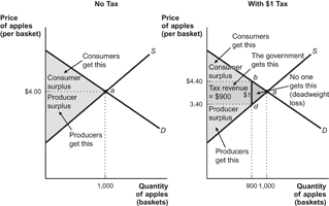 -(Figure: Consumer and Producer Surplus) According to the figure, what is the value of the deadweight loss?
 (Multiple Choice)
4.9/5 (74)
(74) If there is a tax on both medicine and sugar, ceteris paribus, how will the deadweight losses in each market compare?
(Multiple Choice)
4.8/5 (77)
(77) Use the following to answer questions:
Figure: Consumer and Producer Surplus
-(Figure: Consumer and Producer Surplus) According to the figure, what would happen to the deadweight loss if the tax increased to $2 per basket of apples?
-(Figure: Consumer and Producer Surplus) According to the figure, what would happen to the deadweight loss if the tax increased to $2 per basket of apples? (Multiple Choice)
4.9/5 (79)
(79) A government's decision to subsidize the production of insulin for people with diabetes would mostly benefit the:
(Multiple Choice)
4.8/5 (73)
(73) Use the following to answer questions:
Figure: Tax on Sellers  -(Figure: Tax on Sellers) The size of the tax in the diagram is:
 (Multiple Choice)
4.8/5 (79)
(79) Use the following to answer questions:
Figure: Tax Imposed on Sellers  -(Figure: Tax Imposed on Sellers) According to the figure, the price that buyers pay AFTER the tax is imposed is:
 (Multiple Choice)
4.8/5 (93)
(93) 
Filters
- Essay(0)
- Multiple Choice(0)
- Short Answer(0)
- True False(0)
- Matching(0)