



 Chat with AI
Exam 6: Taxes and Subsidies

Exam 1: The Big Ideas253 Questions
Exam 2: The Power of Trade and Comparative239 Questions
Exam 3: Supply and Demand249 Questions
Exam 4: Equilibrium256 Questions
Exam 5: Elasticity and Its Applications271 Questions
Exam 6: Taxes and Subsidies225 Questions
Exam 7: The Price System275 Questions
Exam 8: Price Ceilings and Floors327 Questions
Exam 9: International Trade195 Questions
Exam 10: Externalities- When the Price Is Not Right273 Questions
Exam 11: Costs and Profit Maximization Under Competition217 Questions
Exam 12: Competition and the Invisible Hand144 Questions
Exam 13: Monopoly233 Questions
Exam 14: Price Discrimination262 Questions
Exam 15: Oligopoly and Game Theory218 Questions
Exam 16: Competing for Monopoly160 Questions
Exam 17: Monopolistic Competition and Advertising113 Questions
Exam 18: Labor Markets262 Questions
Exam 19: Public Goods and the Tragedy of the Commons244 Questions
Exam 20: Political Economy and Public Choice306 Questions
Exam 21: Economics, Ethics, and Public Policy241 Questions
Exam 22: Managing Incentives263 Questions
Exam 23: Stock Markets and Personal Finance271 Questions
Exam 24: Price Discrimination151 Questions
Exam 25: Consumer Choice145 Questions
Select questions type


Use the following to answer questions:
Figure: Soda Market  -(Figure: Soda Market) Suppose the U.S. Congress passes a tax of $0.70 on each can of soda. Using the diagram and the "wedge shortcut," determine how much deadweight loss this would create.
 (Multiple Choice)
4.9/5  (63)
(63) Figure: Tax 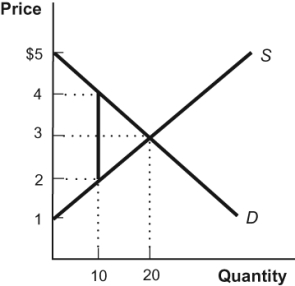 Refer to figure. After instituting a $2 tax on the market in this figure, calculate the loss in consumer surplus, the loss in producer surplus, the government's revenue from the tax, and the area of deadweight loss.
 (Essay)
4.9/5 (76)
(76) Who bears the majority of the burden in the case of a state cigarette tax?
(Multiple Choice)
4.9/5 (74)
(74) Figure: Two Demand Curves 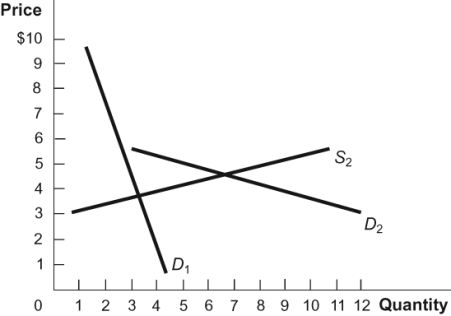 In the figure, demand curve _____ is the least elastic demand curve, and the lost gains from trade because of a tax are greater with demand curve _____.
 (Multiple Choice)
4.9/5 (76)
(76) Which of the following statements is TRUE?
I. Buyers bear the majority of the tax burden if the tax is originally imposed on buyers.
II. Buyers bear the majority of the tax burden if the tax is originally imposed on sellers.
III. Buyers and sellers will always bear equal amounts of the tax burden.
IV. Buyers and sellers will jointly bear the tax.
(Multiple Choice)
5.0/5 (76)
(76) Whether buyers or sellers bear the majority of the tax burden depends on who initially imposed the tax.
(True/False)
4.9/5 (74)
(74) Use the following to answer questions:
Figure: Commodity Tax on Suppliers 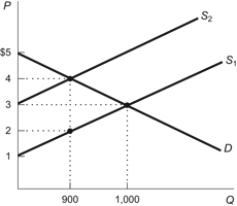 -(Figure: Commodity Tax on Suppliers) Refer to the figure. If a tax shifts the supply curve from S1 to S2, tax revenue is:
 (Multiple Choice)
5.0/5 (87)
(87) Which of the following statements is NOT true regarding subsidies?
(Multiple Choice)
4.8/5 (85)
(85) Use the following to answer questions:
Figure: Tax on Supply and Demand  -(Figure: Tax on Supply and Demand) According to the figure, if the tax is placed on sellers, the equilibrium is at Point:
 (Multiple Choice)
4.9/5 (77)
(77) Use the following to answer questions:
Figure: Imposition of a Tax 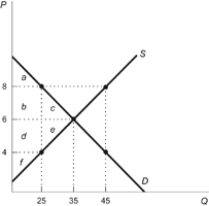 -(Figure: Imposition of a Tax) Refer to the figure. Consumer surplus before the $4 tax is ________, and consumer surplus after the $4 tax is ________.
 (Multiple Choice)
5.0/5 (85)
(85) Figure: Supply and Demand  If the government places a tax on sellers of $0.67 per unit in this market, who will bear the burden of the tax?
 (Multiple Choice)
4.7/5 (80)
(80) The effects of taxing demanders are the same as taxing suppliers.
(True/False)
4.7/5 (83)
(83) If instead of a per-unit subsidy, the government offered to pay for half the good's price, no matter the price:
(Multiple Choice)
4.8/5 (79)
(79) Whether a buyer or a seller pays more of a commodity tax depends on:
(Multiple Choice)
4.9/5 (79)
(79) A tax targeted to reduce consumption of a good by a specific quantity will raise the most revenue when:
(Multiple Choice)
4.8/5 (73)
(73) With a subsidy, the price paid by the buyers exceeds the price received by the sellers.
(True/False)
4.7/5 (87)
(87) Every summer, Matt travels by air to see his grandmother. Matt's maximum willingness to pay for an airline ticket is $260, but the airline only requires a minimum of $100 to fly him. Normally, Matt pays the airline the going market price of $250 per ticket. If the government places a $50 tax on each ticket, raising ticket prices to $270, and causing Matt not to go, what is the deadweight loss created by this tax?
(Multiple Choice)
4.7/5 (85)
(85) Use the following to answer questions:
Figure: Tax on Sellers of Gadgets  -(Figure: Tax on Sellers of Gadgets) According to the figure, what is the amount of the deadweight loss caused by the imposition of the tax on gadgets?
 (Multiple Choice)
5.0/5 (95)
(95) 
Filters
- Essay(0)
- Multiple Choice(0)
- Short Answer(0)
- True False(0)
- Matching(0)