



 Chat with AI
Exam 6: Taxes and Subsidies

Exam 1: The Big Ideas253 Questions
Exam 2: The Power of Trade and Comparative239 Questions
Exam 3: Supply and Demand249 Questions
Exam 4: Equilibrium256 Questions
Exam 5: Elasticity and Its Applications271 Questions
Exam 6: Taxes and Subsidies225 Questions
Exam 7: The Price System275 Questions
Exam 8: Price Ceilings and Floors327 Questions
Exam 9: International Trade195 Questions
Exam 10: Externalities- When the Price Is Not Right273 Questions
Exam 11: Costs and Profit Maximization Under Competition217 Questions
Exam 12: Competition and the Invisible Hand144 Questions
Exam 13: Monopoly233 Questions
Exam 14: Price Discrimination262 Questions
Exam 15: Oligopoly and Game Theory218 Questions
Exam 16: Competing for Monopoly160 Questions
Exam 17: Monopolistic Competition and Advertising113 Questions
Exam 18: Labor Markets262 Questions
Exam 19: Public Goods and the Tragedy of the Commons244 Questions
Exam 20: Political Economy and Public Choice306 Questions
Exam 21: Economics, Ethics, and Public Policy241 Questions
Exam 22: Managing Incentives263 Questions
Exam 23: Stock Markets and Personal Finance271 Questions
Exam 24: Price Discrimination151 Questions
Exam 25: Consumer Choice145 Questions
Select questions type


Use the following to answer questions:
Figure: Supply Tax  -(Figure: Supply Tax) In the accompanying pizza market, with a $2 tax imposed on the sellers, how much do buyers pay for a pizza?
 (Multiple Choice)
4.8/5  (81)
(81) According to economic theory, consumers should support taxes on the producer, and producers should support taxes on the consumer.
(True/False)
4.9/5 (72)
(72) Which of the following statements is TRUE? A tax and subsidy are similar in that:
I. they both create a deadweight loss.
II. the burden of the tax and benefit of the subsidy depend on relative elasticities of demand and supply.
III. they both change the equilibrium level of output.
(Multiple Choice)
4.8/5 (77)
(77) Let the price elasticity of supply for a good be 1.5, and the absolute value of the price elasticity of demand be 2.0. Which of the following is TRUE in this case?
(Multiple Choice)
4.9/5 (71)
(71) Use the following to answer questions:
Figure: Imposition of a Tax 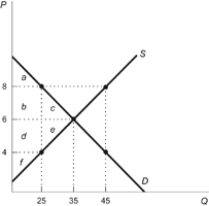 -(Figure: Imposition of a Tax) Refer to the figure. After the imposition of a $4 tax, the government collects revenues of:
 (Multiple Choice)
4.8/5 (83)
(83) If the goal is to reduce cigarette consumption per smoker through taxation, a federal tax is ______ effective than a state tax.
(Multiple Choice)
4.8/5 (79)
(79) If the government taxes walnuts at 50 cent a package, who pays the tax?
(Multiple Choice)
4.9/5 (75)
(75) As long as neither supply nor demand is perfectly elastic, both suppliers and demanders will pay part of any tax.
(True/False)
4.7/5 (70)
(70) Figure: Commodity Tax with Elastic Supply  According to the figure, who bears the greater burden of the tax?
 (Multiple Choice)
4.9/5 (80)
(80) Let the price elasticity of supply for a good be 2.0, and the absolute value of the price elasticity of demand be 1.5. Which of the following is TRUE in this case?
(Multiple Choice)
4.9/5 (71)
(71) A tax that creates the smallest deadweight loss occurs in markets with inelastic demand and inelastic supply curves.
(True/False)
4.8/5 (78)
(78) A ________ creates a situation in which the price received by sellers ________ the price paid by buyers.
(Multiple Choice)
4.9/5 (87)
(87) When the government subsidizes driving by building roadways, the demand for gasoline:
(Multiple Choice)
4.8/5 (99)
(99) On June 23, 2011, Honduras announced new taxes on various industries including the telephone industry. If local consumers have access to the Internet independent of telephones, and the local phone industry's main consumer base is in Honduras, who will bear most of burden of this tax and why?
(Multiple Choice)
4.9/5 (72)
(72) The supply of labor is not very internationally mobile, in part because people in different countries speak different languages. If everyone learned the same language, worker mobility would increase and:
(Multiple Choice)
4.9/5 (75)
(75) Suppose the government is attempting to discourage consumption of two goods: Good X and Good Y. Good X has a very elastic demand and Good Y has a very inelastic demand. The government plans to implement a tax on the suppliers of both goods. If the elasticity of supply for both goods is perfectly elastic, which tax will be more effective at reducing consumption and why?
(Essay)
4.8/5 (77)
(77) The burden of a tax rests most heavily with the party who can better "escape" the tax.
(True/False)
5.0/5 (72)
(72) Use the following to answer questions:
Figure: Soda Market  -(Figure: Soda Market) After the imposition of a per-unit tax on production, consumers pay $5.00 per unit and producers receive $4.95 per unit. What is the value of the per unit tax?
 (Multiple Choice)
4.9/5 (79)
(79) 
Filters
- Essay(0)
- Multiple Choice(0)
- Short Answer(0)
- True False(0)
- Matching(0)