



 Chat with AI
Exam 13: Monopoly

Exam 1: The Big Ideas253 Questions
Exam 2: The Power of Trade and Comparative239 Questions
Exam 3: Supply and Demand249 Questions
Exam 4: Equilibrium256 Questions
Exam 5: Elasticity and Its Applications271 Questions
Exam 6: Taxes and Subsidies225 Questions
Exam 7: The Price System275 Questions
Exam 8: Price Ceilings and Floors327 Questions
Exam 9: International Trade195 Questions
Exam 10: Externalities- When the Price Is Not Right273 Questions
Exam 11: Costs and Profit Maximization Under Competition217 Questions
Exam 12: Competition and the Invisible Hand144 Questions
Exam 13: Monopoly233 Questions
Exam 14: Price Discrimination262 Questions
Exam 15: Oligopoly and Game Theory218 Questions
Exam 16: Competing for Monopoly160 Questions
Exam 17: Monopolistic Competition and Advertising113 Questions
Exam 18: Labor Markets262 Questions
Exam 19: Public Goods and the Tragedy of the Commons244 Questions
Exam 20: Political Economy and Public Choice306 Questions
Exam 21: Economics, Ethics, and Public Policy241 Questions
Exam 22: Managing Incentives263 Questions
Exam 23: Stock Markets and Personal Finance271 Questions
Exam 24: Price Discrimination151 Questions
Exam 25: Consumer Choice145 Questions
Select questions type


A monopoly that is unregulated always causes deadweight loss.

Free
(True/False)
4.8/5  (96)
(96) Correct Answer: Verified
True
If a pharmaceutical company discovering a new drug is not granted a patent to retain its monopoly power on the drug,:
Free
(Multiple Choice)
4.9/5 (74)
(74) Correct Answer:Verified
VerifiedD
A monopolist will charge a higher markup when demand is more elastic.
Free
(True/False)
4.9/5 (80)
(80) Correct Answer:Verified
VerifiedFalse
Explain how a profit-maximizing monopolist chooses level of output and the price of goods.
(Essay)
4.9/5 (74)
(74) To maximize profit a monopoly firm increases output until marginal revenue exceeds the marginal cost.
(True/False)
4.8/5 (95)
(95) When any firm charges a higher price, fewer of its goods are sold.
(True/False)
4.8/5 (84)
(84) A firm will attain more monopoly power as demand for its product becomes more elastic.
(True/False)
4.7/5 (98)
(98) How could a monopoly offer a lower price than a scenario of intense competition?
(Multiple Choice)
4.9/5 (88)
(88) When a single firm can supply the entire market at lower cost than two or more firms, we say that the industry is:
(Multiple Choice)
4.8/5 (68)
(68) A monopoly is able to increase the markup of price over marginal cost:
(Multiple Choice)
4.7/5 (82)
(82) Use the following to answer questions:
Figure: Maximum Willingness to Pay 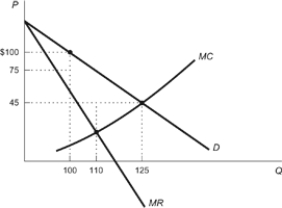 -(Figure: Maximum Willingness to Pay) Refer to the figure. What is the maximum price that the consumer is willing to pay for 100 units?
 (Multiple Choice)
4.9/5 (83)
(83) For a monopoly, marginal revenue is always greater than the price it charges for its good.
(True/False)
4.8/5 (85)
(85) The more inelastic the demand curve is for the monopolist's product, the higher the price is that can be charged for the good.
(True/False)
4.8/5 (81)
(81) Deadweight loss is present in both competitive and monopoly markets.
(True/False)
5.0/5 (78)
(78) A consumer is ________ likely to be sensitive to price if the purchase ________ covered by insurance.
(Multiple Choice)
4.8/5 (84)
(84) The Private Express Statutes, passed in 1792 and (in amended form) still in effect today, contain federal civil and criminal laws relating to the delivery of mail. The Statutes grant monopoly powers to the U.S. Postal Service. Given the technology available today, the average effect of this monopoly on the price and quality of mail service in the populated parts of the United States is that the ______ because of the monopoly privilege of the USPS.
(Multiple Choice)
5.0/5 (68)
(68) A profit-maximizing monopolist chooses the output level where MR = MC and chooses the corresponding price from the marginal revenue curve.
(True/False)
5.0/5 (87)
(87) 
Filters
- Essay(0)
- Multiple Choice(0)
- Short Answer(0)
- True False(0)
- Matching(0)