



 Chat with AI
Exam 13: Monopoly

Exam 1: The Big Ideas253 Questions
Exam 2: The Power of Trade and Comparative239 Questions
Exam 3: Supply and Demand249 Questions
Exam 4: Equilibrium256 Questions
Exam 5: Elasticity and Its Applications271 Questions
Exam 6: Taxes and Subsidies225 Questions
Exam 7: The Price System275 Questions
Exam 8: Price Ceilings and Floors327 Questions
Exam 9: International Trade195 Questions
Exam 10: Externalities- When the Price Is Not Right273 Questions
Exam 11: Costs and Profit Maximization Under Competition217 Questions
Exam 12: Competition and the Invisible Hand144 Questions
Exam 13: Monopoly233 Questions
Exam 14: Price Discrimination262 Questions
Exam 15: Oligopoly and Game Theory218 Questions
Exam 16: Competing for Monopoly160 Questions
Exam 17: Monopolistic Competition and Advertising113 Questions
Exam 18: Labor Markets262 Questions
Exam 19: Public Goods and the Tragedy of the Commons244 Questions
Exam 20: Political Economy and Public Choice306 Questions
Exam 21: Economics, Ethics, and Public Policy241 Questions
Exam 22: Managing Incentives263 Questions
Exam 23: Stock Markets and Personal Finance271 Questions
Exam 24: Price Discrimination151 Questions
Exam 25: Consumer Choice145 Questions
Select questions type


A profit-maximizing monopolist with a less elastic demand has more pricing power than a profit-maximizing monopolist with a more elastic demand.
(True/False)
4.9/5  (85)
(85) Nobel Prize-winning economic historian Douglass North argues that:
(Multiple Choice)
4.8/5 (70)
(70) One way to take advantage of economies of scale and to avoid the market power of a natural monopoly in the short run is through:
(Multiple Choice)
4.8/5 (88)
(88) If a monopolist faces a straight-line negatively sloped demand curve, the price of the units it sells is always:
(Multiple Choice)
4.7/5 (75)
(75) Economists believe that monopoly markets are "bad" because they raise prices for consumers.
(True/False)
5.0/5 (73)
(73) When a pharmaceutical company discovers a new drug, patent law gives it market power by guaranteeing:
(Multiple Choice)
4.8/5 (87)
(87) All monopolies make economic profit, maintained by some sort of barrier to entry.
(True/False)
4.8/5 (85)
(85) When a monopolist faces downward-sloping demand, marginal revenue is less than the price.
(True/False)
4.9/5 (68)
(68) Using a well-labeled diagram, show:
a. the profit-maximizing price and quantity of output for a monopolist.
b. the area representing the deadweight loss.
c. the price that the government regulators would set to achieve the socially optimal level of output.
(Essay)
4.7/5 (68)
(68) Michael Kremer's patent buyout proposal is designed to lower drug prices without decreasing the incentive to innovate and produce new drugs.
(True/False)
4.8/5 (78)
(78) One way that has been suggested to eliminate deadweight loss from monopoly power without reducing incentives to innovation is to:
(Multiple Choice)
4.8/5 (72)
(72) Use the following to answer questions:
Figure: Regulated versus Unregulated Monopolist 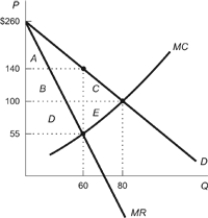 -(Figure: Regulated versus Unregulated Monopolist) Refer to the figure. Calculate consumer surplus when this monopoly is regulated.
 (Multiple Choice)
4.8/5 (83)
(83) When demand is relatively elastic, monopolists will charge:
(Multiple Choice)
4.9/5 (78)
(78) 
Filters
- Essay(0)
- Multiple Choice(0)
- Short Answer(0)
- True False(0)
- Matching(0)