



 Chat with AI
Exam 13: Monopoly

Exam 1: The Big Ideas253 Questions
Exam 2: The Power of Trade and Comparative239 Questions
Exam 3: Supply and Demand249 Questions
Exam 4: Equilibrium256 Questions
Exam 5: Elasticity and Its Applications271 Questions
Exam 6: Taxes and Subsidies225 Questions
Exam 7: The Price System275 Questions
Exam 8: Price Ceilings and Floors327 Questions
Exam 9: International Trade195 Questions
Exam 10: Externalities- When the Price Is Not Right273 Questions
Exam 11: Costs and Profit Maximization Under Competition217 Questions
Exam 12: Competition and the Invisible Hand144 Questions
Exam 13: Monopoly233 Questions
Exam 14: Price Discrimination262 Questions
Exam 15: Oligopoly and Game Theory218 Questions
Exam 16: Competing for Monopoly160 Questions
Exam 17: Monopolistic Competition and Advertising113 Questions
Exam 18: Labor Markets262 Questions
Exam 19: Public Goods and the Tragedy of the Commons244 Questions
Exam 20: Political Economy and Public Choice306 Questions
Exam 21: Economics, Ethics, and Public Policy241 Questions
Exam 22: Managing Incentives263 Questions
Exam 23: Stock Markets and Personal Finance271 Questions
Exam 24: Price Discrimination151 Questions
Exam 25: Consumer Choice145 Questions
Select questions type


A monopolist can raise its price further above marginal cost, the more ______ is the ______ for its product.
(Multiple Choice)
4.8/5  (65)
(65) Which of the following statements is correct? Once a patent expires:
I. monopoly profits increase.
II. deadweight loss is eliminated.
III. generic equivalents appear quickly.
(Multiple Choice)
4.9/5 (69)
(69) For a monopoly, the entire consumer surplus is transferred to the monopolist as profit.
(True/False)
4.7/5 (73)
(73) GlaxoSmithKline (GSK) maximizes profit by producing a quantity of 800 pills where marginal cost is $2 and average cost is $4. Consumers are willing to pay as much as $10 per pill when the quantity supplied is 800 pills. What is the maximum amount of profit that GSK can earn under these conditions?
(Multiple Choice)
4.9/5 (78)
(78) A monopolist maximizes profits where marginal revenue equals marginal cost.
(True/False)
4.9/5 (78)
(78) Use the following to answer questions:
Figure: Regulated versus Unregulated Monopolist 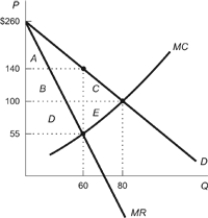 -(Figure: Regulated versus Unregulated Monopolist) Refer to the figure. Calculate the change in consumer surplus from an unregulated monopoly to a regulated monopoly.
 (Multiple Choice)
4.8/5 (95)
(95) In which of the following product markets should we see a higher price markup?
(Multiple Choice)
5.0/5 (95)
(95) Figure: Monopoly Revenue 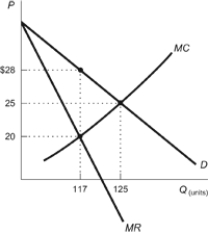 Refer to the figure. A profit-maximizing monopolist faces the market environment described by the figure shown. What is the monopolist's total revenue?
 (Essay)
4.8/5 (84)
(84) A monopolistic industry will have lower output and higher prices than a competitive industry.
(True/False)
4.9/5 (90)
(90) When a regulated monopolist maximizes consumer surplus, it produces at an optimal Q where:
(Multiple Choice)
4.9/5 (89)
(89) Modern theories of economic growth emphasize that monopolies:
(Multiple Choice)
4.9/5 (85)
(85) A monopolist increased output by 100 units but cut prices by $20 to sell this additional output at $1,000 per unit. What is TRUE about marginal revenue?
(Multiple Choice)
5.0/5 (90)
(90) Which of the following effects would generally make demand curves more inelastic?
(Multiple Choice)
4.8/5 (88)
(88) Use the following to answer questions:
Figure: Monopoly Markup  -(Figure: Monopoly Markup) Refer to the figure. Consumer surplus under competition is represented by:
 (Multiple Choice)
4.9/5 (81)
(81) To maximize , a monopolist will produce the level of output where:
(Multiple Choice)
4.9/5 (66)
(66) A monopolist can sell 300 units of output for $29.00 per unit. Alternatively, it can sell 301 units of output for $28.25 per unit. The marginal revenue of the 301st unit of output is:
(Multiple Choice)
4.9/5 (74)
(74) Use the following to answer questions:
Figure: Maximum Willingness to Pay  -(Figure: Maximum Willingness to Pay) Refer to the figure. What is the profit-maximizing quantity for this monopolist?
 (Multiple Choice)
5.0/5 (86)
(86) 
Filters
- Essay(0)
- Multiple Choice(0)
- Short Answer(0)
- True False(0)
- Matching(0)